Most award show performances are designed to eliminate risk.
Everything is rehearsed, timed, and controlled down to the second. Vocals are protected. Movement is calculated. The goal is simple: deliver a flawless moment in front of millions.
In 2010, Pink did the opposite.
She built a performance where everything could go wrong—and then made it unforgettable.
The expectation: a quiet ballad, safely delivered
“Glitter in the Air” isn’t an obvious spectacle song.
It’s reflective. Emotional. Intimate. The kind of track that typically calls for stillness—a spotlight, a microphone, and a voice carrying the weight of the lyrics.
That’s what producers expected.
A grounded performance. Minimal movement. Maximum control.
What they got instead redefined what “live” could mean.
:upscale()/2014/01/26/161/n/1922398/9d1b5de4df3f5930_465310979.jpg)
The decision that made everyone nervous
Behind the scenes, there were real concerns.
Aerial performance on live television introduces variables producers hate:
- Height
- Water
- Movement that can’t be fully controlled in real time
Add to that the fact that she planned to sing live while executing the routine, and the risk multiplies.
This wasn’t just about staging.
It was about physics.
And physiology.
When the performance left the ground
The opening moments gave no hint of what was coming.
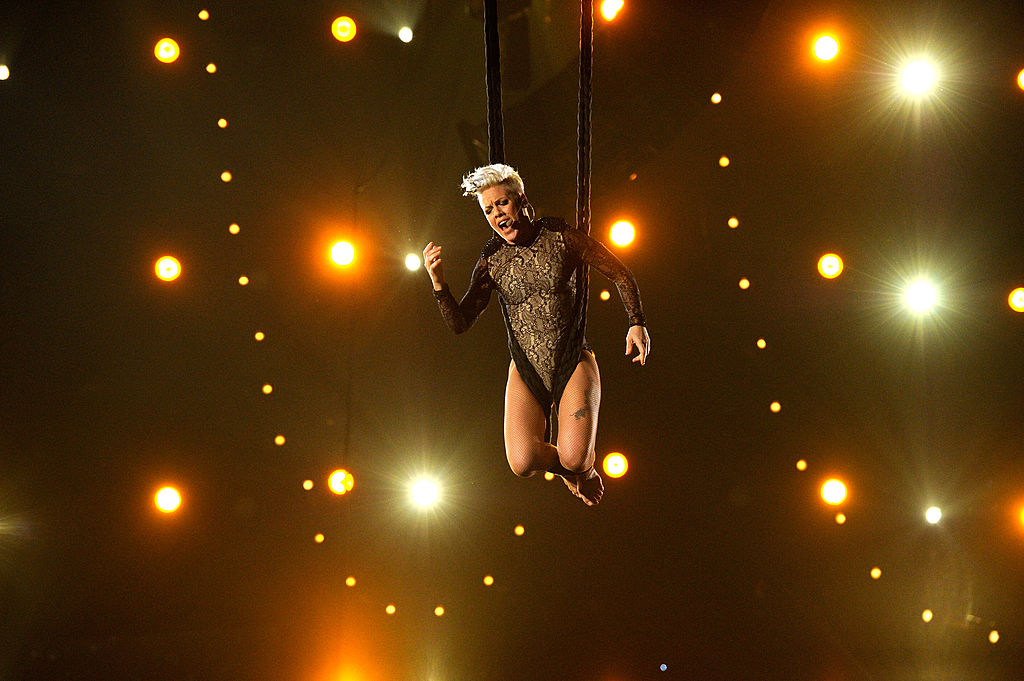
Pink began on stage, grounded, connected to the emotional tone of the song. Then, almost seamlessly, she was lifted into the air.
Not as a visual gimmick.
As a transition.
Because what followed wasn’t decoration—it was the performance itself.
Suspended by silks, she began to climb, invert, and rotate. Then came the element that turned the moment from impressive to surreal:
Water.
Pouring from above, soaking both the performer and the apparatus, adding weight, unpredictability, and a constant challenge to grip and balance.
Why this was far more dangerous than it looked
Aerial silks require:
- Grip strength
- Core control
- Precise body positioning
Now add water.
The fabric becomes slippery.
The body becomes heavier.
Every movement requires more force and more control.
And all of this is happening roughly 30 feet above the ground.
There’s no pause button.
No reset.
Once the routine starts, it has to continue.
The part that still feels impossible
The visuals alone would have been enough.
But Pink didn’t separate the physical from the musical.
She sang.
Live.
Consistently.
Emotionally.
That’s where the performance crosses into something rare.
Because singing requires stability—especially for sustained, controlled phrases.
Aerial work removes that stability completely.
Your body is:
- Inverted
- Rotating
- Engaging multiple muscle groups at once
Each of those disrupts breath control—the foundation of vocal performance.
And yet, the voice held.
Why the voice didn’t break
This wasn’t luck.
It was preparation.
Pink’s background in gymnastics and aerial training gave her something most singers don’t have: full-body awareness under stress.
She wasn’t reacting to movement.
She was controlling it.
That allowed her to:
- Time breaths between transitions
- Stabilize her core mid-air
- Maintain enough control to support the voice
It’s not that she ignored the physical strain.
She integrated it.

The moment the audience realized what they were seeing
At first, the reaction was awe.
Then it shifted.
Because as the routine continued, it became clear this wasn’t a visual illusion. There were no cuts, no tricks, no safety edits.
This was happening in real time.
The gasps weren’t just admiration.
They were recognition.
Of risk.
Of effort.
Of the possibility that something like this could fall apart—and the fact that it wasn’t.
Why this performance changed expectations
After that night, something subtle shifted in how audiences viewed live performances.
Not every artist needed to replicate what Pink did—and most shouldn’t.
But the definition of what was possible expanded.
She proved that:
- A ballad doesn’t have to be static
- Physical intensity doesn’t have to compromise vocals
- Risk, when intentional, can deepen emotional impact
It wasn’t about making performances more extreme.
It was about making them more fully realized.
The emotional core never disappeared
For all the spectacle, the most important thing remained intact:
The song.
“Glitter in the Air” is about vulnerability—about moments that feel fleeting, fragile, uncertain.
The aerial performance didn’t distract from that.
It amplified it.
Because watching someone suspended, exposed, and in motion while delivering those lyrics added a layer of meaning that a grounded performance couldn’t.
It made the emotion visible.
Why it still gets referenced years later
Many performances are impressive in the moment.
Few become benchmarks.
This one did because it wasn’t just technically strong—it was conceptually complete.
Every element served a purpose:
- The height created tension
- The water added unpredictability
- The movement mirrored the song’s emotional instability
Nothing felt added for the sake of spectacle.
It all belonged.
The real achievement
It’s easy to describe this performance as fearless.
But fearlessness isn’t what made it work.
Control did.
Preparation did.
Commitment did.
Pink didn’t remove risk.
She managed it so completely that it became part of the art.
What the industry took from it
After that night, performers didn’t suddenly start flying through water mid-ballad.
But they did start thinking differently.
About how far a performance could go.
About how much of the body could be involved.
About how to merge physical expression with vocal delivery.
It raised the ceiling—not by asking others to copy it, but by showing what happens when someone refuses to stay within expected limits.
A moment that still feels unreal
Years later, the performance still holds up—not as a relic, but as something that feels just as daring now as it did then.
Because it wasn’t built on trends.
It was built on commitment.
To the song.
To the concept.
To doing something fully—even when it would have been easier not to.
And that’s why people don’t just remember that Pink performed at the Grammys.
They remember how she made it feel like gravity didn’t apply.