To the world, Brian May has always looked unbreakable. He’s the man with the Red Special guitar, the quiet genius behind Queen’s towering harmonies, and the survivor who kept walking forward even after the unimaginable happened. Decades after Freddie Mercury’s death in 1991, Brian still stands on stage with calm dignity, still tours with Queen + Adam Lambert, and still inspires people through music, science, and his lifelong passion for animals. From the outside, it’s easy to believe he was built for resilience.
But behind that legendary image is a truth most people didn’t see coming. Brian has spoken candidly about falling into a deep depression during the late 1980s and 1990s, describing it as a “black hole” that swallowed his sense of purpose. It wasn’t a single tragedy that broke him — it was the way everything collapsed one after another, like life was stripping him down piece by piece. He lost his father. His first marriage to Christine Mullen, with whom he has three children, fell apart. And then came the blow that shook Queen forever — the loss of Freddie, not just a bandmate, but the irreplaceable heart of the band.
Brian has admitted that in those years he was so low he could barely function. He described days when he could hardly get out of bed, drowning in grief, guilt, and despair. And at his darkest point, he even contemplated suicide. It’s a reminder that fame is not armor. In fact, for someone suffering privately, the contrast can make everything worse — the world cheering your name while inside you feel completely empty. The applause can’t reach you when you’re trapped in silence.
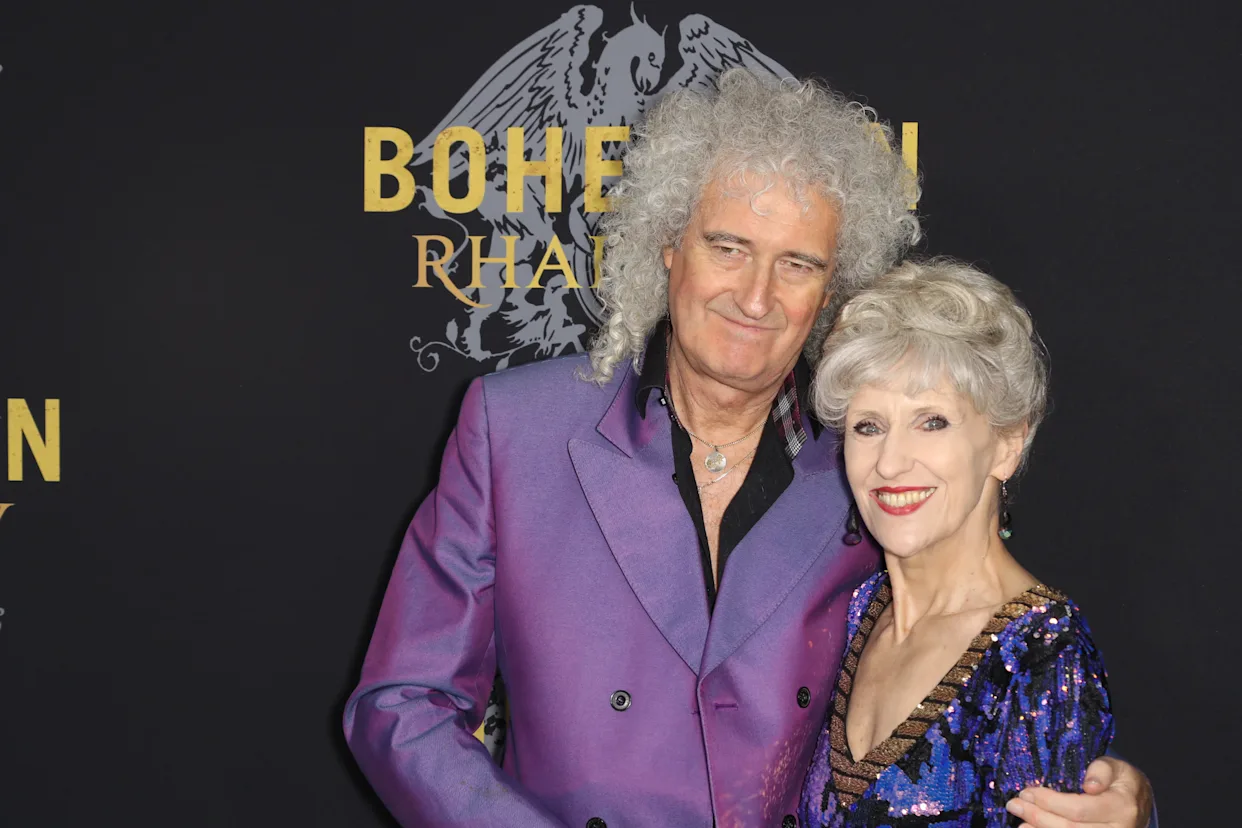
It was during this fragile chapter of his life that Anita Dobson became more than just a partner. She became his lifeline. They first met in 1986 at a film premiere, when Anita was already a household name in the UK for playing Angie Watts on EastEnders. Brian was still married at the time, but their connection didn’t disappear — it grew quietly over the years, and by the early 1990s, when Brian was carrying unbearable loss, Anita became the one steady presence that didn’t fade away.
Brian later spoke about her with a kind of honesty that leaves no room for exaggeration. In a 2002 interview, he said: “If I didn’t have Anita, all the therapy in the world wouldn’t sort me. If she wasn’t by my side now, I wouldn’t be in this state. She’s somehow part of me.” That wasn’t just love — that was survival. That was Brian admitting that without her, he genuinely believes he wouldn’t have made it through.
What makes their story so powerful is that Anita didn’t “save” him in some dramatic, cinematic way. She didn’t fix him with grand speeches or sudden miracles. She stayed through the slow part — through the emotional withdrawal, through the heaviness, through the nights that probably felt endless. She absorbed the pain when it overflowed and gave him the one thing depression destroys first: stability. Sometimes the strongest kind of love isn’t loud. Sometimes it’s simply refusing to leave.
One of the most meaningful results of that support was something far beyond Queen. Before the band became the biggest name on the planet, Brian had started a PhD in astrophysics at Imperial College London. But when Queen exploded into global fame, he walked away from that dream and left it unfinished for decades, as if a part of him was left behind. Later, with Anita’s encouragement and the emotional foundation their relationship gave him, Brian finally returned to that long-abandoned passion. In 2007, he completed his doctorate in astrophysics, a quiet personal triumph that felt like more than education — it was proof that he could still rebuild who he was.
And Anita’s role in his life didn’t end after the depression years. In 2020, during lockdown, Brian suffered a serious heart attack, and he publicly credited Anita for saving his life again. He said she nursed him when he couldn’t do anything for himself, and that he would forever be in her debt. Then in 2024, when Brian experienced a minor stroke, she was there once more — the same calm strength, the same steady presence, the same emotional safety net that had already carried him through the worst period of his life.
They married in 2000 after more than a decade together, and their bond has only deepened. And when you look at Brian May’s story now, it becomes clear that his survival isn’t just about rock-star toughness or talent. It’s about what happens when someone is loved at their weakest point — not in a glamorous way, but in a real one. Anita Dobson didn’t just help preserve a legend for the public. She helped a man find his way back to life, back to music, back to science, and back to himself.
Today, at 78, Brian May continues to create and inspire, not because he never broke, but because he was given space to heal. And behind every performance, every new chapter, and every moment he stands tall again is one quiet truth that makes this story hit harder than any stage light ever could: even legends need someone who believes in them when they can’t believe in themselves.