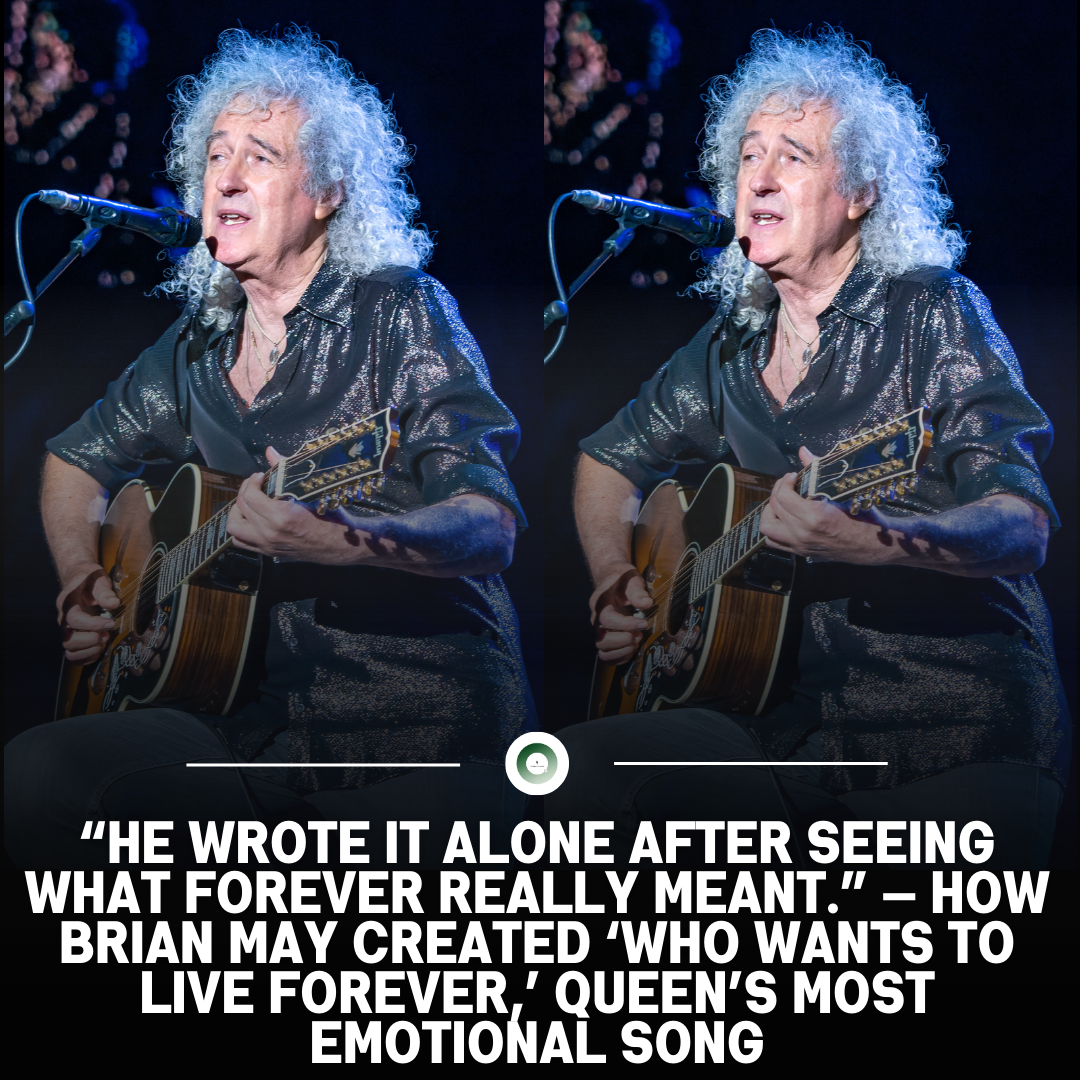
The Song Brian May Wrote That Became Queen’s Emotional Core — “Who Wants to Live Forever”
Brian May did not write “Who Wants to Live Forever” inside a studio. He wrote it alone, in the quiet aftermath of a film scene that stayed with him longer than he expected. Queen had been asked to contribute music to Highlander, a story built around immortality, loss, and the quiet burden of outliving everyone you love. It was fiction. But the emotional truth inside it was unmistakable.
Driving home after an early screening, Brian couldn’t escape a single question the film had left behind. What would it really mean to live forever if everything that made life meaningful disappeared along the way?
By the time he reached his house, the song was already forming.
He sat down immediately. There was no delay, no planning, no attempt to shape it into something commercial. The melody arrived first, fragile but certain. Then the words followed, not as lyrics, but as reflections. The song was not asking about immortality as a fantasy. It was asking about its cost.
“Who wants to live forever?”
It wasn’t a dramatic question. It was a human one.
When Brian brought the song to Freddie Mercury, he didn’t need to explain it. Freddie understood it instantly. He recognized the emotional space it came from — the awareness that time gives meaning to everything it eventually takes away. Freddie approached the song with restraint, allowing vulnerability to guide the performance rather than power.
In the studio, his voice carried something quieter than Queen’s usual grandeur. There was no need for dominance. The strength came from honesty. Each note felt suspended between acceptance and resistance, as if he were confronting the question in real time rather than performing it.
The arrangement reflected that same restraint. Orchestral elements surrounded the song, but they never overwhelmed it. They existed to support the emotion, not to define it. Brian’s guitar did not command attention. It stayed patient, deliberate, allowing space for the voice and the question to remain at the center.
When the song was released in 1986, it became one of Queen’s most emotionally resonant recordings. It did not rely on spectacle. It relied on recognition. Listeners understood what it was asking, even if they couldn’t articulate it themselves.
Over time, the meaning of the song deepened in ways no one could have anticipated. Years later, after Freddie Mercury’s death, “Who Wants to Live Forever” no longer felt like a reflection on fictional immortality. It felt like a reflection on memory. Freddie’s voice remained, unchanged by time, even as the person behind it was gone.
Brian May would later perform the song knowing it carried a weight it didn’t originally possess. It had become more than a soundtrack piece. It had become a document of something fragile — the awareness that nothing lasts forever, and that this impermanence is what gives everything its value.
The question the song asks is never answered. It doesn’t need to be.
Because in the end, Brian May didn’t write it to explain immortality. He wrote it to acknowledge the one truth no one can escape — that life matters because it ends, and that love matters because it doesn’t.