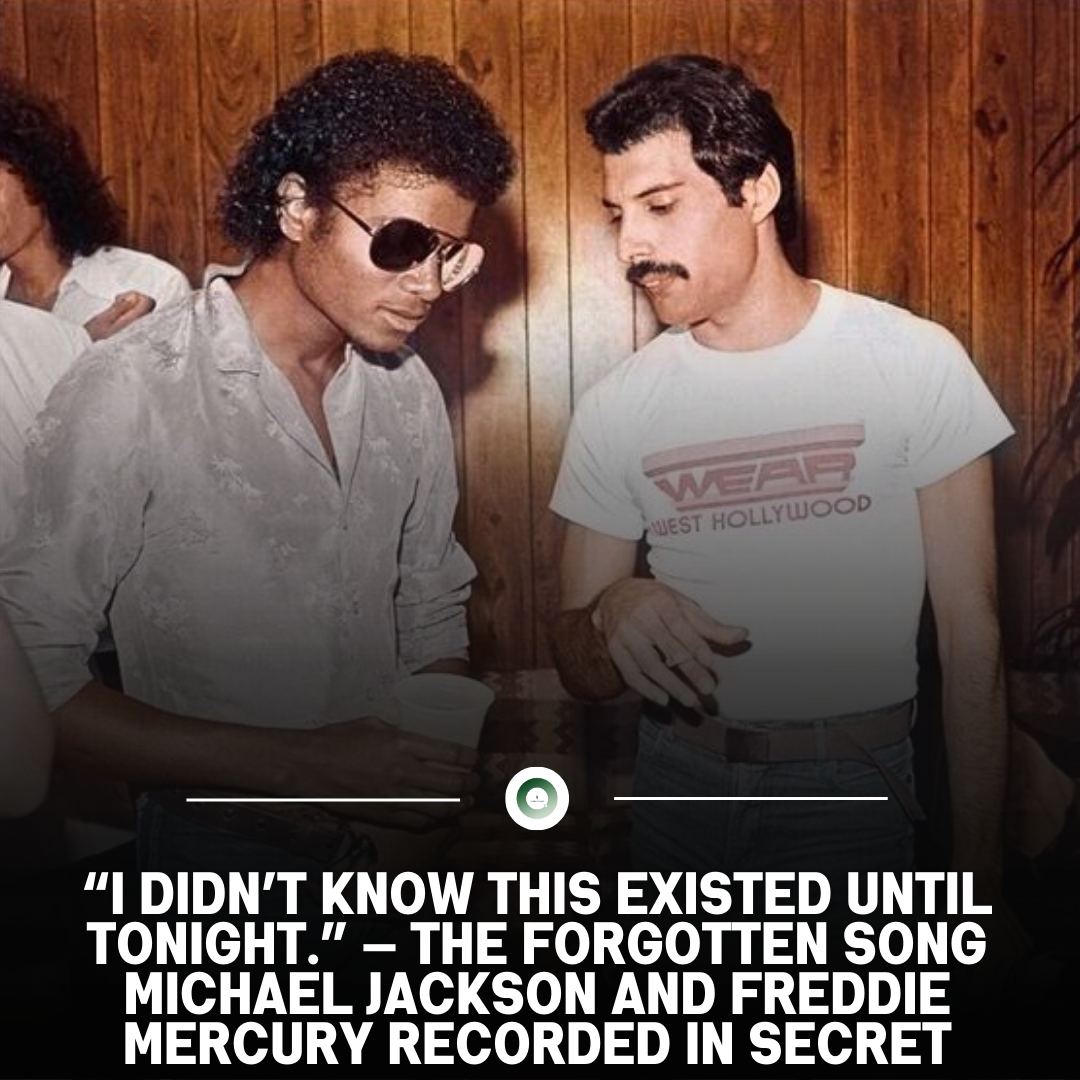
There are moments in music history that feel almost impossible—moments that seem too extraordinary to be real. The idea that Michael Jackson and Freddie Mercury, two of the most unmistakable voices ever recorded, once stood in the same studio and sang together is one of those moments. Not as rivals. Not as distant icons. But as collaborators. And yet, for decades, their work remained unheard by most of the world, existing more as rumor than reality.
This wasn’t a publicity stunt or a fleeting encounter. It happened during a precise moment in time, when both men stood at the absolute peak of their power. Michael Jackson had already redefined global pop, while Freddie Mercury had transformed rock into something theatrical, operatic, and emotionally fearless. They were not just successful—they were shaping the very language of modern music. When their paths crossed in the early 1980s, it wasn’t just a meeting. It was a convergence.
The recordings took place in Michael Jackson’s home studio in Encino, California. There, surrounded by equipment and isolation, two completely different creative energies began to overlap. Michael was known for his quiet precision—his methodical layering of sound, his pursuit of sonic perfection. Freddie, by contrast, carried a volcanic presence into every room, driven by instinct, emotion, and bold theatricality. What emerged from those sessions wasn’t compromise. It was tension. And that tension gave the music its electricity.
Among the songs they worked on was “State of Shock,” a track built on urgency and sharp rhythmic momentum. Freddie’s voice cut through the arrangement with raw force, while Michael’s delivery provided contrast—controlled, rhythmic, and unmistakably his. Together, their voices didn’t blend into one identity. They collided. Each remained completely himself. That collision created something rare: a sound that belonged to neither artist alone.
Yet, for reasons rooted in creative differences, timing, and circumstance, their version of the song was never officially completed for release during their lifetimes. Instead, Michael would later record a different version with Mick Jagger, and that became the official release the world came to know. The collaboration with Freddie Mercury faded quietly into the background, preserved only in tapes and memory.
But the story didn’t end there.
Years later, fragments of those original recordings resurfaced. Not as polished, mainstream releases, but as glimpses into something unfinished and deeply human. You could hear the rawness. The experimentation. The moment when two artistic forces were still trying to understand each other. It wasn’t perfect. And that imperfection made it more real.
There’s something profoundly moving about hearing those recordings now. Not because they represent what was completed, but because they reveal what was possible. You can hear Freddie pushing into the edges of the song with fearless intensity. You can hear Michael shaping every phrase with microscopic control. Neither dominates. Neither disappears. They coexist.
It reminds us that music history isn’t built only on what was released. It’s built on what almost happened.
Their collaboration exists in a strange space—both real and elusive. It stands as proof that even the most famous artists still chase uncertainty, still experiment, still reach for something they don’t fully control. And in those moments, stripped of image and expectation, they stop being untouchable icons. They become artists again.
Listening to those recordings today feels less like discovering a forgotten song and more like uncovering a hidden intersection in music’s timeline—one where two of the most distinct voices ever heard stood face to face, not competing for greatness, but quietly creating something that neither of them could have created alone.
And perhaps that’s what makes it unforgettable. Not the perfection of the result, but the rarity of the moment itself.