There are certain names you never separate from Queen. Freddie Mercury is not just part of the band’s history — he is its center of gravity. His voice was never treated as something that could be replicated. It was something that could only be remembered. So when Brian May first heard that Pink would be stepping into Queen’s world, his reaction wasn’t excitement. It was fear.
Not fear of failure, but fear of disrespect. Fear that someone might try to imitate what was never meant to be imitated.
For Brian, Freddie’s voice wasn’t simply about range. It was about identity. Every note carried personality. Every performance carried defiance. And Queen had spent decades protecting that legacy carefully, choosing collaborators who understood the difference between honoring Freddie and replacing him. Pink was not an obvious choice. She was known for her aggression, her independence, and her refusal to soften her voice for anyone. She didn’t approach songs with caution. She attacked them.
And that made Brian uneasy.
He later admitted that he didn’t know whether she could reach the highest emotional and vocal peaks that defined Queen’s most iconic songs. Freddie’s voice could soar effortlessly, shifting between vulnerability and dominance within seconds. It wasn’t just about hitting the notes. It was about owning them completely.
Pink didn’t try to imitate that.
Instead, she did something far more dangerous.
She reinterpreted it.
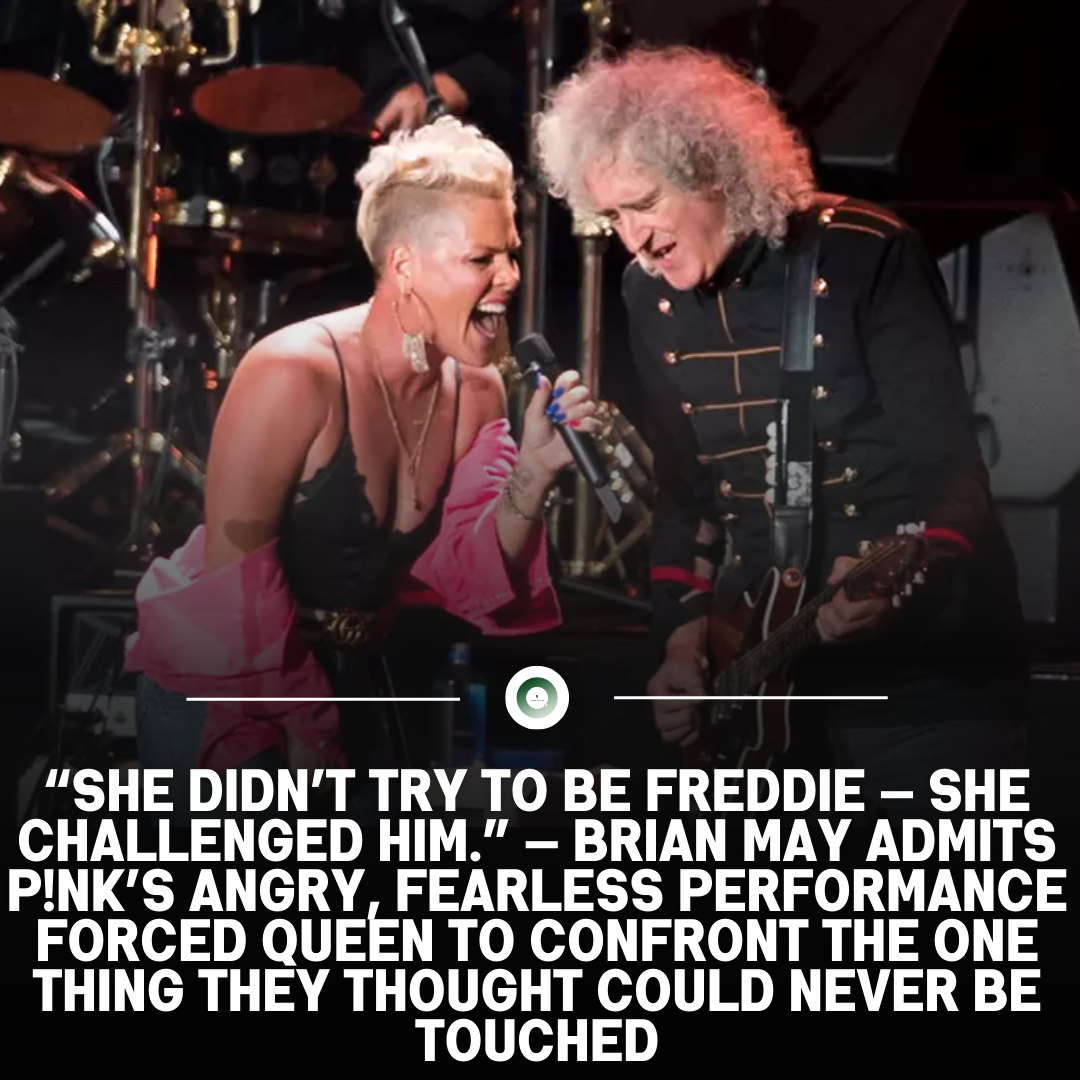
From the moment she stepped onto the stage, it was clear she wasn’t there to recreate Freddie. She wasn’t trying to mimic his posture, his tone, or his theatrical gestures. She wasn’t borrowing his identity. She was bringing her own. And at first, that unpredictability created tension. Brian watched closely, unsure of what was coming.
Then came the moment everything changed.
She leaned into the microphone and delivered the opening lines with restraint — almost deceptively calm. It wasn’t loud. It wasn’t explosive. It was controlled. But underneath that control was pressure building, the kind that only releases when it has no other choice. And when it finally did, the transformation was immediate.
Her voice didn’t chase Freddie’s notes. It confronted them.
There was anger in it. Strength. Defiance. She wasn’t trying to float above the music the way Freddie often did. She was driving through it. The sound wasn’t delicate. It was raw. It carried weight. And as the performance intensified, Brian realized something unexpected.
She wasn’t weakening the song.
She was forcing it to evolve.
Queen’s music had always been about emotional extremes — beauty and chaos existing in the same space. Pink understood that instinctively. She didn’t approach the song like a guest trying to fit into someone else’s world. She approached it like an artist entering a conversation with the past, adding her own truth without erasing what came before.
Brian later described feeling stunned, not because she had replicated Freddie’s voice, but because she had proven something far more important. She had proven that Queen’s music didn’t belong to one voice. It belonged to a spirit.
And that spirit was still alive.
What frightened him initially wasn’t her inability to match Freddie. It was the possibility that she might try. Instead, she chose a harder path. She chose authenticity. She chose to risk criticism rather than play it safe. And in doing so, she preserved the one thing Freddie had always protected — individuality.
Freddie Mercury never wanted copies. He wanted impact.
And that night, Brian May realized that Pink wasn’t there to replace Freddie Mercury.
She was there to remind everyone why he could never be replaced in the first place.