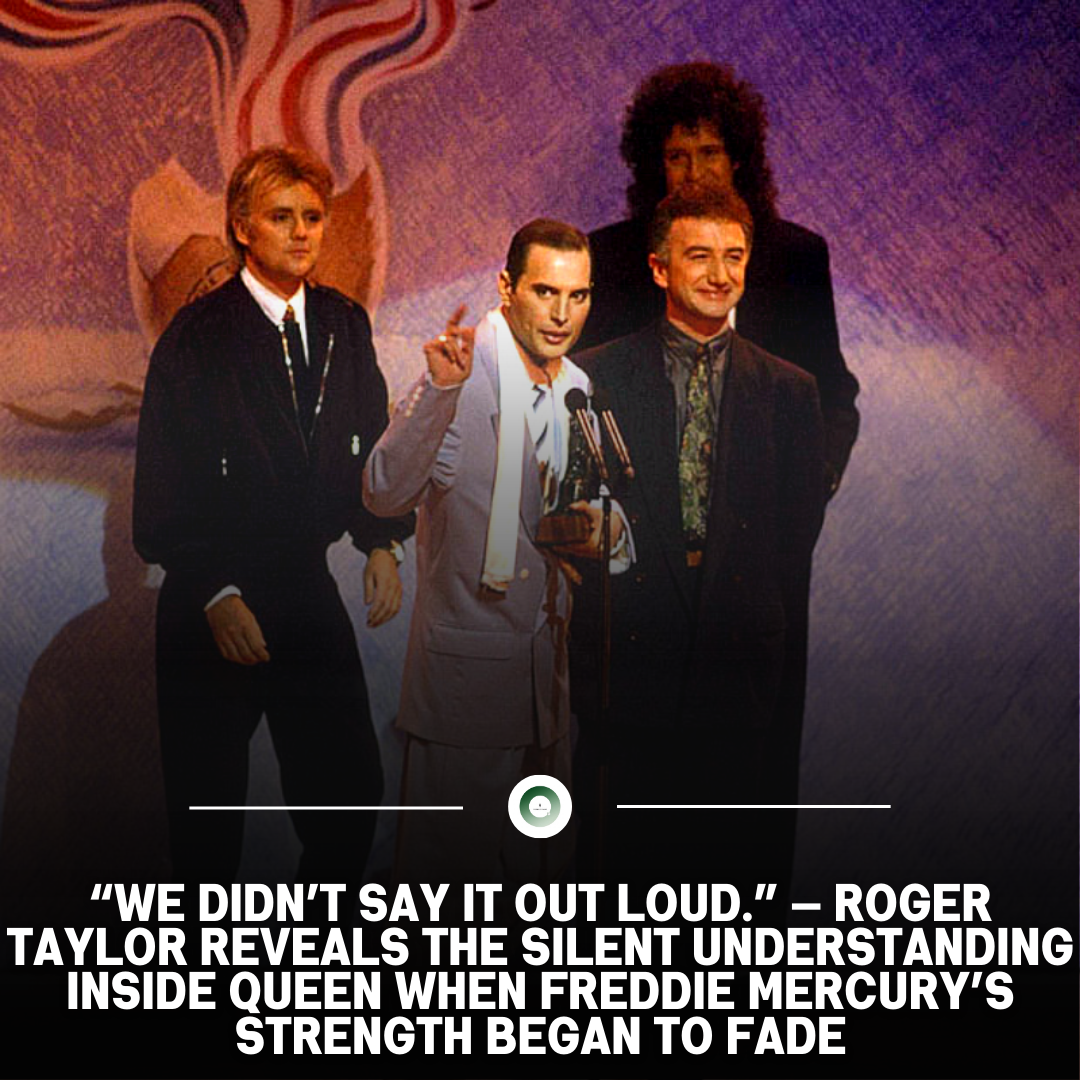
For years, Queen had lived inside momentum. Albums turned into tours. Tours turned into global domination. Their rhythm was unstoppable, defined by movement, noise, and the unshakable presence of Freddie Mercury at the center of everything.
Roger Taylor had always known Freddie as invincible.
Not physically — but spiritually. Freddie’s confidence wasn’t something that faded. It filled every room. Every studio session. Every performance. Even in moments of exhaustion, he never allowed uncertainty to show itself.
But slowly, something changed.
It wasn’t announced. It wasn’t explained. It was felt.
And Roger noticed it first in the silence.
The Studio Felt Different
Queen returned to the studio not with the explosive chaos they were known for, but with something quieter. Freddie was still there. Still focused. Still determined. But there was a difference in how he moved, how he conserved his energy.
Roger didn’t ask questions.
No one did.
Because asking would have forced something into reality that no one was ready to face.
Instead, they continued working.
Freddie would arrive, step to the microphone, and deliver performances with the same precision he always had. His voice hadn’t weakened. His control hadn’t disappeared. If anything, his performances felt more deliberate — more urgent.
As if he understood something time itself hadn’t spoken yet.
The Understanding That Never Needed Words
Roger has spoken about how there was never a formal conversation acknowledging what was happening. No meeting. No confession. No moment where Freddie sat them down and explained everything.
They simply knew.
Not through evidence.
Through instinct.
It existed in the way sessions were scheduled more carefully. In the way Freddie would record vocals in shorter bursts, preserving his strength. In the way the band adjusted without ever discussing why.
It became an unspoken agreement.
Protect the music.
Protect Freddie.
Protect the moment.
And above all, never turn it into something fragile.
Freddie Never Allowed Himself to Become a Goodbye
What stayed with Roger most was Freddie’s refusal to surrender creatively. He didn’t record like someone fading away. He recorded like someone racing forward. His voice carried urgency, not weakness. Purpose, not fear.
Freddie never framed those sessions as endings.
He framed them as continuation.
Even when his body began to fail him, his mind remained anchored to the music. He wasn’t interested in sympathy. He was interested in permanence. In creating something that would exist long after he was gone.
Roger understood that without needing it explained.
And that understanding made every moment heavier.
And more meaningful.
The Moment Roger Realized Nothing Would Ever Be the Same
There wasn’t one dramatic turning point. No sudden collapse. No single day that marked the end. Instead, the realization arrived gradually, settling into the space between moments.
Roger could feel it in the pauses.
In the restraint.
In the quiet determination Freddie carried with him into every session.
Queen was still functioning. Still creating. Still moving forward.
But Roger knew, deep down, that they were no longer standing inside permanence.
They were standing inside legacy.
The Truth They Carried Without Speaking
Roger Taylor has said that the most powerful part of that time wasn’t what was said.
It was what wasn’t.
They never turned Freddie into someone to be mourned while he was still alive. They never allowed fear to interrupt what he was still capable of creating. They treated him exactly as they always had — as their singer, their partner, their center.
Because Freddie never stopped being Freddie.
And even as everything around them was changing, Roger understood something that didn’t need words.
Some people don’t leave when their voice stops.
They leave when their presence stops being felt.
And Freddie Mercury’s presence never did.