The Super Bowl halftime show is designed to eliminate uncertainty. Every second is rehearsed, every camera movement mapped, every gesture anticipated. It is not just a performance. It is an institutional broadcast — one of the most tightly controlled cultural environments in modern entertainment. By the time the show reaches the public, nothing is supposed to remain unpredictable.
Which is why Eminem’s decision mattered.
In February 2022, as part of the NFL’s halftime show featuring Dr. Dre, Snoop Dogg, Mary J. Blige, and Kendrick Lamar, Eminem occupied a specific role within a larger structure. The performance was historic, not only for its scale but for its symbolism — a gathering of artists whose careers had reshaped the sound and language of American music. Yet the system surrounding the show was built on containment. The NFL did not create the halftime show to invite disruption. It created it to manage attention.
And Eminem had spent his career resisting management.
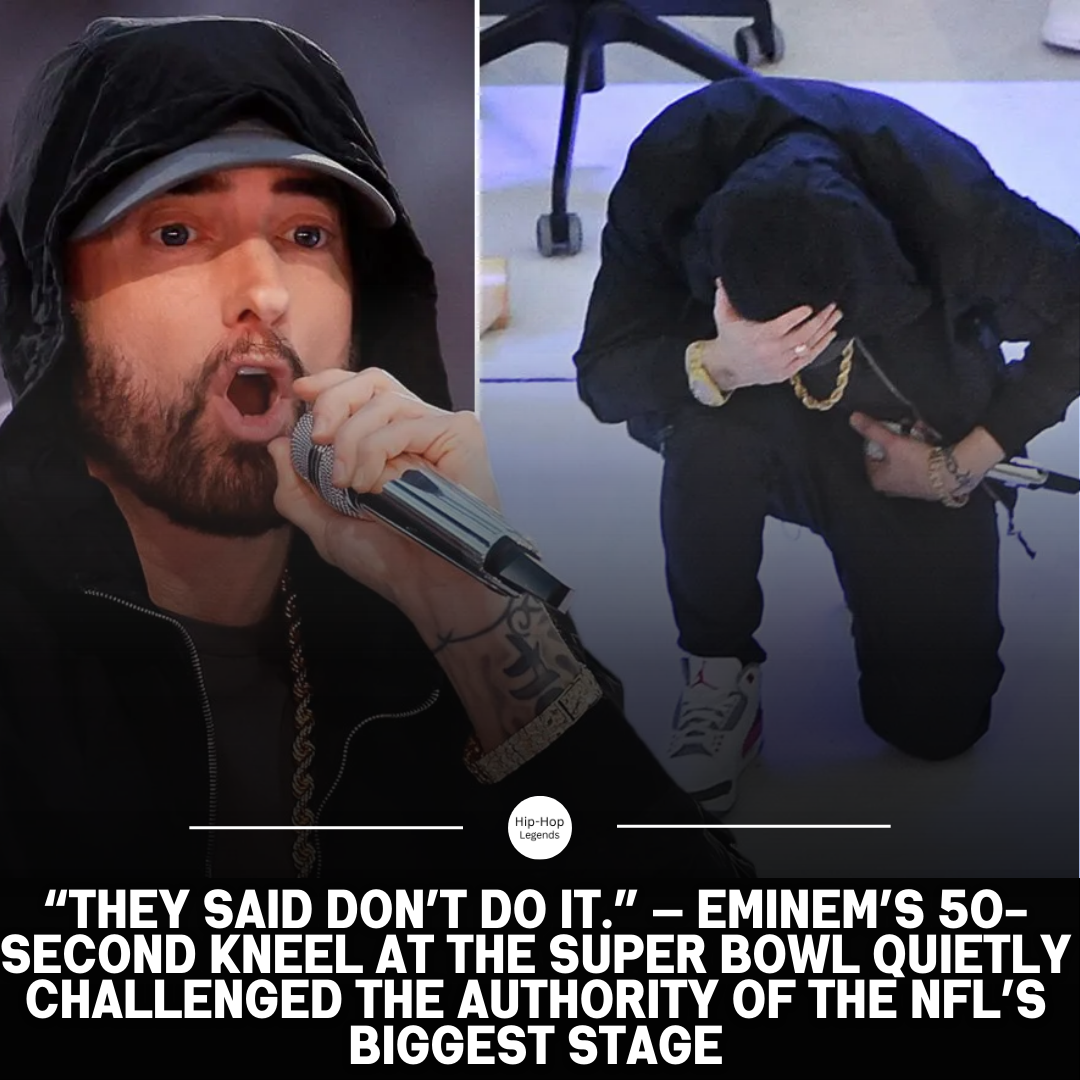
As the performance unfolded inside SoFi Stadium, nothing initially appeared out of place. The transitions were precise. The pacing was exact. The spectacle moved forward with institutional confidence. But when Eminem reached the closing moments of “Lose Yourself,” something shifted. He stepped forward, lowered himself onto one knee, and held the position in silence.
It lasted less than a minute.
There was no announcement. No explanation. No attempt to frame the gesture. For viewers who recognized the symbolism, the meaning was immediate. Kneeling had become one of the most contested gestures in modern American public life — a silent act associated with protest, consequence, and institutional resistance. The NFL had spent years navigating its relationship with that gesture, attempting to contain its implications without fully acknowledging its origins.
And yet here it was, inside the most controlled broadcast the league produced.
What made the moment significant was not its scale, but its placement. Eminem did not kneel at a rally or a personal concert, where autonomy was expected. He knelt inside an environment designed to eliminate autonomy. The halftime show existed to present certainty, not dissent. His decision did not interrupt the performance mechanically. It interrupted it symbolically.
Reports later suggested uncertainty behind the scenes — whether the gesture had been approved, anticipated, or tolerated. The NFL would publicly describe the moment as part of the planned performance. But the ambiguity itself became part of the story. It was unclear where permission ended and decision began.
That uncertainty reflected something larger than a single performance. Eminem had built his career by refusing to conform to institutional expectations. His presence at the Super Bowl represented a kind of reconciliation between artist and system — an acknowledgment that cultural influence eventually becomes too large to exclude. But reconciliation does not erase identity. It only relocates it.
His kneeling did not break the system.
It revealed its boundaries.
Inside a broadcast engineered for precision, Eminem introduced something the structure was never designed to accommodate: independent meaning. The cameras did not cut away. The music did not stop. The performance continued as scheduled. Yet the moment lingered beyond the choreography, beyond the rehearsal, beyond the broadcast itself.
Because the gesture did not belong to the show.
It belonged to the artist.
And for 50 seconds, inside a system built to control everything, control became impossible to measure.