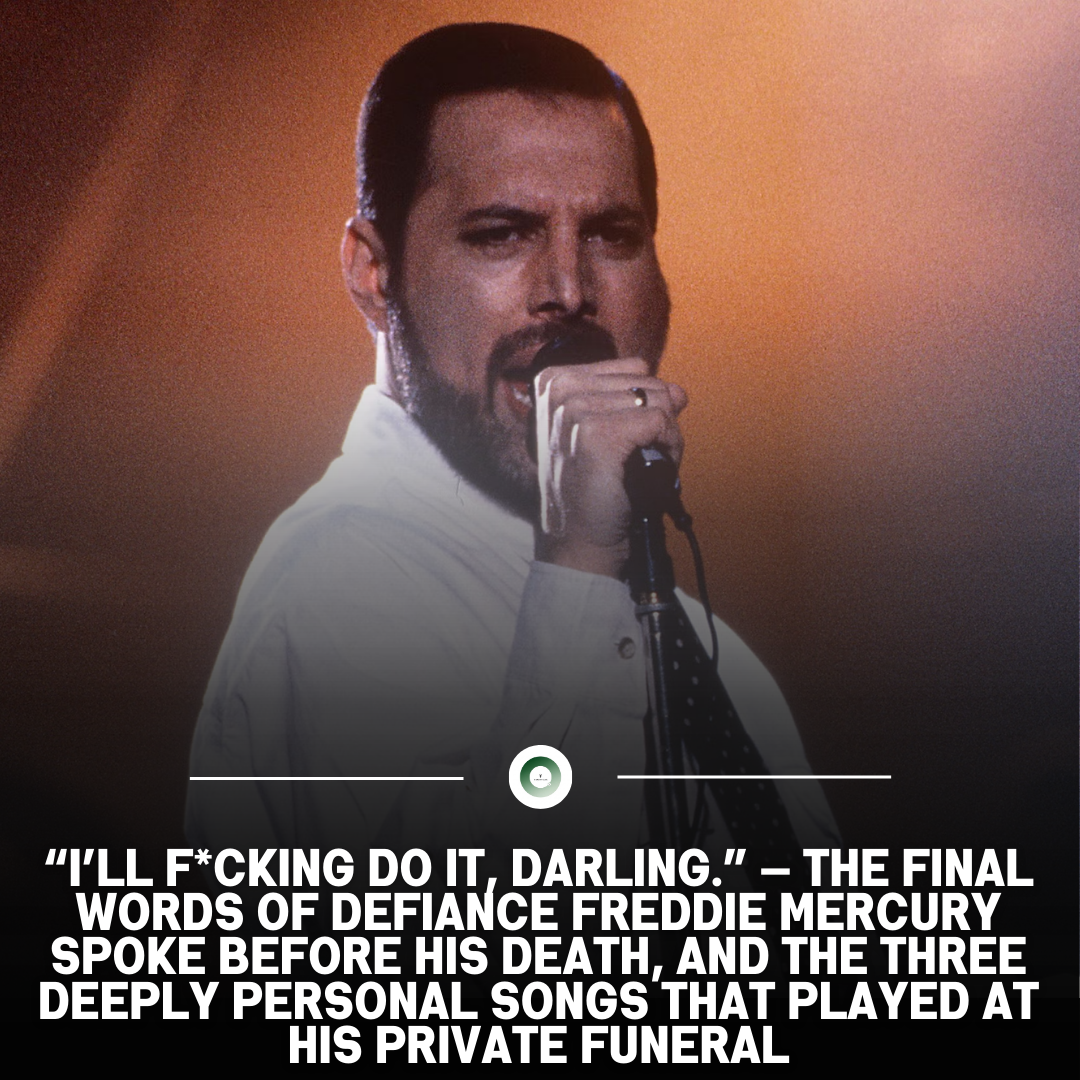
On November 27, 1991, three days after Freddie Mercury’s death, the world outside continued without pause. His voice still played on radios. His image still lived on television. Fans gathered outside his home, leaving flowers, letters, and candles. But inside West London Crematorium, something far quieter—and far more personal—was taking place.
Freddie Mercury, the man who had commanded stadiums and defined spectacle, was leaving the world in silence.
There were no cameras.
No reporters.
No public farewell.
Only those who had known him not as Freddie Mercury, but as Farrokh Bulsara.
At the center of the room rested his coffin. On top of it lay a single red rose.
And then, the music began.
The First Song: A Voice of Faith and Strength
As Freddie’s coffin was carried into the crematorium, the first song filled the air.
“Precious Lord, Take My Hand” by Aretha Franklin.
The choice revealed something deeply personal. Freddie Mercury had always admired Aretha Franklin—not for her fame, but for her voice. It carried authority, vulnerability, and emotional truth. Her voice didn’t perform emotion. It embodied it.
In that moment, her voice guided Freddie’s final entrance.
Not as a rock star.
But as a man at peace.
For those present, the song didn’t feel like loss. It felt like dignity.
The Second Song: A Message to Those He Left Behind
Later, as the service continued, another song began to play.
“You’ve Got a Friend” by Carole King.
Its message was unmistakable. It wasn’t dramatic. It wasn’t grand. It was intimate.
Freddie Mercury had always protected his private circle fiercely. Fame never replaced the importance of loyalty in his life. Mary Austin, Brian May, Roger Taylor, and John Deacon had stood beside him long before the world did. They had witnessed the man behind the legend.
Now, this song became his final message to them.
Not spoken.
But understood.
A reminder that even in absence, connection remained.
The Final Song: The Voice That Defined His Private World
The last piece played during the service was unlike the others.
“D’amor sull’ali rosee,” performed by Montserrat Caballé.
Opera had always lived inside Freddie Mercury. Long before the world saw his theatrical brilliance, he had studied voices like Caballé’s. Her control, her emotional precision, her power—it represented everything he believed singing could be.
Their collaboration years earlier had been one of the proudest achievements of his life.
Now, her voice became part of his farewell.
It didn’t feel like an ending.
It felt like recognition.
Recognition of the part of Freddie Mercury the public had never fully seen.
The Goodbye He Designed Without Saying a Word
Freddie Mercury never wanted his death to become spectacle. He had spent his life creating moments for the world. His funeral was not one of them.
Instead, he left quietly.
His service lasted only 25 minutes.
Two Zoroastrian priests led the ceremony according to his family’s faith. No announcements were made. No public invitations were sent. His closest friends stood together, listening not to Queen’s anthems, but to the music Freddie loved as a person, not a performer.
He had chosen songs that reflected truth, not image.
Strength, not fame.
Identity, not legend.
The Man Who Chose His Own Final Voice
Freddie Mercury understood something most people never confront. He knew his time was limited. But he never allowed fear to shape his final chapter. Instead, he shaped it himself.
He didn’t leave behind instructions for applause.
He left behind music.
Music that spoke gently, honestly, and without performance.
Because in the end, Freddie Mercury didn’t need a stage to be remembered.
His voice had already made sure of that.