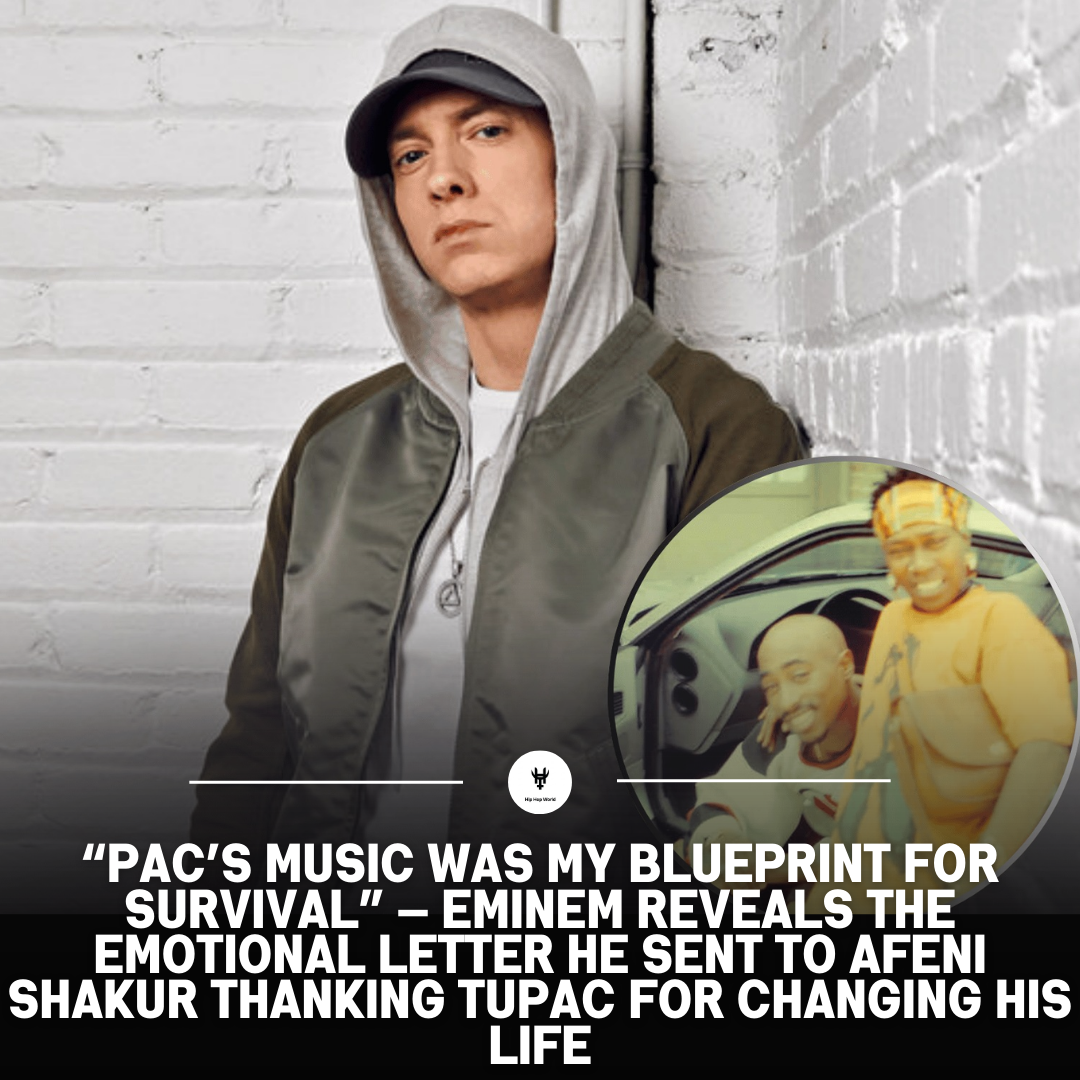
“Pac’s Music Was My Blueprint For Survival” — Eminem Reveals The Emotional Letter He Sent To Afeni Shakur Thanking Tupac For Changing His Life

Eminem Once Wrote a Personal Letter to Tupac’s Mother — Revealing How Pac’s Music Helped Him Survive

For decades, Eminem has been known as one of hip-hop’s most fearless voices — an artist capable of turning anger, humor, and vulnerability into razor-sharp lyricism. Yet long before the world knew him as the “Rap God,” there was another voice guiding him through his most difficult years. That voice belonged to Tupac Shakur.

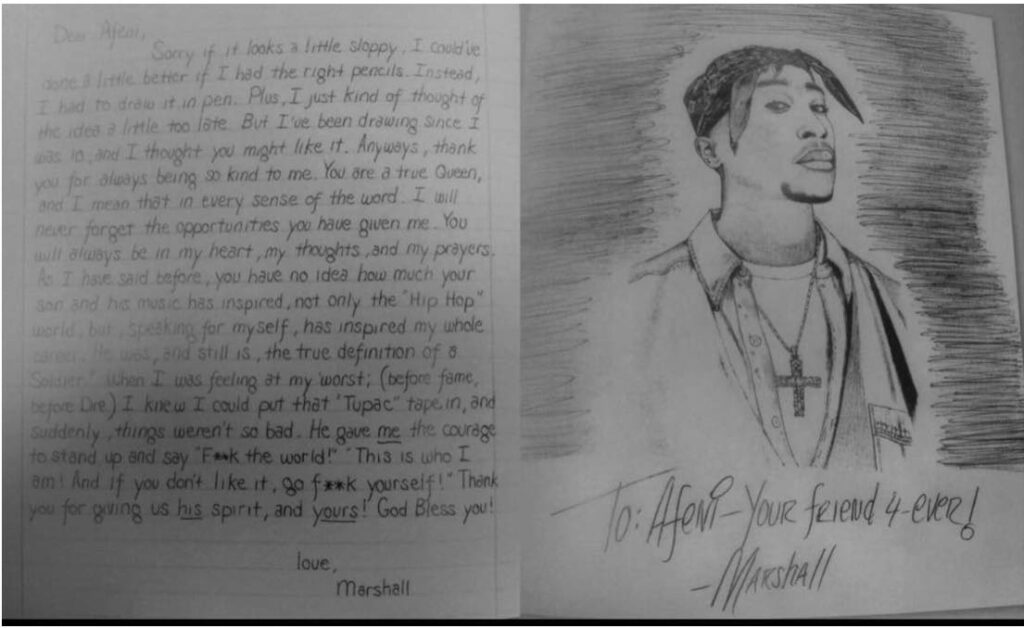
Years later, Eminem revealed a deeply personal gesture he made to Tupac’s mother, Afeni Shakur. The Detroit rapper sent her a handwritten letter along with a hand-drawn portrait of Tupac, thanking her for the impact her son’s music had on his life.

In the letter, Eminem began by apologizing for the drawing’s imperfections, explaining that he had to sketch it in pen because he didn’t have the right pencils. Still, he hoped she would appreciate the effort, noting that he had been drawing since he was ten years old. But the real heart of the message was not the drawing — it was the gratitude behind it.

“Thank you for always being so kind to me,” Eminem wrote to Afeni. “You are a true Queen, and I mean that in every sense of the word.”

The rapper went on to explain that Tupac’s music had shaped his entire outlook on life and art. Growing up as a struggling kid in Detroit, Marshall Mathers often felt isolated and misunderstood. But during those moments, Tupac’s music became something powerful.
It became a lifeline.

In one of the most revealing lines of the letter, Eminem wrote that when he was feeling at his worst — before fame and before the world knew his name — he would put on a Tupac tape and suddenly “things weren’t so bad.” He credited Pac with giving him the courage to stand up and say what he truly felt, even when the world might not like it.

“Thank you for giving us his spirit, and yours,” Eminem concluded in the letter, signing it simply: “Love, Marshall.”

The moment revealed a side of Eminem that fans rarely see. Behind the reputation for sharp lyricism and fearless battles was once a young artist searching for direction, drawing strength from the honesty and emotional depth in Tupac’s music.

Tupac’s legacy is often measured by platinum albums, cultural debates, and his enduring influence on hip-hop. But stories like Eminem’s reveal something deeper — the quiet, personal ways his words reached listeners who were fighting their own battles.

Among those listeners was a teenager in Detroit who would eventually become one of the most influential rappers in history.

And years later, that teenager found a simple way to say thank you — with a sketch, a letter, and a message written straight from the heart.

0 Shares:
Leave a Reply

Your email address will not be published. Required fields are marked *

You May Also Like
Read More

The arena was full long before the lights dimmed. Every seat was taken. The air carried that familiar mix of anticipation and respect that follows **Bruce Springsteen** wherever he plays. People had come for the songs—the ones that feel like hometown memories, the ones that sound like survival, the ones that have carried people through entire lifetimes. That night was supposed to be loud. It still was. But it also became something else. A Moment No One Expected Midway through the set, as Bruce stood under the spotlight with the E Street Band behind him, something shifted in the crowd. Near the edge of the floor, close to the barricade, a young soldier stood up. His uniform looked heavy on him. Not just the fabric—but everything it represented. He raised his hand slowly, firmly, and offered a salute that didn’t feel performative. It felt personal. Bruce saw him. The band eased down. The room went still. For a moment, thousands of people didn’t breathe. It was clear instantly—this wasn’t planned. This wasn’t part of the show. Stepping Away From the Stage Bruce didn’t turn it into a headline. He didn’t wait for security. He didn’t ask questions into the mic. He simply stepped forward, walked to the edge of the stage, and reached out. Up close, the soldier looked like he was holding back tears he didn’t want anyone to see. His salute stayed in place, like it was the only way he knew how to say everything at once. Bruce met him with something quieter than words—an open hand, a nod, a look that said: *I see you.* “Your Music Brought Me Home” When the soldier finally spoke, his voice shook. “Your music… brought me home.” He said that during the hardest nights overseas, when everything felt too loud inside his head and sleep wouldn’t come, Springsteen’s songs were the one thing that made him feel human again. Not a machine. Not a weapon. Not a number. Just a person trying to hold on. Those songs didn’t just entertain him. They reminded him what he was fighting to return to. No Words Were Needed Bruce didn’t answer with a speech. He didn’t try to make it inspirational. He didn’t need to. He simply took the soldier’s hand and held it for a moment longer than most people would. Long enough for the soldier’s face to change. Long enough for the crowd to understand. One Shared Heartbeat When Bruce finally stepped back, the band kicked in again and the show continued. The sound got louder. The crowd came alive. But everyone in that arena knew the truth. The most powerful moment of the night wasn’t the song. It was the silence before it. Two men. Two different battles. One shared heartbeat of gratitude.

The arena was full long before the lights dimmed. Every seat was taken. The air carried that familiar…