The stage was already set in Daytona Beach.
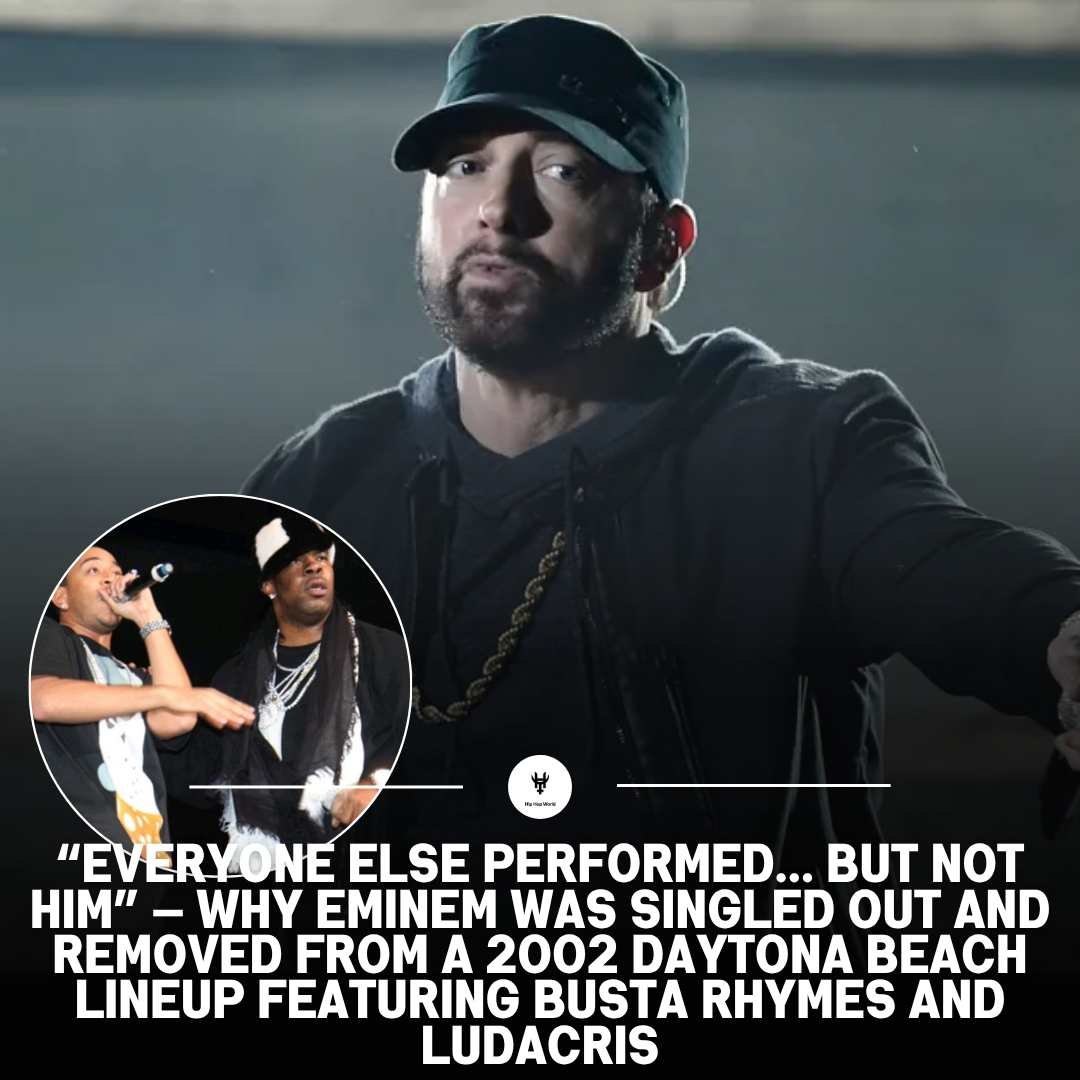
It was 2002, and the city was preparing for a string of high-profile concerts that would bring some of the biggest names in hip-hop to Florida. The energy around the event was building, and among the artists expected to appear was a figure who, at that moment, stood at the very center of global music culture—Eminem.
He was preparing to release The Eminem Show, an album that would soon dominate charts and redefine commercial success in hip-hop. Anticipation around him wasn’t just strong—it was overwhelming. This was the kind of artist cities competed to host.
But in Daytona Beach, something unusual happened.
Before Eminem could even step onto the stage, the decision was made for him.
He wouldn’t be performing at all.
A Reputation That Followed Him
To understand how things reached that point, the story goes back one year earlier.
In 2001, Eminem had already appeared in Daytona Beach alongside D12. During that performance, the group ran through one of their most controversial tracks, “Purple Pills,” a song known for its open references to drug use. For many in the crowd, it was just another high-energy moment in a hip-hop show.
But for Daytona Beach’s mayor at the time, Bud Asher, it was something else entirely.
Asher saw the performance not as entertainment, but as a violation. The event had been tied to an agreement with broadcaster BET, which included restrictions around profanity and explicit behavior. When “Purple Pills” made its way into the set, it crossed a line in his eyes.
His response was immediate.
The performance was shut down.
That moment didn’t fade with time. Instead, it became the foundation of a lasting stance. Asher’s reaction wasn’t just about one song or one night—it turned into a broader rejection of what Eminem represented.
From that point on, the message was clear.
Eminem would not be welcomed back.
The Decision That Changed Everything
So when plans for the 2002 concert series came together, and Eminem’s name surfaced again as a potential performer, the situation quickly escalated.
By then, his influence had only grown. He was no longer just controversial—he was unavoidable. His upcoming album was already generating massive attention, and his presence alone could elevate any event.
Yet for Mayor Asher, none of that mattered.
His position hadn’t changed.
When the possibility of Eminem returning to Daytona Beach became real, Asher intervened once again. This time, the decision was more definitive. Under pressure from the mayor, BET—one of the key partners involved in organizing the event—chose to step back.
“He’s actually got a new album coming out later this month and he wanted to come back,” a spokesperson explained at the time. “But the mayor… [BET] had to respect his wishes.”
With that, the outcome was sealed.
Eminem was officially out.
A Line Drawn in Public
What made the situation even more striking was who remained on the lineup.
While Eminem was being blocked from performing, other major hip-hop artists were still set to take the stage. Names like Busta Rhymes, Ja Rule, Ludacris, and Master P were all part of the event. Each of them carried their own style, their own edge, and their own share of explicit content.
Yet none faced the same level of resistance.
The contrast was impossible to ignore.
It wasn’t just about music anymore. It felt like something more specific—something tied directly to Eminem himself. His image, his lyrics, his persona had always pushed boundaries in a way that made people react strongly, and in this case, that reaction came from the highest level of local authority.
The message wasn’t subtle.
Eminem wasn’t just controversial—he was unwelcome.
The Silence That Followed
For Eminem, however, the moment didn’t turn into a public battle.
There was no drawn-out feud, no extended response. The decision had been made, and he moved forward. His focus remained on what was directly ahead—the release of The Eminem Show.
And when that album arrived in May 2002, it did exactly what many expected.
It went straight to number one.
The project didn’t just succeed—it became one of the most significant commercial releases in music history. The same artist who had been blocked from performing in one city was now dominating charts on a global scale, reaching audiences far beyond any single stage.
In a way, the contrast spoke for itself.
While one door had been closed, the world had opened even wider.
A Moment That Still Resonates
Looking back, the incident in Daytona Beach captures a very specific moment in time—when hip-hop’s growing influence collided with the boundaries set by traditional authority.
Eminem stood at the center of that collision.
He represented a kind of expression that didn’t always fit within accepted limits, and for some, that made him impossible to ignore. For others, it made him impossible to accept.
But the outcome revealed something deeper.
Even when he was kept off a stage, his presence didn’t diminish. If anything, it became clearer just how far his reach extended beyond any one performance, any one city, or any one decision.
Because in the end, the show went on.
Just not where they expected it to.