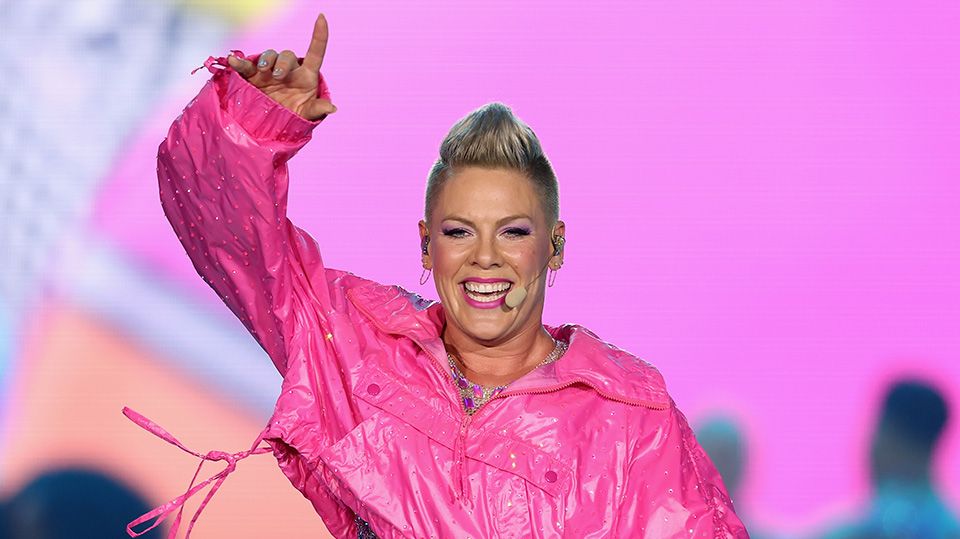
For years, Pink has done something few global pop stars would even attempt: turning live concerts into aerial spectacles. She doesn’t just sing—she flies, spins, and performs suspended above thousands of fans.
But in 2010, that signature spectacle nearly ended everything.
What followed wasn’t just a recovery. It was a recalibration of risk, trust, and identity—and ultimately, one of the most defiant comebacks in modern pop performance.
The Night Everything Went Wrong
The moment unfolded during a stop on the Funhouse Summer Carnival Tour in Nuremberg.
Mid-performance of “So What,” Pink prepared for a routine aerial launch—something she had executed countless times. But this time, the system failed.
Instead of lifting her into the air, the harness—improperly secured—yanked her off balance. She was dragged offstage and slammed into a barricade in front of the crowd.
The show stopped instantly.
She was taken to the hospital. Physically, she avoided catastrophic injury. But the psychological impact was harder to measure—and far more lasting.
When Confidence Breaks Before the Body Does
From the outside, Pink seemed to brush it off with humor. But performers who rely on physical precision know the truth: once trust in the system is shaken, everything changes.
Aerial performance isn’t just about strength or fearlessness. It’s about absolute confidence in:
- The rigging team
- The equipment
- The timing
- And your own body
That night disrupted all of it.
The thought that reportedly lingered—“I almost died up there”—wasn’t dramatic. It was practical.
And it forced a decision: push forward immediately, or step back and rebuild.
She chose the latter.
A Quiet Shift Away From the Air
For nearly two years, Pink dialed down the very element that had set her apart.
This wasn’t a complete disappearance from performing—far from it. She continued to record and release music, channeling energy into her artistry off the ropes. But the high-risk aerial work that had become her trademark was noticeably reduced.
It wasn’t fear alone driving that pause.
It was discipline.
Stepping back allowed her to:
- Reevaluate safety protocols
- Rebuild trust with her team
- Reconnect with her physical limits
- And most importantly, regain mental control over the fear
In high-performance environments, restraint can be more powerful than bravado.
The Return Was Never Going to Be Small
When Pink came back, she didn’t ease in.
She re-entered the air on her own terms during the era of The Truth About Love—an album that marked a major commercial and creative milestone in her career.
But it was the tour that made the statement unmistakable.
The Comeback That Redefined Risk
The Truth About Love Tour wasn’t just a return to aerial work—it was an escalation.
The rigging systems were more advanced. The choreography was more complex. The visual scale was bigger.
And Pink? She was right back where she had fallen—only higher.
Performances like “Try” saw her suspended far above the audience, executing intricate movements that required total physical and mental commitment. There was no visible hesitation.
But what made this comeback different wasn’t just the spectacle.
It was the intention behind it.
Fear Didn’t Disappear—It Was Rewired
Great performers don’t eliminate fear. They learn how to work with it.
Pink’s return to aerial stunts wasn’t about pretending the accident never happened. It was about proving that it didn’t get the final say.
By coming back stronger—and smarter—she reframed the narrative:
- The fall wasn’t the end
- The pause wasn’t weakness
- The return wasn’t reckless
It was controlled defiance.
Why This Moment Still Matters
In an industry that often rewards pushing limits without acknowledging consequences, Pink’s experience offers a different perspective.
She didn’t immediately “bounce back” for the sake of optics.
She took time, recalibrated, and then returned with purpose.
That approach doesn’t just protect longevity—it deepens credibility.
Fans weren’t just watching a performer do stunts again. They were watching someone reclaim something that had once nearly taken everything from her.
More Than a Stunt Performer
It’s easy to reduce Pink’s aerial work to spectacle. But that misses the point.
The stunts are an extension of her identity as an artist—fearless, physical, and emotionally transparent. When that part of her performance was threatened, it wasn’t just a technical issue.
It was personal.
That’s why the comeback resonated.
The Legacy of the Fall—and the Flight After
Today, Pink’s aerial performances are once again a defining feature of her shows. But they carry a different weight.
Every spin, every drop, every moment suspended in midair now tells a layered story:
- Of risk
- Of failure
- Of recovery
- And of choice
Because in the end, the most impressive part isn’t that she flies.
It’s that after hitting the ground, she chose to go back up.