The album arrived without warning.
In January 2020, **Eminem released Music to Be Murdered By overnight, continuing a pattern of surprise drops that had become part of his later career. There was no long rollout, no extended build—just a full project suddenly available, waiting to be heard.
Listeners pressed play, moving track by track through a record built on sharp lyricism, dark themes, and the kind of provocative writing that had long defined Eminem’s style.
And then came a moment that shifted everything.
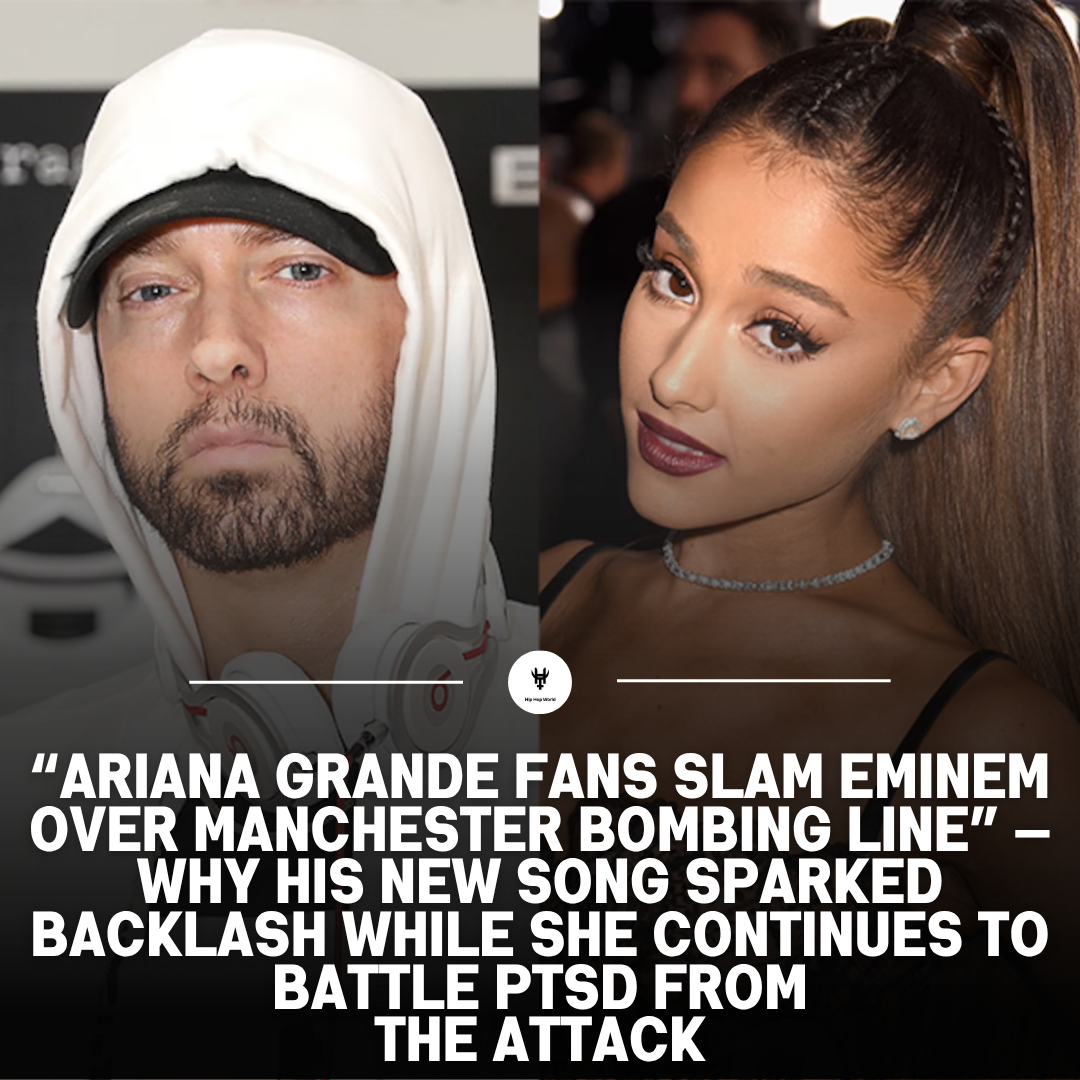
On the track “Unaccommodating,” a single line referenced the 2017 bombing at an **Manchester Arena bombing during a concert by Ariana Grande—an attack that had taken 22 lives and left lasting trauma for countless families.
The reaction was immediate.
When A Lyric Becomes A Flashpoint
Eminem has always operated close to the edge of controversy. His writing often blends shock, wordplay, and cultural references in ways that invite strong reactions. But this time, the subject wasn’t distant or abstract—it was tied to a real tragedy that remained deeply felt.
Within hours of the album’s release, listeners began isolating the lyric and sharing it online. The conversation moved quickly, spreading across platforms as people tried to process what they had heard.
The hashtag #EminemIsOverParty began trending.
For some, the line crossed a boundary that shouldn’t have been approached at all. Posts reflected anger, disappointment, and disbelief that a tragedy of that scale had been referenced in that way.
Others struggled with the same question: where is the line between artistic expression and something that feels too close to real pain?
The debate wasn’t new in hip-hop, but the context made it heavier.
Voices From Outside The Music
The reaction didn’t stay within fan circles.
Among those who responded was Figen Murray, the mother of one of the victims. Her words added a perspective that moved the conversation beyond music and into something more personal.
She described the lyric as unnecessary and distasteful, questioning its purpose and the attention it seemed to seek. It was a reminder that behind every headline or reference, there are people still living with the consequences of what happened.
At the center of the conversation was not just a lyric, but the memory of an event that had reshaped lives.
The Weight Of The Original Moment
In the years following the attack, Ariana Grande had spoken openly about the emotional aftermath. She described the anxiety and trauma that followed, as well as the ongoing impact it had on her and those connected to the event.
For her, and for many others, the incident wasn’t something that had simply passed with time.
It remained present.
That context made the lyric feel different. It wasn’t just a reference—it was tied to something still unresolved for many people.
And that connection intensified the reaction.
A Complicated Contrast
What added another layer to the moment was Eminem’s own history with the event.
In 2017, he had publicly expressed support for the victims and their families, encouraging donations and contributing himself. At that time, his response aligned with many others in the music industry—a collective effort to acknowledge and support those affected.
That earlier stance didn’t disappear.
But it made the contrast sharper.
For some, it raised questions about how the same artist who once supported the victims could later reference the event in a way that sparked backlash. It didn’t provide an easy answer, but it added complexity to how the moment was understood.
The Ongoing Conversation
In the days that followed, the discussion around the lyric became part of a larger conversation about boundaries in music.
Eminem’s work has often existed in that space—testing limits, provoking reactions, and forcing listeners to confront uncomfortable ideas. For some, that has always been part of his appeal. For others, moments like this challenge whether those limits should exist at all.
There was no single response that settled the issue.
Some defended the artistic freedom behind the lyric, while others felt that certain events should remain outside that space entirely. The divide reflected something broader than one song—it reflected how audiences interpret responsibility in art.
More Than Just A Song
Looking back, the moment stands as more than a controversy tied to a single line.
It represents the tension between expression and impact—the space where creative intent meets real-world consequence. It shows how quickly a piece of music can shift from entertainment into something that carries deeper implications.
For Eminem, it became another chapter in a career defined by pushing boundaries.
For listeners, it became a moment that asked a difficult question.
Not just about what artists can say—but about what they should.
And sometimes, the answers to those questions are less clear than the reactions that follow.