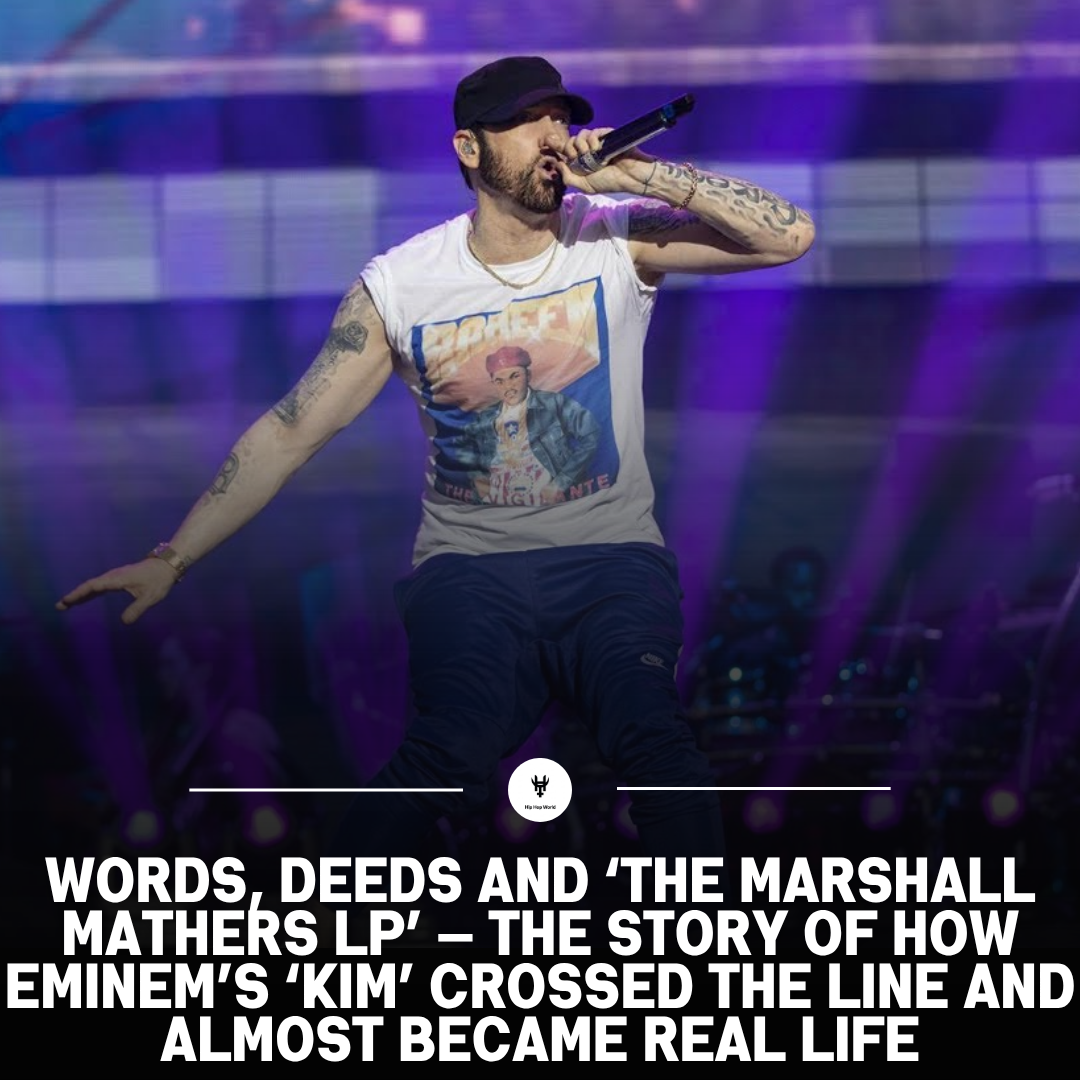
The arena was loud, almost celebratory. Thousands of voices moved together, chanting words that had long escaped the boundaries of a recording studio. On stage, Eminem performed one of his darkest creations, while somewhere in the crowd sat Kim Mathers—watching a story built around her name unfold in front of tens of thousands.
That moment didn’t begin on stage. It began years earlier in Los Angeles, during the making of The Slim Shady LP with Dr. Dre. Eminem was crafting “97 Bonnie and Clyde,” a track that blurred innocence and violence in a way few had attempted. When Kim asked what the song was about, he told her it was simply about taking their daughter out—something closer to a “Just the Two of Us” kind of story. But when she eventually heard it, the illusion collapsed. As Eminem later recalled, she “bugged the fuck out.”
A Voice That Provoked A Culture
Controversy followed naturally. Songs like this didn’t just exist in music—they spilled into public debate. Critics and activists reacted strongly, while Eminem leaned further into the chaos, shaping it into something deliberate.
By the time The Marshall Mathers LP arrived, that tension had become the core of the album. It didn’t just tell stories—it challenged the listener’s ability to separate performance from reality. Lines like, “Put lives at risk when I drive like this [screech] / Put wives at risk with a knife like this [scream]” didn’t ask for comfort. They forced confrontation.
“Stan” pushed that idea even further—a fan unable to distinguish between artist and persona, driven to a fatal end. It wasn’t just storytelling anymore. It was commentary on what happens when people stop seeing the difference.
When The Story Came Home
But nothing blurred that line more than “Kim.”
Darker, slower, and more direct, the track carried a level of intensity that made it impossible to ignore. Its climax echoed with the chilling refrain: “NOW BLEED! BITCH BLEED! / BLEED! BITCH BLEED! BLEED!” Even within the Mathers household, it wasn’t spoken about directly. It became something else—referred to simply as “that song.”
So when Kim prepared to attend a show during the 2000 tour, she asked a simple question. Would he perform it?
He told her no.
For a moment, that answer created distance between the art and the person. But on stage, that distance disappeared. Eminem performed “Kim” anyway—fully, theatrically, in front of a massive crowd. The audience responded the only way they knew how: by shouting every word back.
“All together now…”
“BLEED! BITCH BLEED! / BLEED! BITCH BLEED! BLEED!”
And Kim was there, surrounded by it.
When Words Stop Feeling Like Words
There is a point where art stops feeling like expression and starts feeling like something else entirely. That night crossed it. For the crowd, it was performance. For Kim, it was personal—impossible to detach from the reality behind it.
What followed wasn’t part of the show. It was what came after, when the noise faded and the weight remained.
Eminem had always built his work on pushing limits—on testing how far words could go. But this moment revealed something deeper. It showed what happens when those words don’t stay contained.
Because sometimes, the most unsettling part of a story isn’t what’s written.
It’s what happens when people start believing it.