Sometimes the most defining moments in music don’t begin with ambition. They begin with irritation.
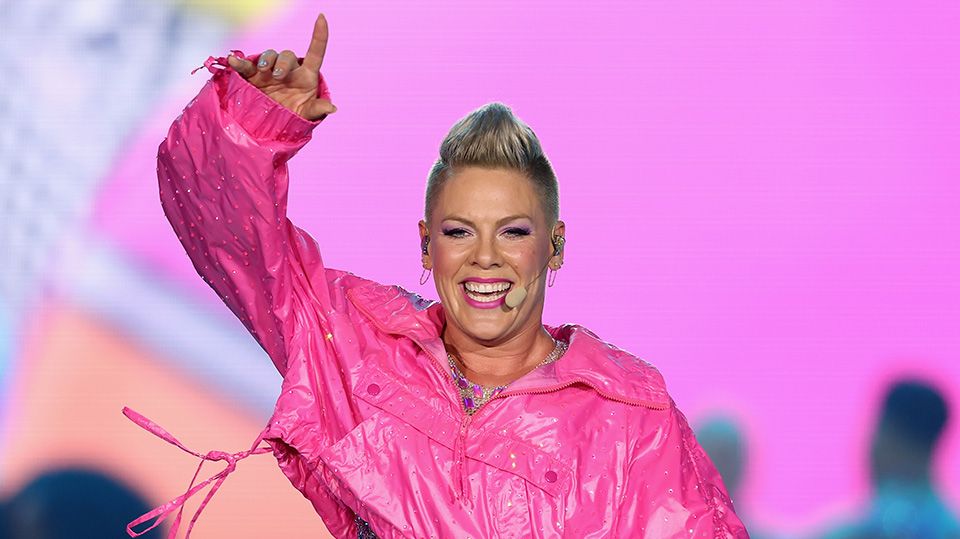
At the start of the 2000s, P!nk wasn’t chasing a reinvention—she was trying to escape one. Her early success had placed her neatly inside a version of pop that worked commercially but felt creatively hollow. The songs were structured to succeed. The image was easy to market. The results were measurable.
The problem was, none of it felt like hers.
So when she walked into Linda Perry’s home studio expecting a traditional writing session, she wasn’t looking for a hit. She was looking for a way out.
What she got instead was something far less polished—and far more important.
The day “serious songwriting” didn’t happen
Linda Perry didn’t greet P!nk with a strategy.
There was no whiteboard of concepts, no team of producers fine-tuning sounds, no sense that they were about to engineer a career pivot. Instead, Perry was casually experimenting with an old drum machine—something outdated, almost dismissible in an era leaning hard into slick, digital production.
It wasn’t impressive. It wasn’t modern. It wasn’t even particularly intentional.
And that was exactly why it worked.
Rather than building a track from the ground up with precision, Perry let a simple loop play and started improvising. No pressure. No expectations. No attempt to be clever. Just noise, rhythm, and instinct.
For an artist suffocating under overproduced pop, that kind of environment can feel like oxygen.
Why simplicity unlocked something bigger
There’s a misconception in pop music that bigger production equals bigger impact. More layers, more polish, more perfection.
But sometimes, complexity gets in the way of personality.
The stripped-down beat Perry was playing did something subtle but powerful: it removed the safety net. There was nowhere to hide behind arrangement or production tricks. If something worked, it was because it had energy—not because it was engineered to sound good.
That’s where the phrase “get the party started” began to emerge—not as a carefully crafted hook, but as a spontaneous reaction. It wasn’t trying to be iconic. It was trying to be fun.
And in that looseness, it found its identity.
From joke to statement
What makes this origin story compelling isn’t just that the song came together quickly. It’s that it wasn’t treated seriously at first.
The early moments of the track were playful, almost throwaway. The kind of creative detour artists take when they’re avoiding the “real work.” But that detour ended up revealing something more honest than any calculated writing session could have.
The hook had attitude. The rhythm had swagger. And most importantly, it didn’t sound like the version of pop P!nk was trying to escape.
That shift—from obligation to expression—changed everything.
Reinvention without permission
When “Get the Party Started” was released, it didn’t just perform well. It reframed P!nk entirely.
Up to that point, there had been uncertainty around who she was as an artist. Was she a traditional pop vocalist? A rebellious outlier? Something in between?
This track answered that question without needing to explain it.
It carried confidence without trying too hard. It felt self-aware without being cynical. And it gave P!nk space to lean into a sharper, more distinctive identity—one that blended pop accessibility with rock attitude.
Importantly, this wasn’t a reinvention handed down by a label. It wasn’t a calculated rebrand. It was the byproduct of creative freedom.
And audiences can feel the difference.
The quiet rebellion behind the sound
On the surface, “Get the Party Started” is a high-energy, feel-good anthem. But beneath that, it represents something more subversive.
At a time when pop music was becoming increasingly formula-driven, the track broke a few unspoken rules:
- It didn’t rely on dense, layered production
- It embraced a slightly raw, imperfect energy
- It prioritized personality over precision
Those choices might seem small, but in a highly controlled industry, they matter. They signal that not everything needs to be optimized to work.
Sometimes, what connects is what feels human.
Why this moment still matters
It’s easy to look back at a chart-topping song and assume it was inevitable. But the truth is, moments like this are fragile. They depend on timing, chemistry, and a willingness to ignore what’s supposed to work.
If Perry had approached the session traditionally, the result might have been technically stronger—and creatively forgettable.
If P!nk had stayed within the boundaries she was given, her career might have continued successfully—and safely.
Instead, they allowed boredom to lead the process.
That decision didn’t just produce a hit. It reset the trajectory of an artist who would go on to build a career defined by individuality, emotional honesty, and a refusal to fully conform.
There’s a tendency in creative industries to treat success as something that can be reverse-engineered. Find the formula, repeat the pattern, scale the outcome.
But stories like this resist that logic.
You can’t plan for the moment when a throwaway idea becomes the defining one. You can’t schedule spontaneity. And you can’t manufacture the kind of energy that comes from genuine creative relief.
What you can do is create space for it.
In that sense, the real breakthrough wasn’t the drum machine or the hook. It was the environment—one where experimentation wasn’t just allowed, it was the point.
Turning boredom into direction
In hindsight, calling it a “boredom experiment” feels almost poetic.
Because boredom, in this context, wasn’t emptiness. It was a rejection of routine. A refusal to keep repeating what worked just because it worked.
And in that rejection, something new surfaced.
For P!nk, that moment wasn’t just about making a song people would remember. It was about rediscovering why she wanted to make music at all.
Not to fit into a system.
But to break out of one.