The stage is alive with movement—lights shifting, the crowd locked into rhythm, every word landing with precision. Ice Cube stands at the center of it all, commanding attention the way he always has. His voice cuts through the noise, steady and controlled, carrying the same authority that defined an entire era of hip-hop.
And then, almost without warning, something changes.
It’s not dramatic. There’s no break in the music, no visible disruption. But for a brief second, his focus shifts inward. The performance continues, yet the energy feels different—quieter, more personal. It’s the kind of moment that most people wouldn’t notice unless they were looking closely. But for those who do, it reveals something deeper than performance.
It reveals memory.
A Loss That Arrived Too Early
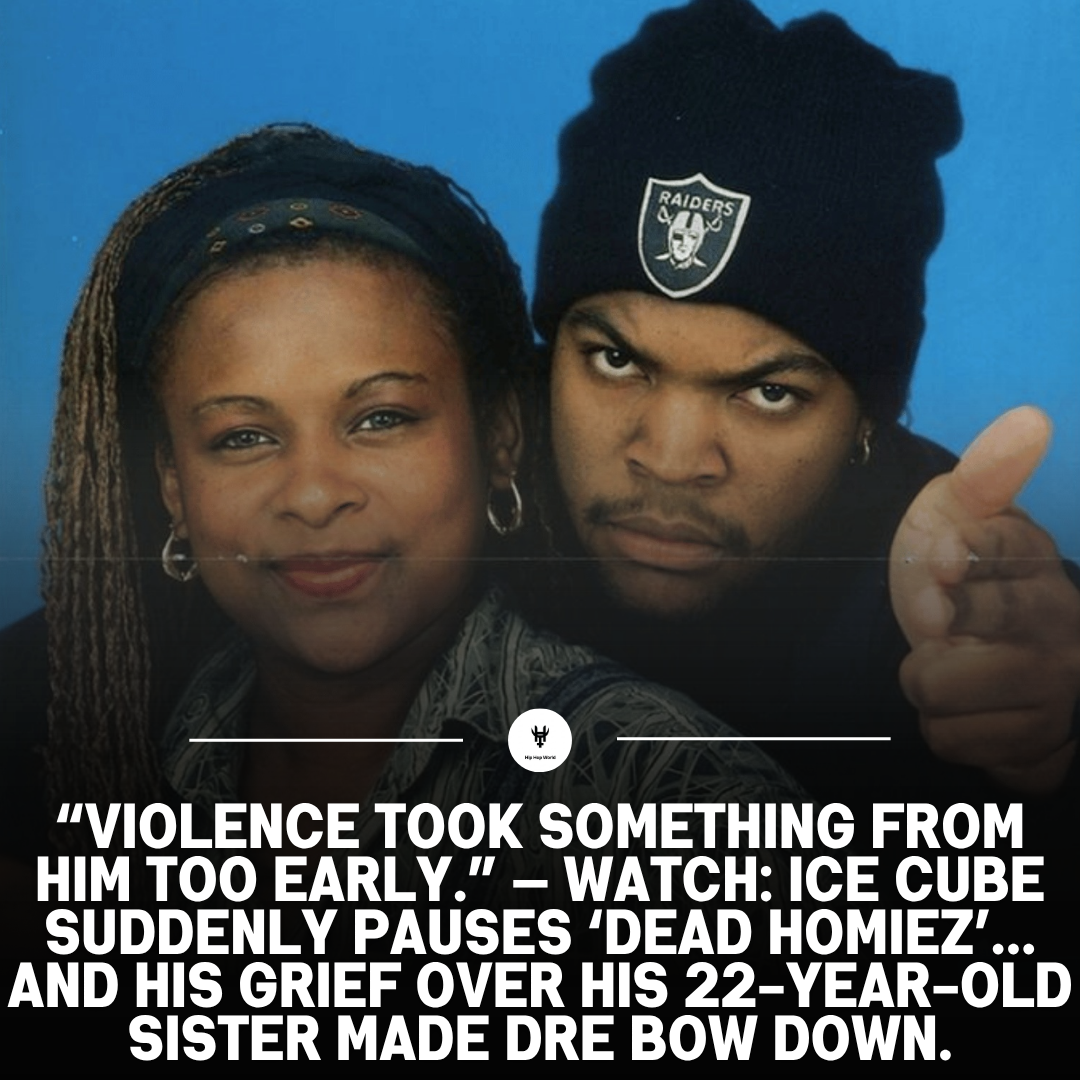
Long before the stages, the records, and the cultural weight of his voice, there was a moment that shaped everything that came after. As Dr. Dre would later reflect, one of the most defining experiences in Ice Cube’s life came during his youth, when his family was struck by the loss of his 22-year-old half-sister.
For a young person still learning how the world works, grief doesn’t arrive gently. It disrupts everything—how safety is understood, how trust is formed, how family is felt. It forces a kind of awareness that most people don’t encounter until much later, if at all.
In Cube’s case, that loss didn’t fade into the background. It stayed.
Not always visible. Not always spoken. But present—quietly shaping how he saw the world and how he would eventually express it.
When Personal Becomes Universal
Years later, that emotional weight would find its way into his music. Not in obvious ways, not as a direct retelling, but as something embedded beneath the surface.
Tracks like Dead Homiez carry that imprint.
On the surface, the song is often understood as a reflection on loss within the broader realities of street life—a tribute to friends, to absence, to the cost of survival. But as Dre suggests, there is something more personal woven into it. A tone that goes beyond observation. A sense of remembrance that feels closer, more intimate.
It’s not just about a community.
It’s about family.
The way the words are delivered, the space between lines, the weight behind certain moments—it all points to something lived, not imagined. Something that continues to exist long after the original moment has passed.
The Performance Within the Performance
Those layers don’t disappear when the music moves from the studio to the stage. If anything, they become more visible.
There are performances where everything aligns—the crowd, the sound, the presence—and yet, within that momentum, there are brief pauses. Not mistakes. Not hesitation. Something else entirely.
Recognition.
In those seconds, the song shifts. It stops being just a performance and becomes a connection—to people who are no longer there, to moments that cannot be revisited, to emotions that still carry weight. The audience may still be moving, still reacting, but for the artist, the meaning deepens.
It’s a reminder that some songs are not left behind once they’re recorded.
They are carried forward.
Strength and Vulnerability, Side by Side
For Dr. Dre, witnessing those moments offers a different understanding of Ice Cube’s artistry. The intensity that audiences often associate with his voice—the sharp delivery, the commanding tone—is not separate from vulnerability.
It exists alongside it.
That balance is part of what gives his work its staying power. The same voice that challenges systems, that speaks with clarity and force, also carries something quieter beneath it. A sense of experience that doesn’t need to be explained to be understood.
In hip-hop, storytelling has always been central. But what sets certain artists apart is not just what they say—it’s what they carry into the music with them. The experiences that shape the delivery, the pauses, the weight behind a single line.
Ice Cube’s work lives in that space.
More Than a Song
Over time, listeners begin to recognize that not every track is meant to be consumed in the same way. Some songs move quickly, built for energy and reaction. Others ask for something different—attention, reflection, a willingness to sit with what’s being said.
Dead Homiez belongs to the latter.
It doesn’t just tell a story. It holds one.
And for those who understand where that weight comes from, the song becomes something more than a moment in a catalog. It becomes a place where memory is preserved—where loss is acknowledged without needing to be fully explained.
What Remains
Looking back, the connection between that early loss and the music that followed is not always direct. It doesn’t need to be. What matters is how those experiences shape the way an artist sees the world—and how that perspective finds its way into what they create.
For Ice Cube, that shaping happened early.
And it stayed.
In the studio. On stage. In the brief moments where everything slows just enough for something deeper to surface.
Because in the end, some songs are not just performed.
They are remembered