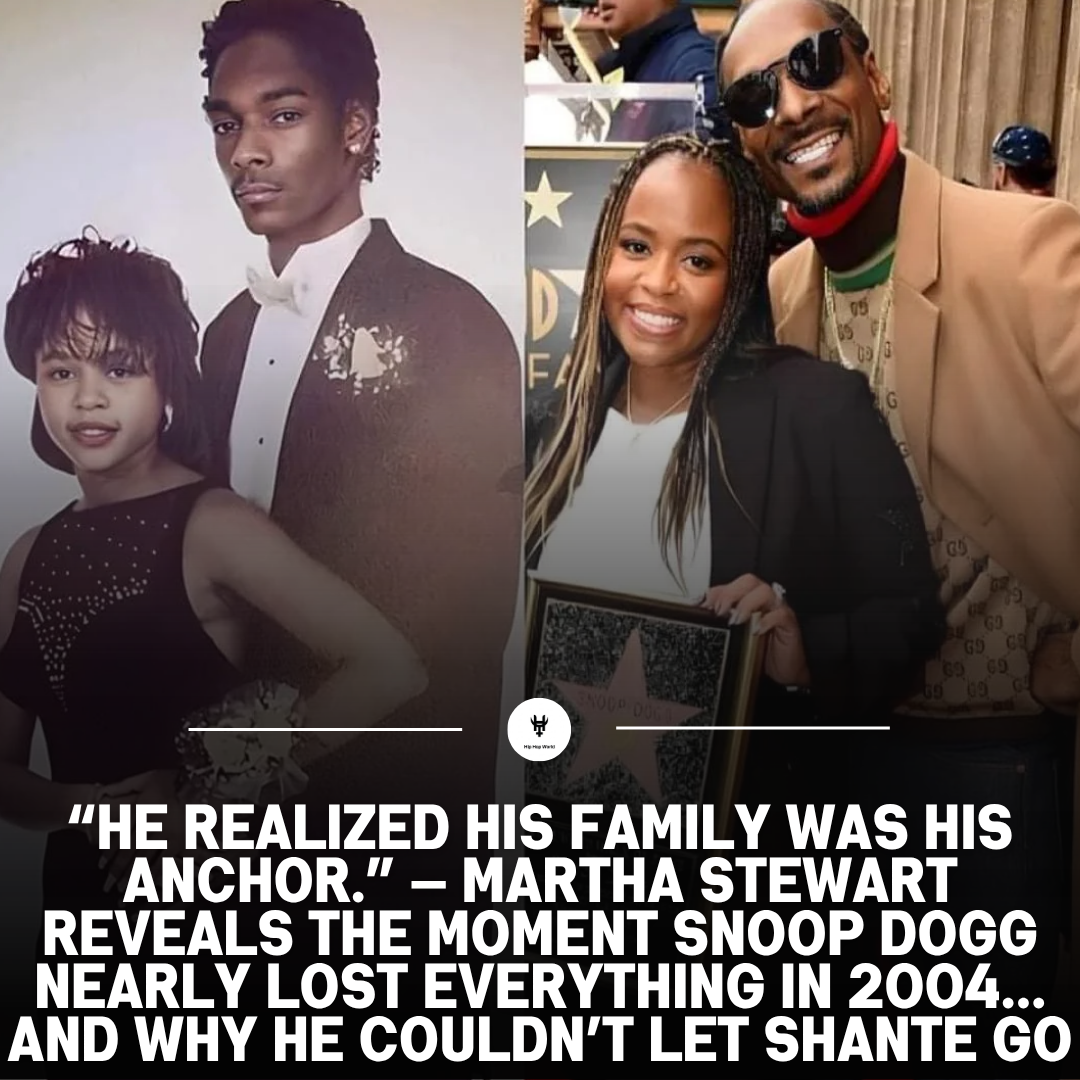
There was a time when the world saw Snoop Dogg as untouchable.
The image was effortless—cool, composed, always in control. A presence that moved through the industry with ease, balancing fame and personality in a way that felt almost natural. But behind that image, there was a moment where none of it felt stable.
Not the career.
Not the lifestyle.
And most importantly, not the family.
Because in the early 2000s, while everything around him was expanding, something at the center of his life was quietly beginning to break.
When Fame Starts to Pull Things Apart
Success doesn’t always arrive alone. It brings movement, pressure, expectation—and sometimes, distance.
For Snoop, that distance showed up in the place that mattered most. His relationship with Shante Broadus, his high school sweetheart, began to feel the strain of a life that was no longer grounded in the same way it once had been.
In 2004, he made a decision that could have ended everything.
He filed for divorce.
From the outside, it looked like a familiar story—another relationship struggling under the weight of fame. But what followed didn’t move in the direction people expected.
Because the moment the decision became real, something shifted.
The Realization That Changed Everything
There are moments in life where clarity doesn’t build slowly—it arrives all at once.
For Snoop, that moment came when he faced what divorce would actually mean. Not just separation, but loss. The loss of shared history, of daily presence, of the foundation that existed long before music, before fame, before everything else.
It wasn’t just about a relationship.
It was about home.
And in that realization, something became clear.
Success without that foundation didn’t feel like success at all.
Choosing to Stay
The next move required something different.
Not image.
Not confidence.
But humility.
Snoop withdrew the divorce papers.
It wasn’t a quiet reversal—it was a conscious decision to step back, to take responsibility, and to rebuild what had been placed at risk. He asked for forgiveness, not as a gesture, but as part of a larger commitment to change the direction things were heading.
And over time, that decision turned into something more than recovery.
It became renewal.
The couple later reaffirmed their relationship, not as a continuation of what had been, but as a recommitment to what they were choosing to protect.
A Perspective Few Expected
Years later, someone from outside the music world would offer a different lens into that transformation.
Martha Stewart, who would go on to form a genuine and unlikely friendship with Snoop, spoke about seeing a side of him that didn’t always match his public image.
What stood out wasn’t the persona.
It was the priority.
The way he showed up as a father. The way he carried himself around his children and, later, his grandchildren. The consistency of someone who had made a decision—and stayed with it.
It wasn’t performative.
It was grounded.
Redefining What Strength Looks Like
In hip-hop, strength is often framed through independence—through control, through distance, through the ability to stand alone.
But Snoop’s story moves in a different direction.
It suggests that strength can also look like staying. Like admitting when something is slipping and choosing to fix it before it’s gone. Like understanding that loyalty isn’t passive—it’s active, intentional, and sometimes difficult.
That shift doesn’t change the image.
It deepens it.
Because behind the persona is something more stable than success.
Something that doesn’t depend on an audience.
A Legacy That Exists Beyond Music
Looking at Snoop Dogg today, it’s easy to focus on the longevity, the influence, the cultural reach. But there’s another part of his legacy that doesn’t live in music.
It lives in the decision he made at a moment when things could have gone another way.
A decision to step back.
To reassess.
To choose something that doesn’t trend, doesn’t go viral, but lasts longer than any of those things.
Because in the end, the moment that could have taken everything away became the moment that redefined what mattered most.
And sometimes, the most important move in a career isn’t the one that builds it.
It’s the one that protects what’s already there.