There’s a point in every long career when the noise changes. It’s no longer about breaking through—it’s about holding ground. The same voices that once pushed you forward begin to question whether you still belong there. For some artists, it arrives quietly. For others, it comes all at once.
For Eminem, that moment didn’t come early—it came after dominance. After the records, the headlines, the era where his name defined the genre’s edge. And yet, even for someone who reshaped hip hop’s mainstream identity, longevity brought a different kind of challenge: staying relevant in a culture that constantly replaces itself.
A Career That Outlived Its Era
By the 2010s, Eminem wasn’t fighting for recognition—he was fighting perception. Albums continued to arrive, each one measured not just on its own merit but against the weight of what came before. For many listeners, the comparison became unavoidable.
Projects outside of The Marshall Mathers LP 2 were often met with a different tone. Not dismissal, but scrutiny. The conversation shifted from impact to decline, from innovation to expectation. It wasn’t about whether Eminem could still rap—few questioned that. It was about whether the culture still felt the same urgency toward him.
And Eminem heard it all.
The Warning Hidden Inside the Verse
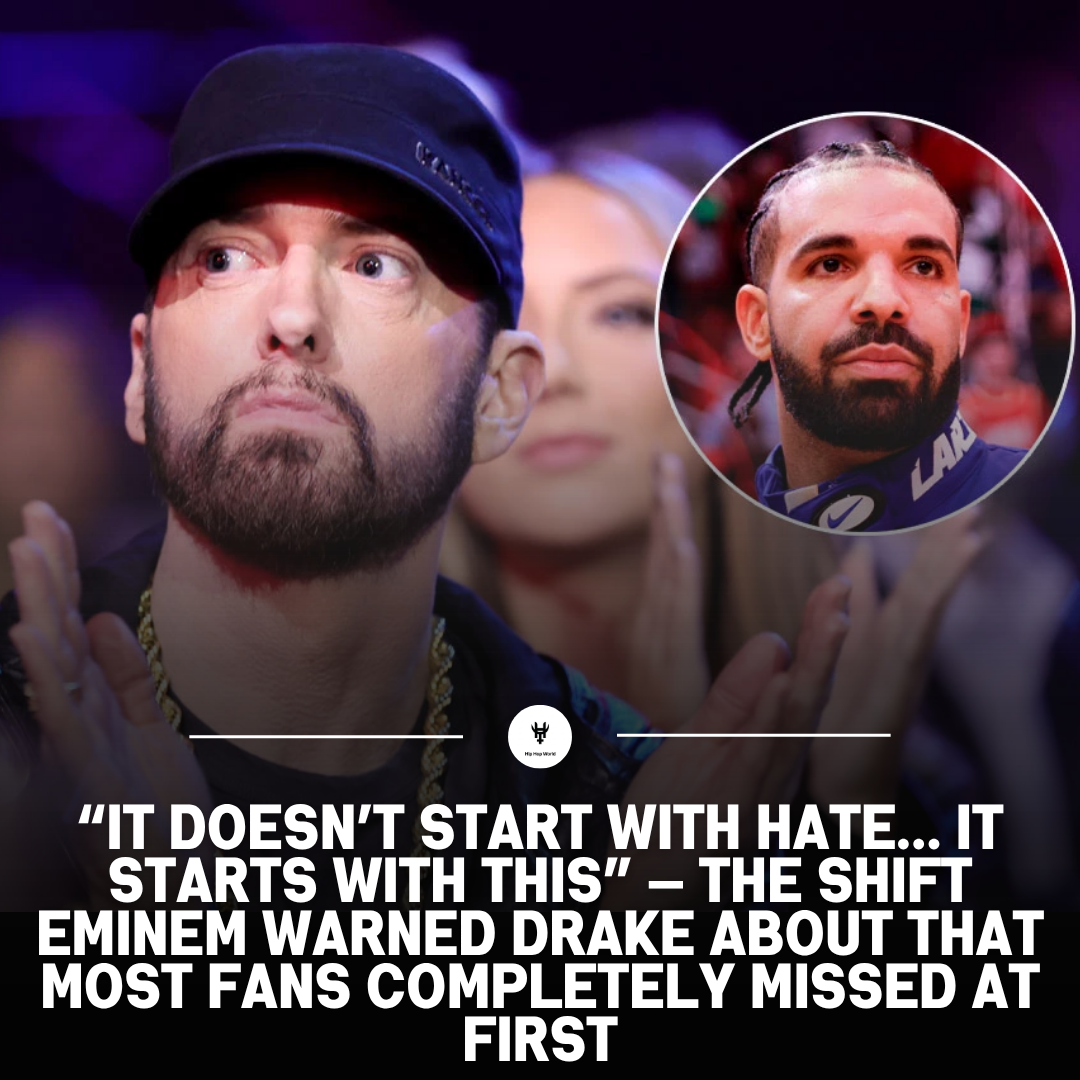
On “Zeus,” from Music to Be Murdered By – Side B, he didn’t just respond—he reframed the conversation. Instead of defending himself directly, he widened the lens. He spoke about the cycle itself.
In a few direct lines, he turned toward Drake—not as a rival, but as someone walking a similar path at a different stage.
“And, Drake, they’re gonna turn on you one day too / And the more you win, the sooner they do.”
It wasn’t delivered as a challenge. It felt more like recognition. A statement from someone who had already experienced what comes after sustained success.
He didn’t stop there. The verse expanded to include other names—artists who, at the time, were still firmly in their moment. Chance, Future, Migos. The implication was clear: no one stays untouched by the shift.
Because in hip hop, momentum doesn’t fade slowly. It flips.
Turning Point: From Defense to Perspective
What makes that moment stand out isn’t just the message—it’s the position it comes from. Eminem wasn’t speaking as someone trying to hold onto relevance. He was speaking as someone who had already watched it evolve around him.
The criticism didn’t disappear. If anything, it became part of the narrative. But instead of resisting it, he acknowledged it as inevitable. The idea that fans might move on, that comparisons would grow harsher, that even strong work could be dismissed once perception changes—he treated it less like a personal attack and more like a pattern.
That shift—from reaction to understanding—marked a different phase in his career.
No Rivalry, Just Respect
Despite the direct mention, Eminem made it clear there was no tension behind the warning. His relationship with Drake wasn’t built on competition, but on something more personal.
He later spoke openly about his respect, pointing to a moment that mattered beyond music—something Drake had done for his daughter that he said he would never forget. It wasn’t framed for headlines. It was stated simply, as a reason why respect remained intact regardless of how the lyric might be interpreted.
In a genre often driven by rivalry, that distinction mattered.
The Pattern That Doesn’t Change
What Eminem laid out wasn’t unique to him, or to Drake, or to any one artist. It’s a cycle that repeats, regardless of era. The rise, the peak, the shift in perception, and the eventual reassessment.
New voices arrive. Energy moves forward. And the artists who once defined the moment are left navigating how to exist after it.
Some disappear. Some adapt. And some, like Eminem, choose to confront it directly—turning the criticism into part of the conversation rather than something to avoid.
The Legacy Beyond Relevance
Looking back, the warning in “Zeus” feels less like a prediction and more like a reflection. Not of one artist’s career, but of the structure surrounding all of them.
Because longevity in hip hop isn’t just about staying visible. It’s about surviving the moment when visibility starts to work against you.
And in that sense, Eminem’s words weren’t about Drake at all.
They were about what comes next—for everyone.