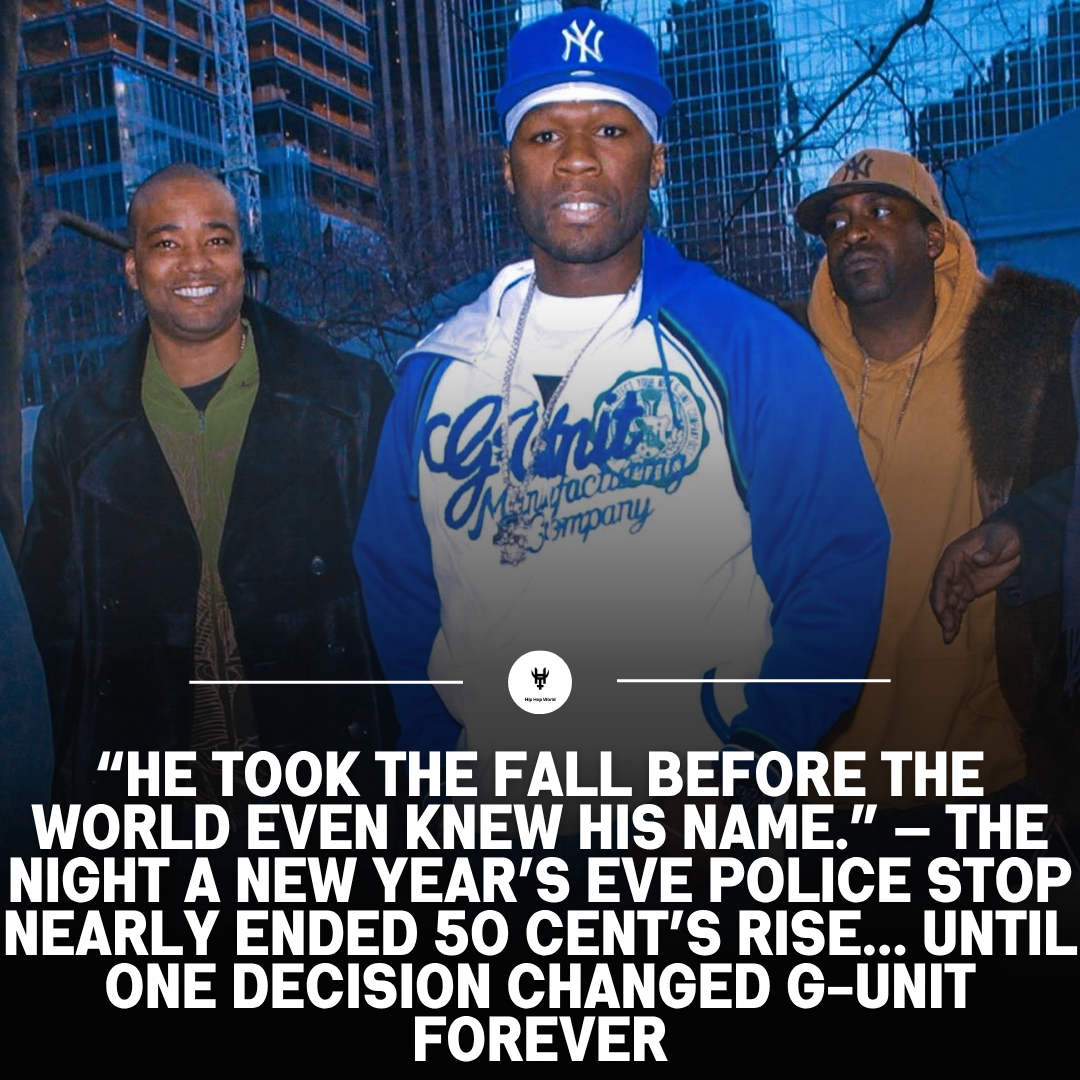
The air was cold that night—one of those late December evenings in New York where the streets feel quieter than usual, but never still. It was New Year’s Eve, 2002, and what should have been just another moment in a long grind toward recognition suddenly became something else entirely.
A routine police stop. A pause. A search.
And then, in an instant, everything shifted.
At the time, 50 Cent was standing on the edge of a breakthrough that had been years in the making. The momentum was undeniable. The industry was watching. The foundation for what would soon become one of the most defining debuts in hip-hop was already in motion.
But in that moment, none of it felt certain.
What happened next wouldn’t be announced in headlines or captured in the rollout of a debut album. It would exist quietly—underneath the success, beneath the narrative the world would eventually celebrate.
And it would define everything that came after.
A Decision Made in Seconds
When the situation escalated, it wasn’t handled with hesitation or calculation. There was no time for strategy, no space for negotiation.
Tony Yayo made a choice.
He took responsibility.
In doing so, he stepped directly into consequences that would remove him from the very moment he had helped build. While the outside world would soon witness the rise of G-Unit, one of its core members would disappear from the picture—physically absent during the most critical phase of their emergence.
It wasn’t a move designed for recognition. It wasn’t about future credit or legacy.
It was loyalty, in its most unfiltered form.
The Rise Without One of Its Own
Just months later, Get Rich or Die Tryin’ would arrive and reshape the landscape of hip-hop. The album didn’t just perform well—it dominated. Its impact was immediate, its reach global, and its presence impossible to ignore.
The world saw a movement forming. A sound. An identity.
But within that rise, there was an absence that couldn’t be replaced.
Tony Yayo wasn’t there for the performances, the interviews, the early moments when everything was beginning to crystallize. While G-Unit’s image was being introduced to the public, one of its defining figures was watching from the outside, serving time for a decision made in seconds.
Inside the circle, that absence wasn’t just felt—it was understood.
There was an unspoken awareness that what people were celebrating came at a cost.
The Invisible Foundation
As the group’s presence grew, so did its mythology. G-Unit wasn’t just a collection of artists—it became a symbol of loyalty, resilience, and shared history. That image didn’t come from marketing. It came from moments like this.
Tony Yayo became, in many ways, the invisible foundation of that identity.
His absence during the breakthrough gave weight to the group’s story. It reinforced the idea that their rise wasn’t built solely on talent or timing, but on something deeper—on choices made when there was everything to lose.
For 50 Cent, the success that followed was never detached from that memory. As doors opened and opportunities multiplied, there remained a constant reminder of what had been sacrificed to make that path possible.
It was a different kind of pressure—one that doesn’t come from the industry, but from within.
Returning to a Changed Reality
When Tony Yayo eventually returned, the world he stepped back into had transformed.
G-Unit was no longer emerging—it was established. The sound, the brand, the identity had already taken shape. The momentum he helped create had carried forward without him, reaching heights that few could have predicted just a year earlier.
But his role hadn’t diminished.
If anything, it had deepened.
He didn’t return as someone who had been left behind. He returned as someone whose actions had become part of the group’s foundation—woven into the very story that defined their success.
Within the circle, nothing needed to be explained.
They already knew.
Beyond the Spotlight
The public narrative of hip-hop often centers on visibility—on who is seen, who is heard, who stands at the front when the moment arrives. But stories like this exist in the margins, shaping outcomes without ever demanding attention.
Tony Yayo’s role in G-Unit’s rise challenges that idea.
It suggests that some of the most important contributions happen away from the spotlight, in moments that aren’t designed to be remembered but end up defining everything.
It reframes success—not as an individual achievement, but as something built through shared risk, shared history, and, sometimes, sacrifice that goes unseen.
What the Story Leaves Behind
The rise of G-Unit is often remembered for its impact—its music, its influence, its place in hip-hop history. And rightly so. Get Rich or Die Tryin’ remains one of the most significant debuts the genre has ever seen.
But behind that success is a quieter truth.
A moment on a cold New Year’s Eve.
A decision made without hesitation.
And a reminder that the path to the top is rarely shaped by one person alone.
Sometimes, the most defining part of the story isn’t the moment the world sees—it’s the one that happens just before everything changes.