The stage at Saturday Night Live in October 2004 carried its usual energy—fast-paced, unpredictable, and filled with the kind of pressure that comes with live television. But behind the scenes, away from the cameras and the audience, something happened that would remain untold for years.
It wasn’t part of the script. It wasn’t part of the performance.
And it certainly wasn’t something anyone expected to hear later.
Two Worlds Collide on One Stage
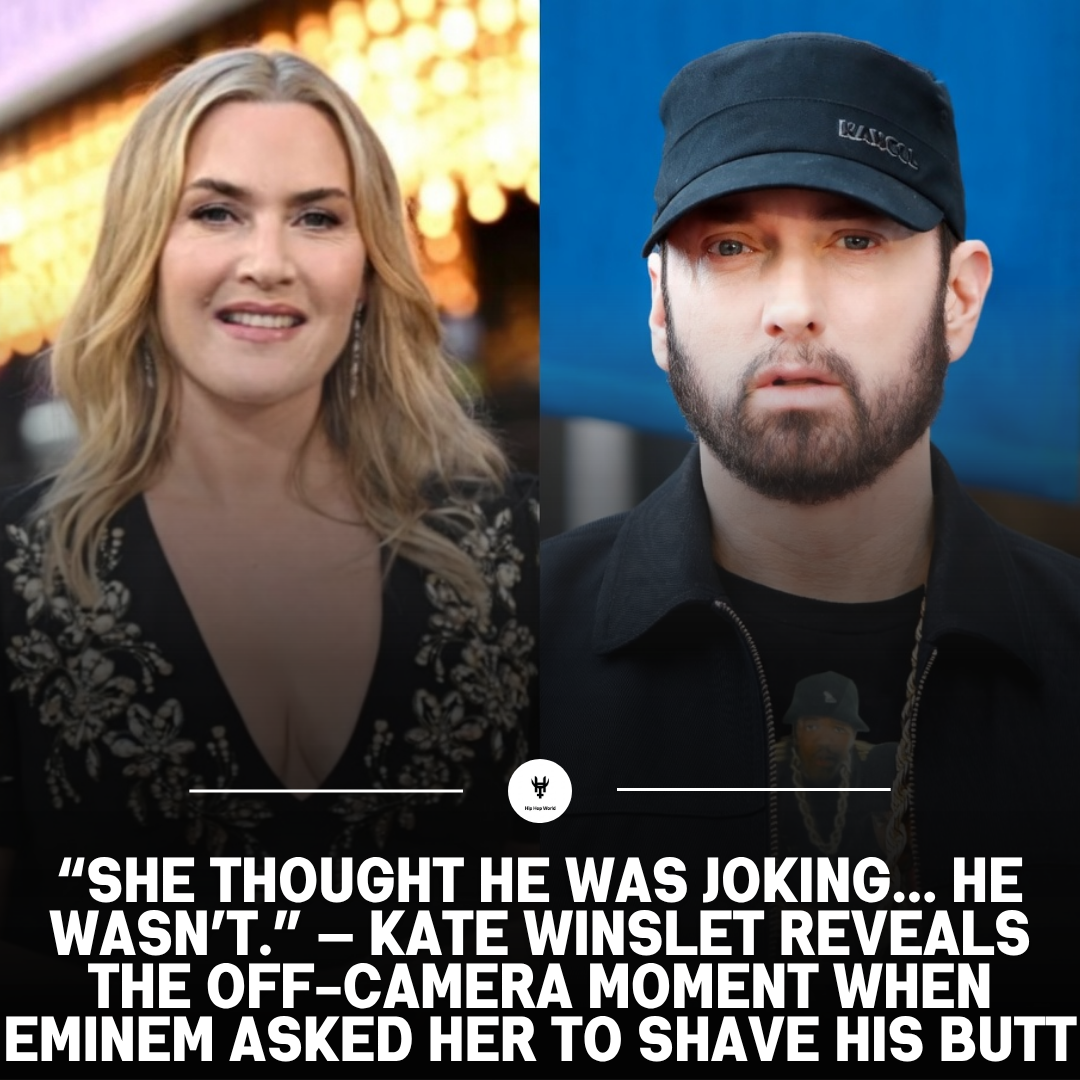
At the time, Kate Winslet was stepping into the spotlight to promote Finding Neverland, sharing the stage with Johnny Depp in what would become one of the most talked-about films of that period.
Across the same stage stood Eminem, arriving in the middle of one of the most defining phases of his career. With Encore on the horizon, his presence carried both anticipation and intensity.
On camera, everything followed the expected rhythm. Winslet introduced performances. Eminem delivered “Mosh” and “Just Lose It.” The show moved forward seamlessly.
But off camera, the moment took a different turn.
A Request That Stayed Hidden for Years
It wasn’t until much later, during an appearance on The Graham Norton Show, that Winslet shared something she had never spoken about publicly before.
A request—unexpected, unusual, and entirely out of place in the context of a high-profile television production.
According to Winslet, Eminem asked her to shave his butt.
The story, told with disbelief and humor, revealed a side of the moment that no audience ever saw. Her response was immediate—clear, direct, and rooted in the simple boundary between colleagues and something far more personal.
It was a brief exchange. A strange one.
But it stayed with her.
The Persona vs. The Moment
For an artist like Eminem, whose career has often blurred the line between performance and provocation, moments like this sit in an unusual space.
They don’t define the work. They don’t shape the music.
But they add to the mythology.
In the early 2000s, Eminem’s presence was built not just on his sound, but on unpredictability—the sense that anything could happen, both on and off stage. That unpredictability was part of what made him impossible to ignore.
And in a quiet, behind-the-scenes moment, that same unpredictability surfaced again.
Not as spectacle. Not as performance.
But as something entirely unexpected.
Beyond the Story Itself
Despite the encounter, Winslet’s experience with Saturday Night Live remained positive. Years later, she would reflect on the adrenaline of the show, the intensity of performing live, and the unique energy that comes with stepping into that environment.
The moment didn’t overshadow the experience.
It simply became part of it.
A story that existed outside the spotlight, only to resurface years later—adding another layer to an already complex era in both of their careers.
What Moments Like This Reveal
Stories like this don’t reshape legacies.
But they do something else.
They remind people that behind the performances, behind the polished appearances and carefully managed images, there are moments that don’t fit into the narrative the public sees.
Unscripted. Unplanned. Often strange.
And sometimes, those are the moments that stay hidden the longest—until, years later, they finally surface and leave people seeing a familiar figure in a completely different light.