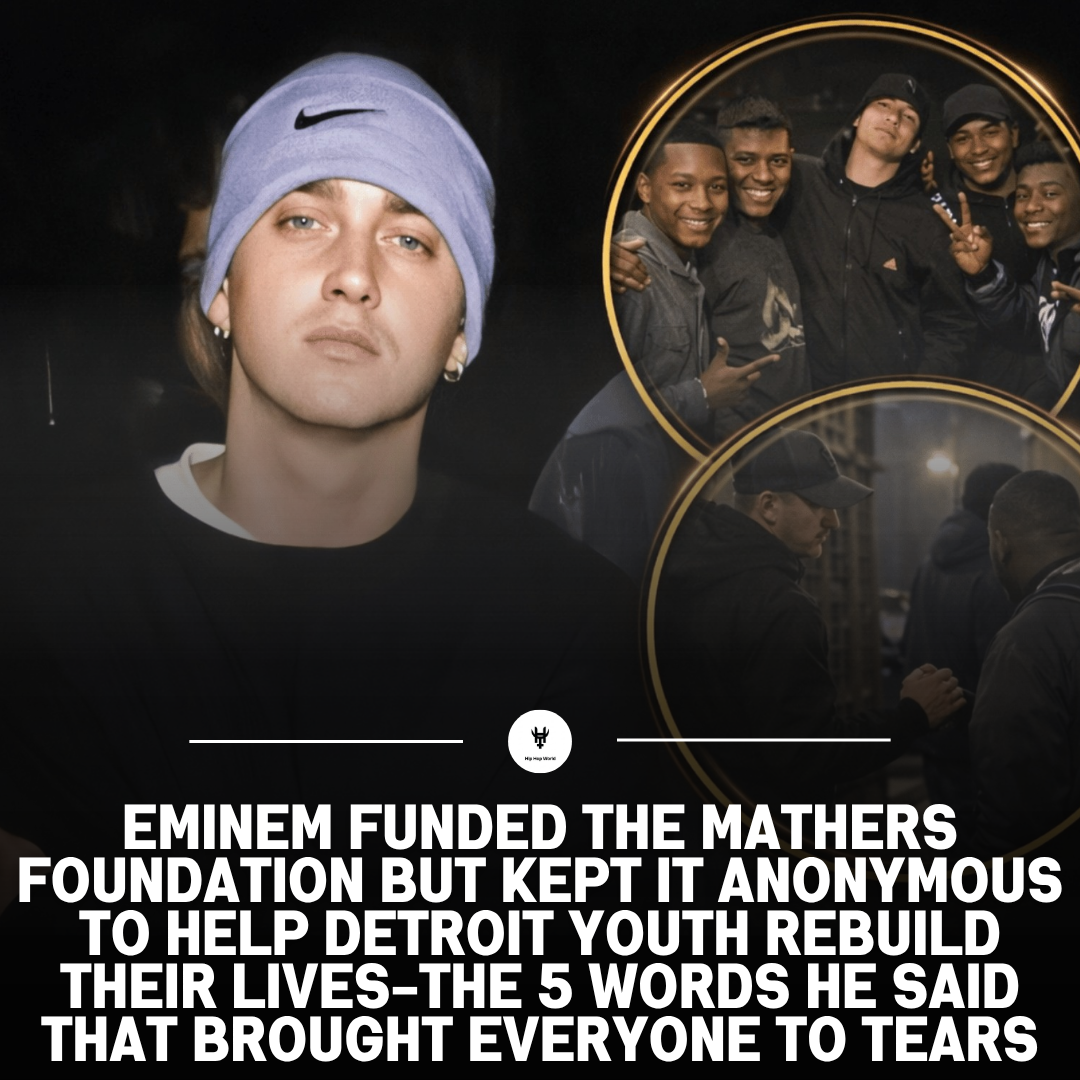
The building was hours away from closing.
Inside, the rooms still carried the echoes of what they had been—kids laughing, voices overlapping, a sense of movement that now felt like it was slipping away. Staff members stood in quiet conversations, trying to process what would happen next. There was no dramatic countdown, no audience watching. Just a slow, unavoidable ending.
And then, just before it was over, everything changed.
The funds appeared. Enough to keep the doors open. Enough to keep the programs alive. Enough to give the people inside another chance to continue what they had built. There was no announcement, no press release, no name attached to it.
Only one condition.
No one would know who did it.
A Legacy Built in Silence
For years, Eminem has existed in two very different worlds. One is visible—stadiums, records, global recognition. The other is almost invisible, rooted in the streets of Detroit, where his influence operates quietly and without attention.
Through the Marshall Mathers Foundation, his connection to the city has never faded. It’s not just about giving back—it’s about returning to the environment that shaped him, understanding it from the inside, and choosing to remain part of it long after success made leaving easy.
Detroit isn’t just where his story started. It’s where he continues to invest it.
But what sets his approach apart is not simply the act of giving—it’s the deliberate absence of visibility. While many public figures build their charitable identity alongside their public image, Eminem has consistently done the opposite. His contributions often arrive without acknowledgment. In some cases, even the people benefiting from them have no idea where the support originated.
It isn’t modesty for appearance. It’s a philosophy.
The Weight of Experience
Long before the success, before the global stage, there was a different version of that story—one shaped by instability, uncertainty, and limitation. The environments he now supports are not distant causes; they are reflections of a life he understands intimately.
That connection changes the intent.
This isn’t charity built on distance. It’s personal.
He has seen what it means to grow up without clear direction, to navigate spaces where opportunity feels scarce and the future uncertain. The young people in these programs are not abstract figures—they are, in many ways, versions of a path he once walked.
And so, the goal was never to be seen as the one who “saved” anything.
The goal was to make sure something didn’t disappear.
The Moment It Became Known
The youth center stayed open. Programs continued. Lives that were about to be disrupted kept moving forward.
For a while, that was the end of the story.
Until someone started asking questions.
A volunteer, tracing back the sudden appearance of funding, eventually connected the act to Eminem. It wasn’t public knowledge. It wasn’t meant to be. But once the connection was made, there was a need—human, natural—to say thank you.
When they finally reached him, the response didn’t match the scale of what had been done.
There was no acknowledgment of the impact. No acceptance of praise. No attempt to explain or justify the decision.
Just a single sentence.
“Don’t thank me, just build.”
A Different Kind of Influence
In a culture where visibility often defines value, that response carries a different weight.
It shifts the focus away from the person and back onto the purpose.
For Eminem, the work was never about recognition. It was about momentum—about ensuring that the people inside those spaces had the chance to continue, to grow, and to shape their own outcomes without feeling like they owed that progress to anyone else.
By stepping back, he allowed the community to remain at the center of its own story.
There’s a kind of respect in that.
It preserves dignity. It protects ownership. It allows growth to feel earned, not given.
Beyond the Spotlight
The image of celebrity philanthropy is often tied to visibility—names on buildings, public announcements, carefully documented acts of generosity. It creates a narrative where the giver becomes part of the story.
Eminem chose to remove himself from that narrative entirely.
Not because the work didn’t matter, but because he believed it mattered more without him in it.
That decision reshapes how impact is measured. It’s no longer about who did it, but about what continues because of it. The programs that stay open. The opportunities that remain. The lives that quietly shift direction without ever knowing why.
In that sense, the absence becomes the point.
What Remains
The youth center still stands. The city continues to move. The foundation keeps working, often without attention, often without acknowledgment.
And somewhere in Detroit, the effects of those unseen decisions continue to ripple outward.
There’s no headline for most of it. No moment where everything is brought into focus. Just a steady, ongoing presence that refuses to disappear.
In the end, that may be the most defining part of Eminem’s legacy beyond music.
Not the scale of what he gave.
But the fact that he made sure it was never about him.