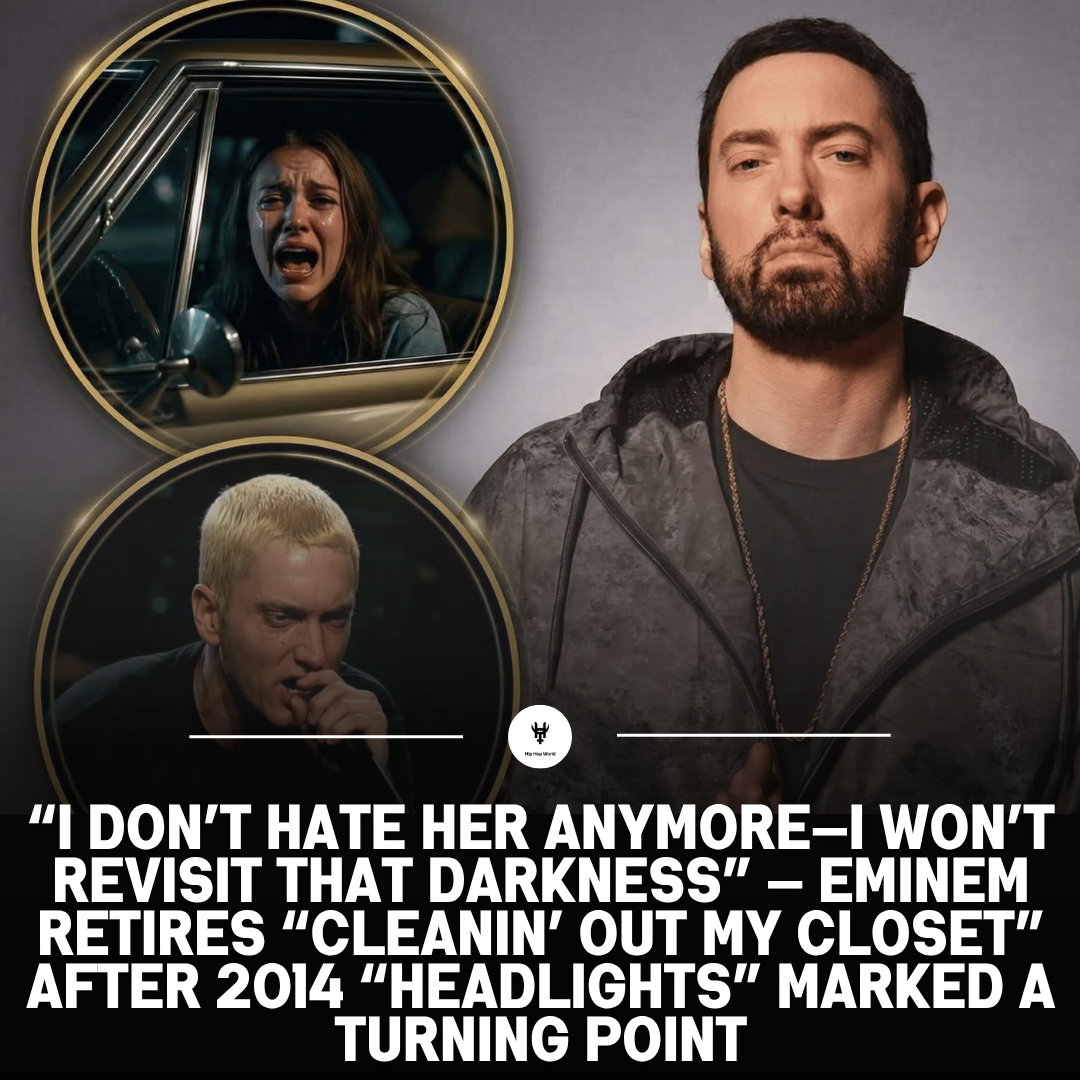
There was a time when the stage lights hit, the beat dropped, and the crowd already knew what was coming. The opening notes alone were enough to trigger a reaction—anticipation, intensity, recognition. For years, Cleanin’ Out My Closet wasn’t just another track in Eminem’s catalog. It was a release. A confrontation. A moment where the line between performance and personal history disappeared.
And he delivered it the same way every time—without hesitation.
Back then, Eminem’s identity was built on a kind of honesty that didn’t ask for permission. His music wasn’t meant to soften the truth; it was meant to expose it. In 2002, when Cleanin’ Out My Closet arrived, it carried something heavier than most hip-hop records of its time. It wasn’t just lyrical aggression. It was deeply personal. The song turned his fractured relationship with his mother, Debbie Mathers, into something public—pain translated into rhythm, resentment sharpened into bars.
For listeners, it felt real. For Eminem, it was real.
The track quickly became one of the defining moments of his early career. It represented everything people associated with him—raw emotion, confrontation, and the willingness to say what others wouldn’t. Night after night, it echoed through arenas, becoming part of the foundation of his legacy. It wasn’t just performed. It was relived.
But time doesn’t leave moments untouched.
A Different Perspective Begins to Form
As the years moved forward, the intensity that once defined Eminem’s music began to shift. The anger that fueled so much of his early work didn’t disappear overnight, but it slowly lost its hold. Life changed. Priorities changed. And with that came something that had been largely absent during the height of his rise—reflection.
Marshall Mathers, the person behind the persona, started to see those earlier moments differently.
The relationship with his mother, once defined by distance and conflict, began to move toward something else. Not perfect resolution, not a rewritten past—but understanding. And that understanding made certain parts of his catalog feel different. Not wrong, but no longer aligned with who he had become.
It wasn’t about denying what he felt back then. It was about recognizing that those emotions no longer defined him.
The Turning Point
That shift became unmistakable in 2014.
When Headlights was released, it didn’t feel like a continuation of the same story—it felt like a response to it. Where Cleanin’ Out My Closet had been sharp, confrontational, and unfiltered, Headlights carried something entirely different. It was measured. Reflective. And most importantly, apologetic.
For the first time, Eminem publicly addressed the impact of what he had said years earlier. Not as an artist defending his work, but as a person acknowledging its consequences. The song didn’t erase the past, but it reframed it—placing accountability where there had once been only anger.
It wasn’t just another track in his discography.
It was a moment of reckoning.
Letting Go of an Iconic Chapter
Sometime after that, the decision became clear.
Eminem would never perform Cleanin’ Out My Closet again.
For an artist whose career had been built on revisiting personal pain, this was a significant departure. The song still existed. Its impact hadn’t changed. But his relationship with it had.
He has admitted that listening to it now brings a sense of discomfort—not because the song lacks meaning, but because it represents a version of himself he no longer connects with. The anger that once gave it power had faded, replaced by something quieter, more grounded.
More importantly, it reminded him of how publicly he had turned private pain into something permanent.
That realization stayed with him.
Beyond the Music
In hip-hop, authenticity has always been one of the most valued traits. Eminem built his reputation on it—on saying what others avoided, on exposing what others kept hidden. But authenticity doesn’t stand still. It evolves. And sometimes, it asks for something different.
In this case, it asked him to step away.
Choosing not to perform one of his most recognizable songs isn’t about rejecting his past. It’s about refusing to remain defined by it. It’s an acknowledgment that growth doesn’t always look like progression—it can also look like restraint.
There’s a difference between remembering and reliving.
Eminem chose the former.
A Legacy That Holds Both Truths
Today, his catalog carries both sides of that story. The anger that once shaped his voice is still there, preserved in the music that defined an era. But alongside it now exists something else—accountability, reflection, and a willingness to evolve publicly.
Both are real. Both are part of his legacy.
But in stepping away from Cleanin’ Out My Closet, Eminem made a decision that goes beyond music. He showed that growth isn’t about rewriting what happened. It’s about deciding what still deserves to be carried forward.
And sometimes, the strongest thing an artist can do isn’t to revisit the moment that made them—
but to finally leave it behind.