There’s a moment in every massive concert when the energy shifts. It stops being just music. It becomes movement—thousands of bodies breathing, pushing, reacting at once. From the stage, it looks like unity. From inside the crowd, it can feel like pressure.
At one show in the American South, that pressure began to build fast.
Fans surged forward, compressing toward the barricade. What starts as excitement in those moments can quickly turn into something more dangerous—weight, force, and the silent panic of not being able to step back. It’s the kind of situation that has defined some of the darkest nights in live music history.
But on that night, something unusual happened.
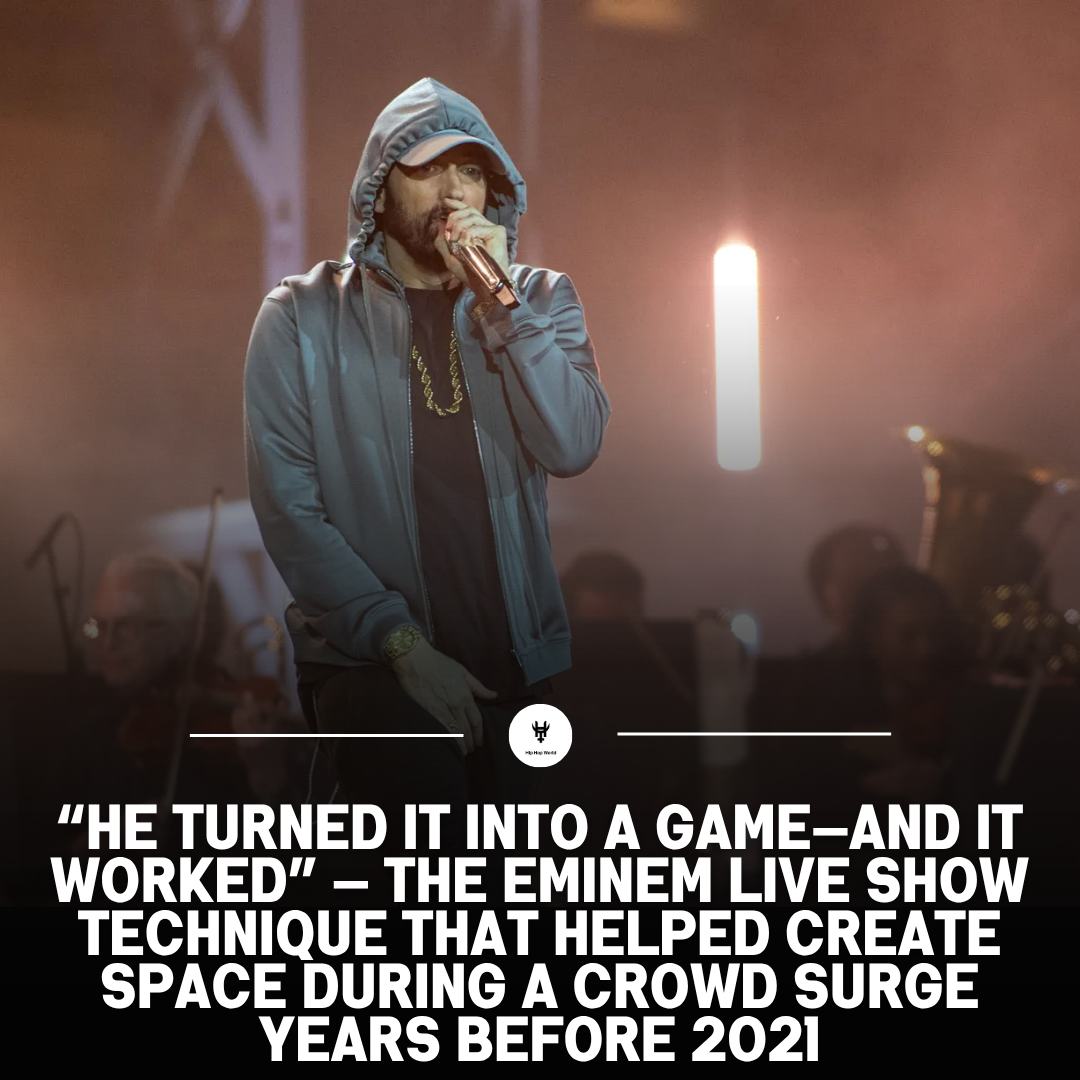
Instead of letting the momentum spiral, the artist at the center of it—Eminem—changed the rhythm of the crowd itself.
Turning Chaos Into Control
According to crowd management expert Gil Fried, who later reflected on the incident, Eminem didn’t respond with panic or confrontation. He responded with instinct—and understanding.
He made it a game.
Standing on stage, he addressed the crowd not with warnings, but with direction disguised as participation. A simple instruction, repeated clearly: move together, step back, then forward, then back again. Two steps back, one step forward. Over and over.
What could have been confusion became synchronization.
The crowd, instead of pushing blindly, began to move as one. Space opened—not suddenly, but enough. Enough for the pressure to ease, enough for those at the front to breathe again. And just as importantly, enough to prevent panic from spreading.
It wasn’t just control. It was psychology.
By framing the movement as a shared moment rather than a command, Eminem diffused tension without breaking the atmosphere of the show. The music didn’t stop. The connection didn’t break. But the danger quietly dissolved.
A Lesson Hidden in Tragedy
Years later, the conversation around crowd safety would return under far heavier circumstances.
In November 2021, ten people lost their lives during a crowd crush at Astroworld Festival, a moment that shook the entire live music industry. The tragedy sparked intense scrutiny around responsibility—who should act, who should intervene, and how quickly.
At the center of that storm was Travis Scott, the performer on stage as the situation unfolded. While a Texas grand jury later cleared him of criminal responsibility, the public debate never settled easily.
Voices across the industry weighed in, including Chuck D of Public Enemy. In an open letter, he pushed back against the idea of placing the burden solely on the artist, pointing instead to the broader system—promoters, organizers, and corporations—arguing that responsibility often disappears into structures designed to absorb blame.
His point wasn’t to absolve, but to widen the lens.
Because in situations like these, the truth is rarely simple. There are layers—planning, security, communication, and yes, the presence of the artist guiding the moment from the stage.
The Power of the Voice on Stage
What Dr. Fried emphasized in the aftermath was not just what went wrong in Houston, but what can go right in moments of rising pressure.
Artists, he argued, hold a unique kind of influence in real time. Not authority in a formal sense—but attention. When they speak, crowds listen. And in critical moments, that attention can become a tool.
Eminem’s response, in that earlier incident, became a case study.
Not because it was dramatic, but because it was effective. It showed that intervention doesn’t always have to disrupt the experience. It can work within it. Guide it. Redirect it.
There’s a fine line between energy and danger in large crowds. Most nights, it holds. Some nights, it breaks.
What separates those outcomes is often not just preparation behind the scenes—but awareness in the moment.
Beyond the Music
Live hip-hop has always thrived on intensity. It’s part of the culture—the closeness, the movement, the shared pulse between artist and audience. But that same intensity carries responsibility, whether spoken or unspoken.
The Astroworld tragedy forced the industry to confront that reality in the harshest possible way. It raised questions that don’t fade when the headlines do. Questions about systems, about accountability, and about what happens when things go wrong faster than anyone expects.
But alongside those questions, there are also examples—quieter ones—of how things can be handled differently.
Eminem’s decision, in that moment years earlier, didn’t make headlines the same way. It didn’t define an era. But it revealed something just as important: that sometimes, control doesn’t come from stopping the show.
Sometimes, it comes from understanding the crowd well enough to move with it—and then gently, deliberately, guiding it back.