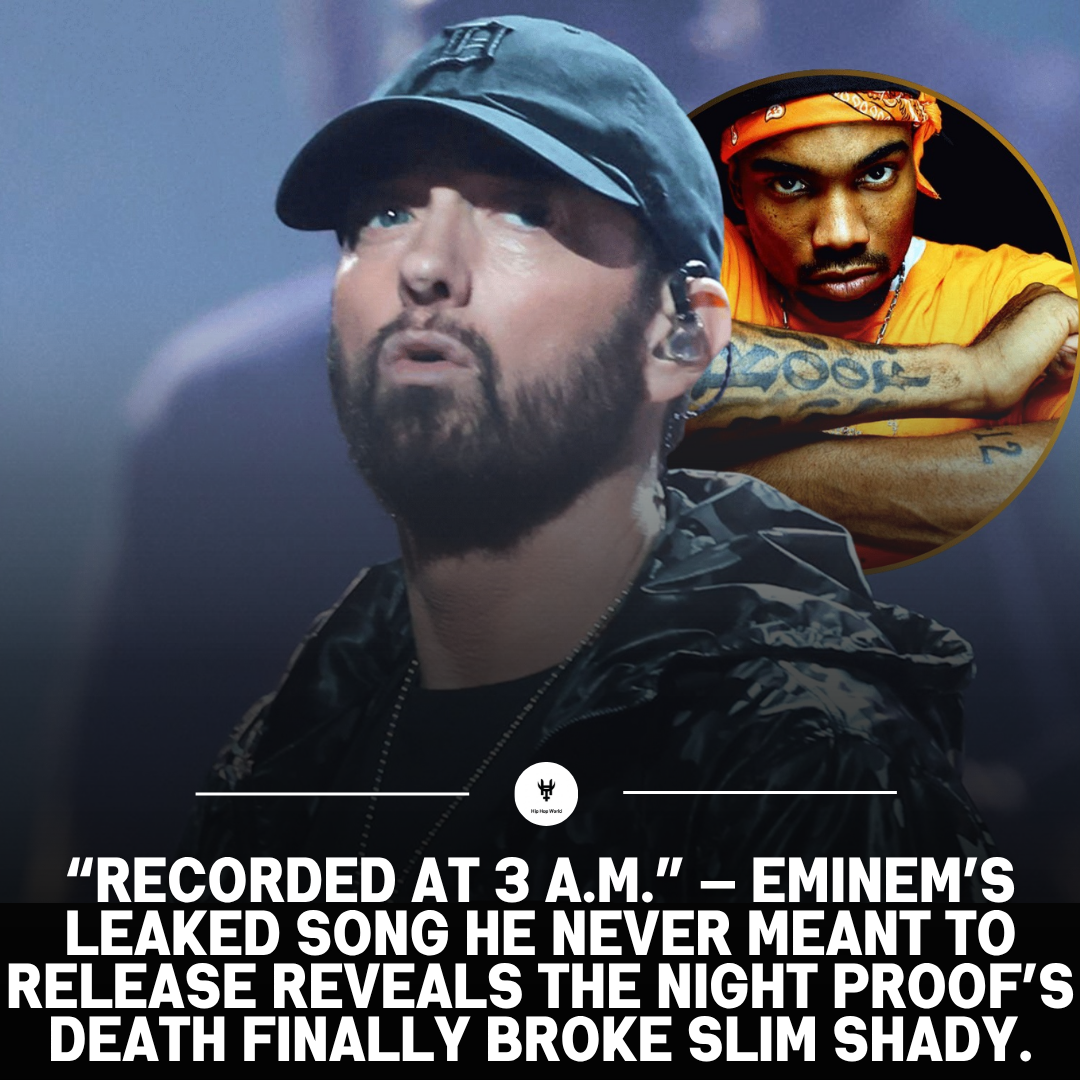
There’s no intro. No build. No performance.
Just a voice—unsteady, exposed—trying to say something it can’t fully carry.
“Difficult” doesn’t sound like a song. It sounds like a moment Eminem wasn’t supposed to survive in public.
The track surfaced years after it was recorded, unfinished and unapproved. No label rollout, no mastering, no intention behind it reaching an audience. And yet, when it leaked, it revealed something that no official release ever had—a version of Eminem without control.
No Slim Shady. No persona. Just Marshall Mathers, alone with grief.
A Private Recording That Escaped
There’s a reason “Difficult” feels different from anything else in his catalog.
It doesn’t follow structure. There’s no hook designed to land. No rhythm engineered to dominate. The delivery drifts—sometimes steady, sometimes breaking. Lines don’t always resolve. The emotion doesn’t wait for permission.
It feels like it was recorded in the middle of something, not after it.
One line anchors the entire track, cutting through everything else with almost uncomfortable clarity:
“I can’t look at that coffin.”
There’s no metaphor hiding inside it. No double meaning to unpack. It’s exactly what it sounds like—a moment frozen in real time, where the weight of loss becomes too direct to process.
The Loss That Changed Everything
To understand why the song exists at all, you have to understand Proof.
Before the fame, before the global success, before the mythology of Eminem was fully formed, Proof was there. He pushed him into Detroit’s battle rap scene, backed him when the room didn’t, and helped build D12 from the ground up.
Even as Eminem’s career exploded, Proof never became distant. He wasn’t part of the machine. He was part of the foundation.
Their connection wasn’t just professional—it was structural. It showed up in real life, and even bled into 8 Mile, where the dynamic between them reflected the same Detroit roots they came from.
So when Proof was killed in April 2006, the impact wasn’t just emotional—it was destabilizing. The one person who had been constant through every version of Eminem was suddenly gone.
And there was no blueprint for what came next.
Before the Recovery, There Was Collapse
After Proof’s death, Eminem disappeared in a way that felt unfamiliar.
Public appearances slowed. Music releases became scarce. Behind the scenes, his struggles with addiction deepened. The pace that once defined his career collapsed into silence.
“Difficult” is widely believed to come from that early period—before anything was processed, before anything was shaped into something presentable.
That’s why it sounds the way it does.
It isn’t constructed. It isn’t refined. It isn’t even finished.
It’s immediate.
And that immediacy is exactly why it was never meant to be released.
Two Songs, Two Different Realities
Years later, Eminem would return to the same loss on Recovery with “You’re Never Over.”
That song feels different in every way.
Where “Difficult” is unstable, “You’re Never Over” is deliberate. Where one sounds like breaking, the other sounds like rebuilding. The grief is still there—but it’s been carried long enough to be shaped into something that can be shared.
The contrast between the two tracks isn’t just artistic.
It’s time.
It’s distance.
It’s survival.
Why “Difficult” Still Stays With People
Eminem has never publicly unpacked “Difficult” in detail. No interviews breaking it down. No official acknowledgment shaping how it should be understood.
And that silence matters.
Some moments don’t belong to an audience. Some recordings aren’t meant to be curated, explained, or even finished.
“Difficult” remains what it was from the start—a fragment of something too raw to complete.
It doesn’t endure because it’s perfect.
It endures because it isn’t.
Because for a brief moment, the persona disappeared, the control slipped, and all that was left was a man standing in front of something he couldn’t face.
“I can’t look at that coffin.”
Not every song is meant to be heard.
Some are only meant to be survived.