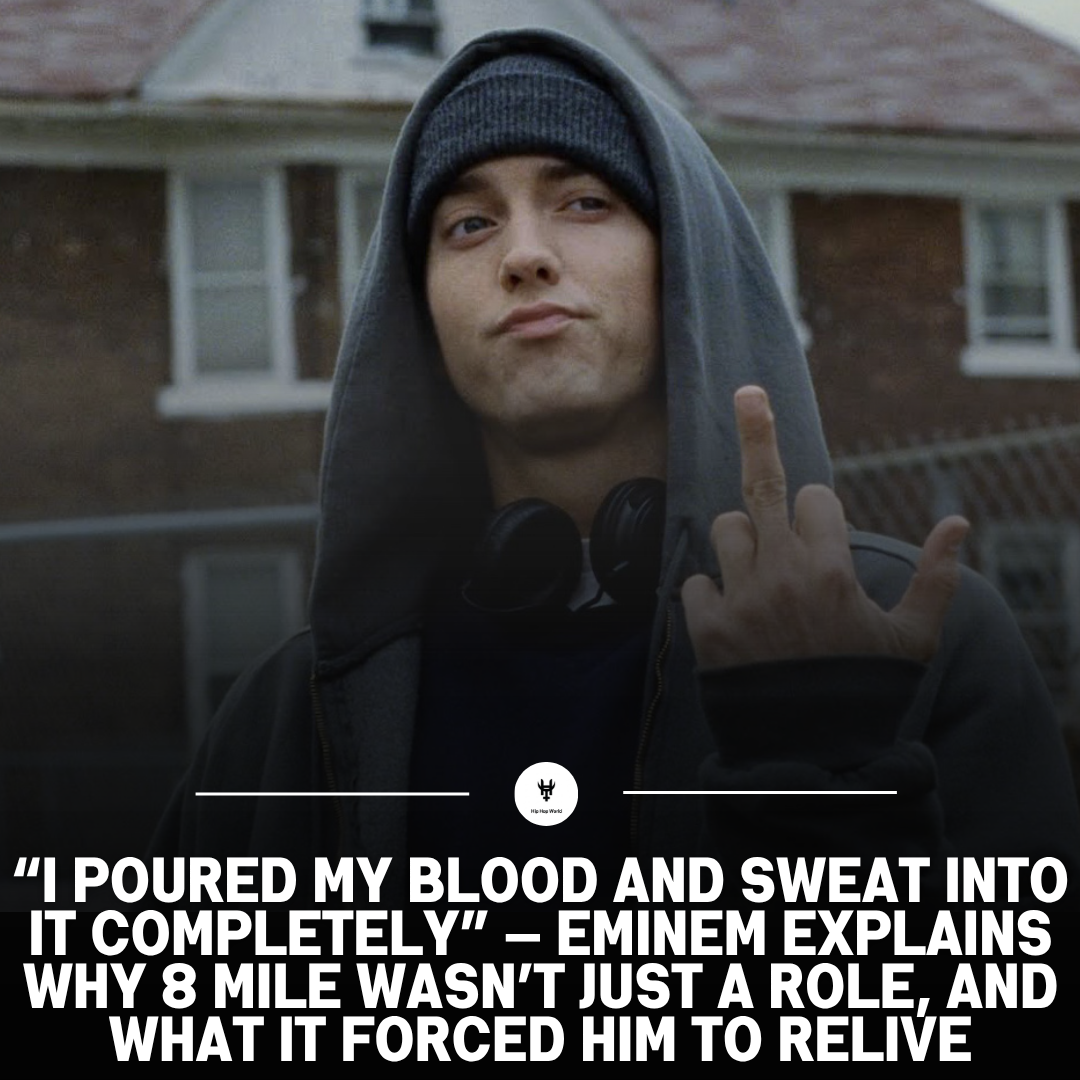
When Eminem stepped onto the set of 8 Mile, it wasn’t just another move in his career—it felt like stepping back into a version of his life he had already fought to leave behind.
By 2002, Marshall Mathers had already become one of the most polarizing and dominant figures in music. His rise was built on raw honesty, controversy, and a voice that didn’t hold anything back. But film demanded something different. It wasn’t about delivering lines in a booth—it was about reliving them, over and over, in front of a camera.
A Story That Wasn’t Just A Story
In 8 Mile, Eminem played Jimmy “B-Rabbit” Smith Jr., an aspiring rapper navigating Detroit’s underground battle scene. But the line between character and reality was thin.
The instability, the pressure, the feeling of being overlooked—those weren’t scripted ideas pulled from imagination. They were reflections of the world he had come from. The environment, the struggle to be heard, the tension of proving yourself in front of a crowd—it all mirrored his own path before fame.
And that made the process heavier than it looked.
Carrying The Weight Of It
Filming wasn’t easy. Long days stretched into 16-hour shoots, and unlike music, there was no distance between the performer and the emotion. Every take required him to tap into something real—moments of rejection, frustration, and doubt that didn’t disappear just because success had arrived.
It wasn’t just acting. It was revisiting.
At the same time, something else was forming behind the scenes.
The Song That Came Out Of It
“Lose Yourself” didn’t come together in a studio session built for comfort. It came in pieces—written between takes, on scraps of paper, inside trailers, in the middle of a demanding schedule.
The pressure of the film shaped the music. The urgency, the focus, the sense that everything was on the line—it all found its way into the song. It wasn’t just about the character anymore. It was about the moment he was living through while creating it.
And that’s why it felt different.
When Everything Connected
When 8 Mile was released, the response went far beyond expectations. The film pulled in audiences outside of hip-hop, earning over $240 million worldwide and shifting how Eminem was viewed in the broader entertainment world.
It wasn’t just about controversy anymore.
It was about discipline. About storytelling. About showing a version of himself that wasn’t built on shock value, but on something more grounded.
“Lose Yourself” followed that same path. Winning the Academy Award for Best Original Song, it marked a moment that went beyond personal success. It pushed hip-hop into spaces that had rarely acknowledged it at that level.
More Than Just A Role
But the impact of 8 Mile wasn’t only measured in numbers or awards.
It was about control.
By stepping into that role, Eminem wasn’t just telling a story—he was reshaping his own. The struggles that once defined him became something he could present on his terms. Something structured. Something understood.
For audiences, B-Rabbit became a symbol. Not just of rap battles or Detroit, but of the idea that breaking out of your circumstances requires more than talent—it requires persistence, focus, and timing.
A Different Kind Of Turning Point
Looking back, 8 Mile doesn’t feel like a side project in Eminem’s career.
It feels like a moment where everything aligned—music, film, and personal history—into something that carried weight beyond entertainment.
Because for him, it wasn’t just about playing a role.
It was about proving that the story behind the music mattered just as much as the music itself.