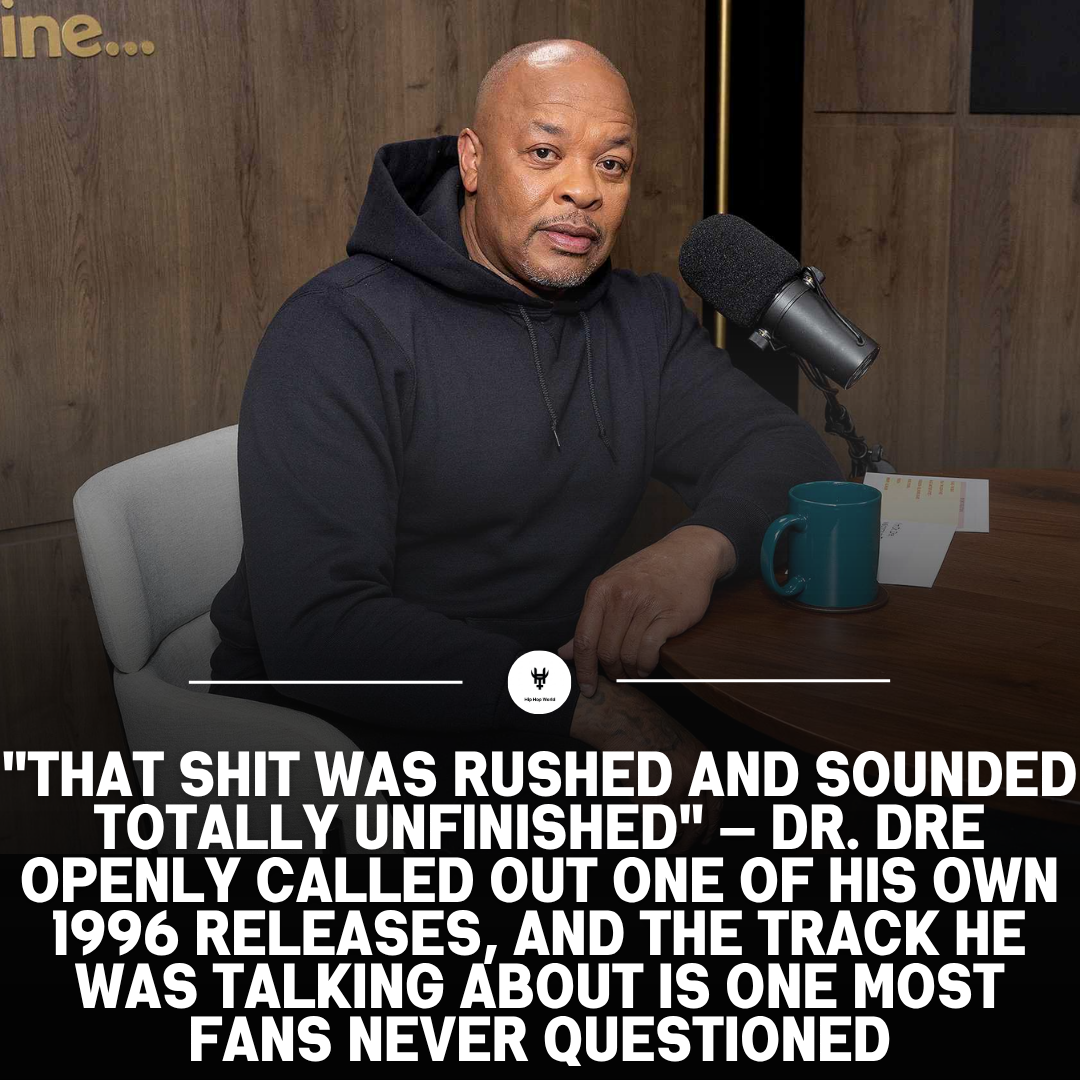
“That shit was rushed and sounded totally unfinished.”
It’s not the kind of statement you expect from Dr. Dre—an artist whose name has become synonymous with precision, patience, and control. For decades, his process has been defined by refinement. Nothing leaves the studio until it feels right. But in the mid-90s, even Dre found himself releasing something that didn’t meet his own standard.
A Career Reset No One Could Ignore
In 1996, Dre walked away from Death Row Records, the label that had shaped both his sound and his dominance in hip-hop. The split wasn’t quiet. It was tense, public, and uncertain. For the first time in years, Dre wasn’t operating from a position of control—he was rebuilding.
That transition led to Dr. Dre Presents the Aftermath, a compilation meant to introduce his next chapter. At its center was the single “Been There, Done That,” a track that, on paper, had everything working for it. It carried his voice, his presence, and enough polish to secure heavy rotation on radio and MTV.
From the outside, it looked like a successful move.
Where It Fell Apart
But internally, Dre saw something completely different.
The track didn’t feel complete. It wasn’t developed with the same obsessive attention that had defined his earlier work. Instead, it was pushed forward during a moment of instability—when direction wasn’t fully clear, and the creative process wasn’t grounded the way it normally was.
Rather than pushing boundaries, it played it safe. Rather than redefining sound, it followed what was already working.
For most artists, that might have been enough. For Dre, it stood out immediately.
The Turning Point
That dissatisfaction didn’t fade—it sharpened.
Instead of continuing in that direction, Dre pulled back. He reassessed not just the music, but the process behind it. The mistake wasn’t just the song—it was allowing something unfinished to represent him.
That realization reset everything.
From that point forward, the standard became even stricter. Nothing rushed. Nothing forced. Nothing released unless it fully matched the vision.
That mindset would eventually shape the next phase of his career—one that didn’t just restore his position, but redefined it.
What It Really Meant
Looking back, “Been There, Done That” isn’t remembered for its chart performance or visibility. It’s remembered as a rare moment where Dre himself drew a line between success and satisfaction.
The numbers didn’t matter. The exposure didn’t matter.
What mattered was the standard.
And in that moment, he knew he had compromised it.
The Legacy of a Misstep
What makes this story lasting isn’t the track—it’s what it triggered.
For an artist like Dr. Dre, a misstep isn’t just a mistake. It’s a correction point. A reminder of what the work is supposed to be, and what it can’t afford to become.
That one release, the one he openly criticized, didn’t weaken his legacy.
It reinforced it.