The wind was already picking up by the time he stepped into position.
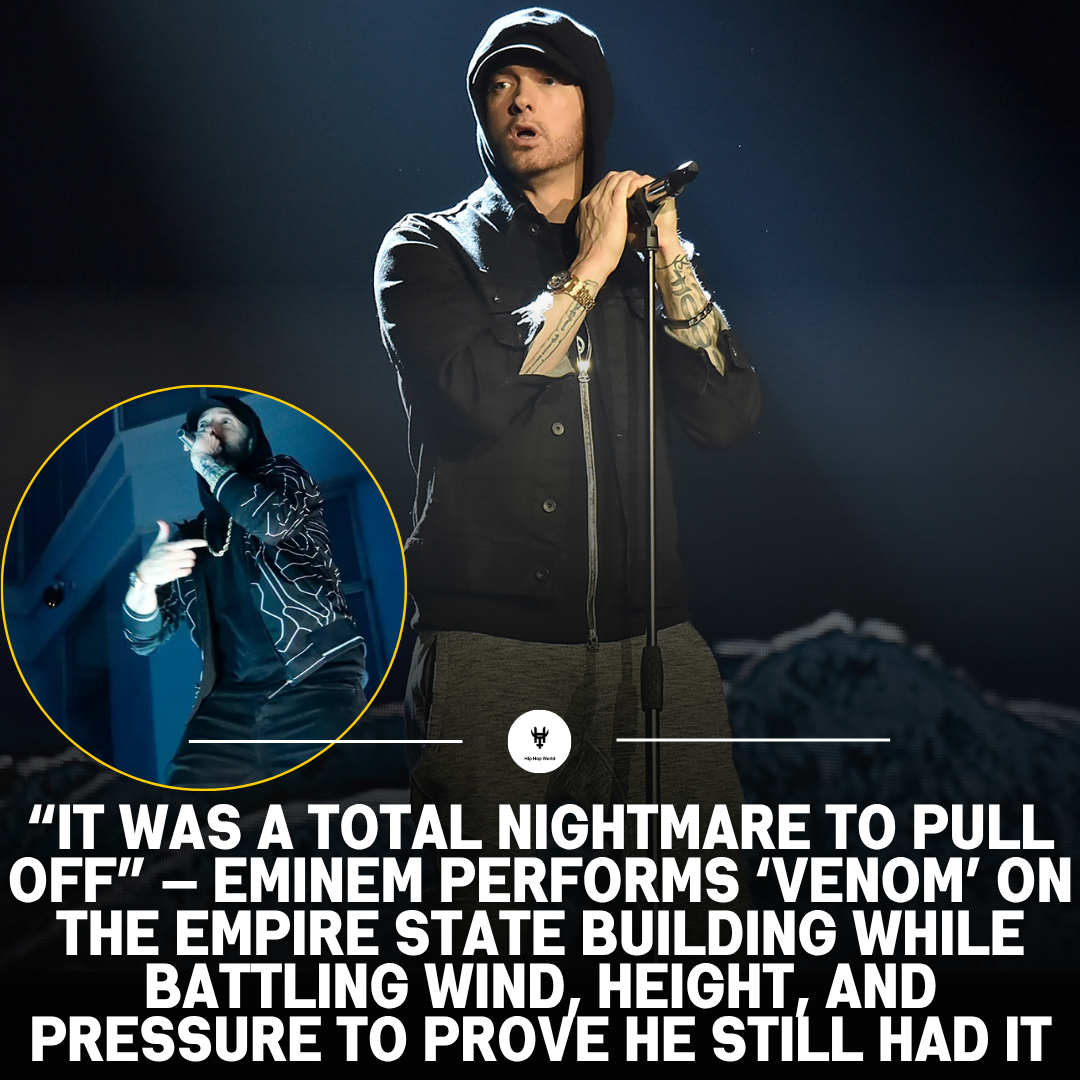
More than a thousand feet above Manhattan, Eminem stood on the 103rd floor of the Empire State Building, looking out over a city that never really goes quiet. The skyline stretched in every direction, lights flickering against the dark, the kind of view most people only ever see from a distance. That night, it wasn’t a backdrop. It was the stage.
When the cameras started rolling for Jimmy Kimmel Live!, it wasn’t just another late-night performance. It was an eight-minute sequence built like a film—tight, controlled, and far more complicated than it looked from the outside.
A Performance Built Under Pressure
The idea alone was ambitious. Performing “Venom” at that height meant dealing with conditions most artists never have to think about. The wind didn’t settle. The space wasn’t forgiving. Every movement had to be deliberate.
Behind the scenes, the setup was anything but simple. Coordinating lighting across the building, syncing cameras in motion, and capturing aerial shots required precision. Helicopters circled the tower, framing the performance from angles that emphasized just how exposed the setting was. Eminem later described the entire process as a “total nightmare.”
But none of that showed once the performance began.
Turning a Landmark Into a Stage
Directed by James Larese, the sequence leaned into scale without losing focus. The building itself became part of the performance. Lights moved in sync with the track, pulsing across the structure as the city below faded into something almost distant.
At the center of it, Eminem stayed locked in. No excess movement. No attempt to play to the spectacle around him. The camera moved. The city moved. He didn’t need to.
That contrast carried the entire performance.
The Moment It Came Together
“Venom” isn’t built for easy delivery. The pace is relentless, the structure unforgiving. Every line depends on control. Performing it live—under conditions that could easily throw off timing—added a different kind of pressure.
There wasn’t a visible adjustment. No hesitation.
He delivered it straight through.
The height, the wind, the scale of the production—none of it broke the rhythm. If anything, it sharpened it. The performance didn’t feel like it was fighting the environment. It felt like it was using it.
After the Lights Faded
By the time it aired, the reaction was immediate. The visuals alone carried weight, but what stayed with people was how controlled it felt. It didn’t collapse under its own scale. It held.
That’s what separated it from a typical televised moment. It didn’t feel like a stunt built around a song. It felt like a performance that could only exist in that exact setting.
A Stage That Matched the Artist
There was an obvious visual statement in placing Eminem above the city. But the moment didn’t rely on symbolism to work. It held because of execution.
He didn’t adjust to the stage.
He made it fit him.
And for a few minutes, high above New York, everything around him moved—lights, cameras, the entire city—while he stayed exactly where he needed to be.