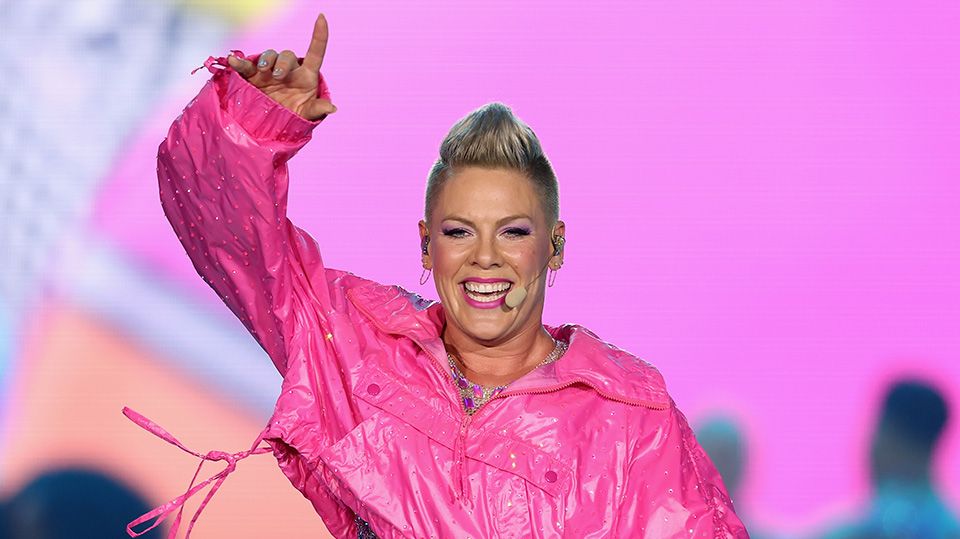
Before the stadium tours, aerial stunts, and global recognition of Pink, there was a version of her the world never saw — a struggling teenager trying to survive emotional chaos in suburban Pennsylvania.
Now, her older brother, Jason Moore, has spoken about one of the darkest chapters of her early life, shedding light on a painful turning point that he says changed everything that came after.
It wasn’t fame that shaped Pink.
It was survival.
A turbulent adolescence long before the spotlight
Growing up in Doylestown, the future superstar — then known as Alecia Moore — was already navigating a fractured home life following her parents’ divorce. According to accounts shared within her family history, that emotional rupture created a deep instability that followed her into her teenage years.
By her early teens, she was spending time in underground club scenes around Philadelphia, drawn into a world that initially felt like escape but quickly became far more dangerous. What began as rebellion and emotional release reportedly spiraled into self-destructive behavior and substance misuse during a period marked by anger, confusion, and isolation.
Friends and family, Jason Moore recalls, could see the trajectory becoming increasingly alarming.
The Thanksgiving night that changed everything
The most defining moment came on Thanksgiving night in 1995.
According to Moore’s recollections, the 15-year-old Pink experienced a severe medical crisis after a combination of drugs during a period of heavy experimentation. The incident became a wake-up call that forced her family to confront just how close things had come to a permanent tragedy.
While later public interviews with Pink herself have referenced being “completely off the rails” during her teenage years, this moment marked a stark realization: continuing down that path was no longer an option.
It was a breaking point — not just physically, but emotionally.
Loss that deepened the wake-up call
The aftermath of that period was compounded by another devastating blow: the death of a close friend, Sekou Harris, due to a heroin overdose.
That loss reportedly stripped away any remaining illusion that the world she had been drifting through was survivable or sustainable. For Pink, it became a painful confirmation of what her family had feared — that the environment around her was not just chaotic, but deadly.
The decision to walk away from self-destruction
Rather than continuing on that path, Pink made a decisive shift.
She stepped away from hard drugs and began channeling her intensity into something more structured — music, writing, and performance. What had once expressed itself as chaos and emotional volatility gradually transformed into creative force.
That shift became the foundation of her identity as an artist.
The same raw energy that once reflected instability was redirected into discipline, songwriting, and eventually the high-impact stage performances that would define her global career.
From survival to superstardom
As Pink evolved into a recording artist in the late 1990s and early 2000s, her reputation stood out in an industry often defined by polished, manufactured personas. Instead, she brought something different — emotional honesty, vocal grit, and a willingness to confront pain rather than conceal it.
Over time, that authenticity became her trademark.
Fans didn’t just hear a powerful voice.
They heard a life that had been lived loudly, survived fiercely, and transformed deliberately.
A turning point that never left her
Jason Moore’s reflections underline a theme that has followed Pink throughout her career: her success was not born from comfort, but from confrontation with some of the most difficult moments of her life.
What happened in 1995 is remembered not as a headline, but as a pivot point — the moment everything could have ended, but instead began to change.
Because for Pink, survival wasn’t the end of the story.
It was the beginning of everything that came after.