At 19, Joe Henley thought he had a pretty clear idea of where life was taking him. Basketball was the dream, music was something he loved, and performing for a crowd was hardly part of his everyday world. Then The Voice entered the picture, and the Alabama teenager found himself facing a future he had never seriously planned for.
What makes Henley’s journey especially compelling is that he isn’t approaching music as someone who has spent years chasing fame. He is still figuring out what he wants, learning how to handle the spotlight, and discovering whether a passion that once belonged mostly at home could become something much bigger.

Before joining Season 30, Henley’s singing experience was limited. He would sing around the house, in his backyard, or in front of a handful of people. One of the few places where he regularly sang for others was a small room at a truck stop connected to his mother’s ministry, which she had been running for more than four decades.
That modest beginning makes the scale of his transformation difficult to ignore. During his Blind Audition, Henley kept his eyes closed because he was nervous about his voice cracking. When he finally looked up and saw the coaches turning their chairs, the experience suddenly felt real.
“I think I had done great with my nerves up until that point, and then I saw them looking at me,” he recalled during an October 16 interview with Talented Universe on the NDB Media Network.

The reaction from the coaches opened a door Henley had not expected to walk through so quickly. Both Kelly Clarkson and Riley Green turned for him, and he ultimately chose Green as his coach. Suddenly, a young man who had largely kept his singing to familiar surroundings was being introduced to a much wider audience.
The attention brought its own adjustment. Social media interest grew, and Henley began experiencing what it meant to have strangers watching his journey and forming opinions about his voice. As he explained in the interview, nothing could fully prepare him for actually living through that kind of sudden exposure.
Yet the biggest change may have come from a conversation away from the stage. Henley asked Green what he would do if he could return to age 19 without having started a music career. Green encouraged him to take the chance and see where music could lead.
For a teenager standing at the crossroads between two possible futures, that advice carried particular weight. Henley did not need someone to promise him success. He needed encouragement to explore an opportunity before deciding it was too late.
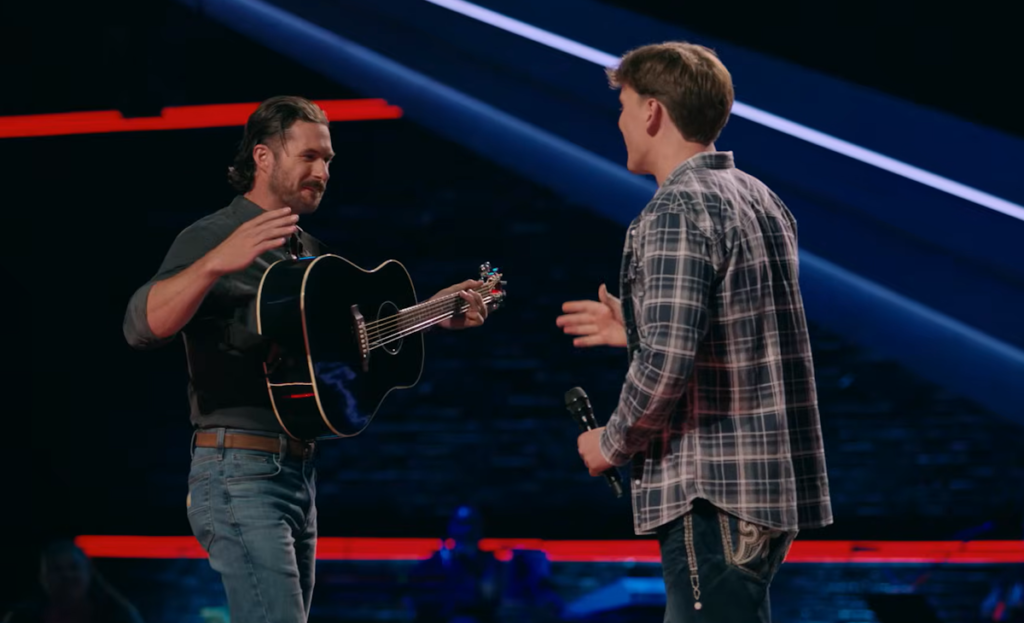
His Battle Round performance showed just how much was at stake. Henley faced fellow Team Riley contestant Kenna Elpers in a duet of Green and Ella Langley’s “Don’t Mind If I Do.” Performing a song associated with his own coach added another layer of pressure, especially when he was sharing the stage with a singer whose abilities he respected.
The two contestants brought contrasting qualities to the performance, with gentle guitar and complementary vocals helping the duet take shape. The coaches noticed different strengths in each singer. Clarkson compared Elpers’ vibrato to Alison Krauss while describing Henley’s voice as reminiscent of Randy Travis.
Clarkson’s praise went beyond a simple compliment about his tone. She emphasized the depth and natural presence of his voice, suggesting that the quality he brought to a song was something that could not easily be taught. Adam Levine and Queen Latifah also recognized the power in Henley’s delivery.
Green, meanwhile, faced the uncomfortable task of choosing one contestant to continue with his team. He made it clear that he valued both singers and had wanted to keep them together. In the end, he selected Henley, giving the young Alabama singer another chance to develop on the show.
But the win did not instantly erase Henley’s self-doubt. Rather than treating the result as proof that he had outperformed Elpers in every respect, he admitted that he struggled with the feeling that he might not have fully deserved the victory. His reaction offered a glimpse of how seriously he takes the competition and how much he respects the people sharing it with him.
That humility could become an important part of his development. A singing competition puts contestants under constant pressure to prove themselves, but it also demands that they learn from criticism, accept difficult decisions, and keep moving after emotionally complicated moments. Henley is discovering those lessons while still learning how to perform comfortably in front of an audience.
His musical influences also offer clues about the kind of artist he hopes to become. Henley named Riley Green, Keith Whitley, Vince Gill, Don Williams, and Travis Tritt among the country singers who have shaped his taste. He is particularly drawn to older country music, whose relatively stripped-back sound gives him room to focus on the story and emotion behind a song.
For Henley, singing is about more than hitting the right notes. He wants listeners to feel what a song is trying to communicate, rather than simply hear its words. That goal helps explain his interest in traditional country storytelling and singers whose performances make emotional connection central to the experience.
He has also been working on the technical side of his voice. To strengthen his lower register, he practices along with Randy Travis’ “Promises.” For a different kind of challenge, he works on demanding vocal runs in “Bridge Over Troubled Water,” including those heard in Tori Kelly’s version.
Those choices reveal a young singer who is still experimenting and learning. Rather than relying entirely on the sound that comes naturally to him, Henley is trying to understand his voice and expand what he can do with it. The combination of traditional country influences and challenging vocal exercises may help him develop a style that feels both personal and versatile.
Even so, the question hanging over his journey is not simply whether he can win The Voice. It is whether the experience will change the direction of his life permanently.
Before the competition, Henley had considered attending college to play basketball and had even entertained the possibility of playing professionally overseas. His plans shifted rapidly after high school graduation, when he flew out to take part in the show just three days later.
Now, with music opportunities beginning to appear, he is considering taking a year away from basketball to see what happens. It is a significant decision, but Henley seems determined not to turn the uncertainty into unnecessary pressure. He knows the show could lead to a career in music, while recognizing that the opportunity might not become a permanent profession.
He has made peace with the possibility of returning to a more conventional working life if that is where things lead. As he explained, going back home and working with heavy machinery or in a blue-collar job would be fine if the music opportunity ended there.
That attitude sets Henley apart from the familiar story of a contestant who arrives determined to become famous at any cost. He appears more interested in giving himself a genuine chance than in pretending he already knows how the story will end. The performances, the lessons from Green, and the friendships formed along the way have value even if they do not immediately produce a full-time career.
For now, Henley has something he did not have before Season 30: a real opportunity to find out what music might become in his life. The teenager who once worried about singing in front of a few people is now competing on national television, learning from established artists, and reconsidering plans that once seemed settled.
Whether basketball eventually brings him back or country music becomes his future, this experience has already challenged his assumptions about what is possible. And with his traditional influences, natural vocal depth, and willingness to learn, Henley has reason to keep exploring the road ahead.
Do you think Joe Henley should take a year away from basketball to pursue country music, or would you encourage him to keep both dreams alive for now?