Imagine swimming through the ocean and suddenly seeing a sea snake, a lionfish or a poisonous flatfish. You might immediately try to escape. But what if none of them were actually there? What if they were all the same animal?
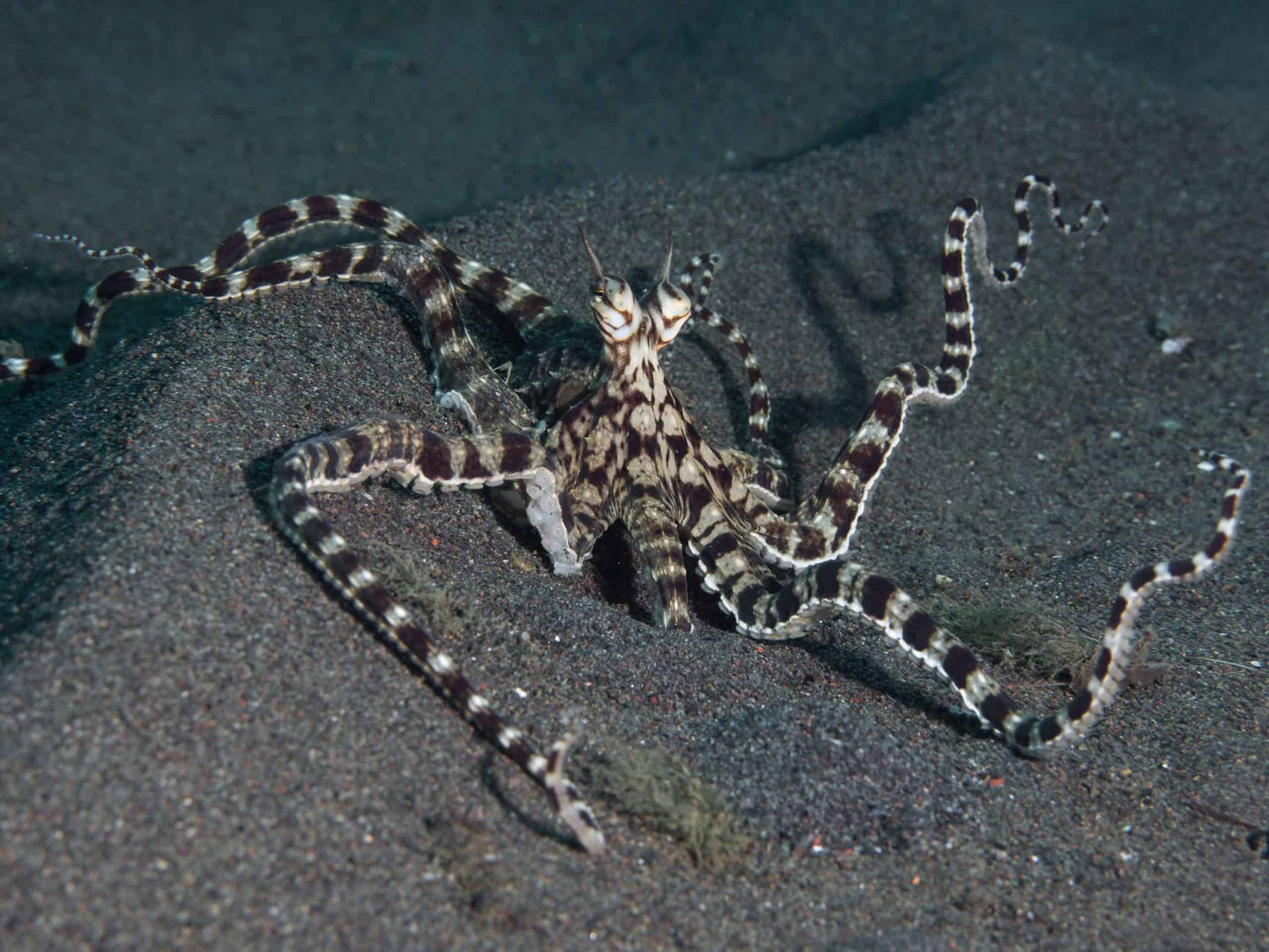
Meet the mimic octopus (Thaumoctopus mimicus), one of the most extraordinary masters of disguise in the marine world. Unlike most animals that rely on camouflage to blend into their surroundings, this remarkable octopus can change its body shape, colour, posture and movements to imitate other marine creatures.
And it doesn’t simply change its appearance. It can also behave like the animals it imitates.
An Octopus Unlike Any Other
The mimic octopus was first scientifically described in 1998. It lives in tropical waters of the Indo-Pacific region, particularly around Indonesia and nearby areas.
Unlike many other octopus species that hide among rocks and coral reefs, the mimic octopus often lives on sandy or muddy ocean floors. These environments offer relatively little natural protection, leaving it exposed to hungry predators.
But evolution has given this animal an extraordinary survival strategy: instead of simply hiding from danger, it can appear to become something else entirely.
Its body is usually light-coloured with brown and white markings, but its appearance can change dramatically depending on what it is trying to imitate.
It Can Pretend to Be Other Dangerous Marine Animals
What makes the mimic octopus particularly fascinating is its ability to imitate several different marine species.
Researchers have documented a number of impressive examples.
1. The Sea Snake
When threatened, the mimic octopus may hide most of its body inside a burrow while extending two arms behind it.
It moves these arms in a way that resembles the swimming motion of a sea snake. Its dark-and-light markings help strengthen the illusion.
For a predator looking for an easy meal, this could make the octopus appear much more dangerous than it really is.
2. The Lionfish
The lionfish is famous for its venomous spines and distinctive striped appearance.
The mimic octopus can spread its arms and position them around its body to resemble the dramatic fins of a lionfish.
This imitation may discourage predators that would otherwise attack a relatively defenceless octopus.
3. The Flatfish
One of its most remarkable transformations involves imitating a flatfish.
The octopus can flatten its body against the seabed and move in a way that resembles a swimming flatfish.
It may also change its colour and posture to make the resemblance more convincing.
This disguise is particularly useful because it allows the octopus to move across exposed sandy areas while appearing to be another animal.
4. Other Marine Creatures
Scientists have also reported mimic octopuses imitating other animals, including jellyfish and other fish-like forms.
However, not every possible imitation has been studied equally well. Its best-documented disguises include the sea snake, lionfish and flatfish.
Why Does It Imitate Other Animals?
The main purpose of mimicry is survival.
Many marine predators use visual signals to identify potential prey and avoid dangerous animals. If a harmless octopus can convince a predator that it is venomous, poisonous or otherwise dangerous, it may escape an attack.
This is an example of defensive mimicry: an animal resembles another organism to reduce its chances of being eaten.
But there is something even more interesting about the mimic octopus.
It doesn’t always use the same disguise.
Scientists believe it can adjust its behaviour depending on the type of threat it faces. For example, an imitation that might discourage one predator may be less effective against another.
This suggests that the octopus is not simply changing its appearance randomly. Its choice of disguise appears to depend on the situation.
How Does It Change Its Appearance?
Octopuses are famous for their ability to change colour and texture, and the mimic octopus is particularly impressive.
Its skin contains specialised cells called chromatophores, which contain pigments and help it produce different colours and patterns.
It can also alter its posture, extend or contract its arms, and change the shape of its body.
These abilities work together to create convincing imitations.
An important distinction is that the mimic octopus does not physically transform into another species. It uses a combination of colour, movement and body positioning to create the illusion.
Its ability to control all these elements is what makes it so remarkable.
Is the Mimic Octopus Intelligent?
Octopuses are widely recognised for their impressive problem-solving abilities, learning and flexible behaviour.
The mimic octopus adds another fascinating dimension to this reputation.
Choosing different forms of mimicry depending on the circumstances suggests a sophisticated behavioural response to environmental threats.
However, scientists are still studying exactly how it selects its imitations and how much of this behaviour is learned versus instinctive.
We should be careful not to assume that its behaviour involves human-like planning. Nevertheless, its ability to respond flexibly to danger is remarkable.
Does It Use Disguise to Hunt?
Although its most famous ability is defensive mimicry, the mimic octopus is also a predator.
It feeds on small marine animals, including fish and crustaceans.
Like other octopuses, it uses its arms and suckers to capture prey. Its flexible body and ability to move across the seabed help it explore places where potential food may be hiding.
However, its famous transformations are primarily associated with avoiding predators rather than pretending to be other animals to hunt.
5 Fascinating Facts About the Mimic Octopus
- It can imitate multiple species: Its documented disguises include sea snakes, lionfish and flatfish.
- It was scientifically described relatively recently: The species was formally described in 1998.
- It lives in exposed environments: Unlike many octopuses that favour reefs and rocky habitats, it is often found over sandy and muddy seabeds.
- It uses its arms as part of its disguise: The way it positions and moves its arms is essential to creating convincing imitations.
- Its camouflage involves more than colour: Body shape, movement, posture and patterns all contribute to its remarkable disguises.
The Ocean’s Ultimate Master of Disguise
The mimic octopus is a perfect example of how extraordinary evolution can be.
It doesn’t have the venom of a sea snake, the poisonous spines of a lionfish or the appearance of a flatfish. Instead, it has developed the ability to imitate these animals when threatened.
In an ocean filled with predators, being able to convince another animal that you are something dangerous can be a powerful survival advantage.
Perhaps the most fascinating thing about the mimic octopus is that you could be looking directly at one without even realising what you are seeing.
Would you recognise a mimic octopus if it were pretending to be a completely different animal?