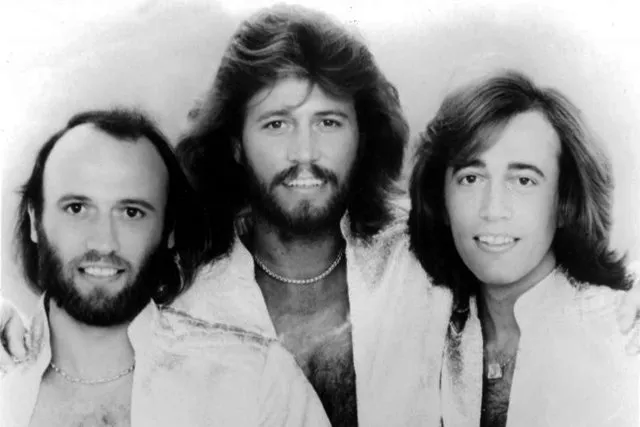
In 1973, Barry Gibb reportedly turned to his brothers and said something that would define a turning point in Bee Gees history:
“This is the low point. We will never be reduced to playing supper clubs again.”
The venue was the Batley Variety Club in England. The brothers Gibb — Barry, Robin, and Maurice — had gone from international superstardom to fading into the shadows of the music industry. But what came from that dark period was something unexpectedly profound: a song so tender and haunting it’s now considered one of the most overlooked masterpieces in their entire catalogue — King And Country.
A Forgotten Era of Genius
The early 1970s were a transitional time for the Bee Gees. After dominating charts in the late ’60s with hits like Massachusetts and To Love Somebody, and before reinventing themselves with the disco explosion of Jive Talkin’ and Stayin’ Alive, they entered what even they considered a commercial “nadir.”
Yet despite lower visibility in the U.S. and U.K., the band continued to tour extensively across Australia, Asia, and Europe. Hidden in this period were no fewer than six studio albums, an entire unreleased album (A Kick In The Head Is Worth Eight In The Pants), and several solo projects. These weren’t throwaway efforts — they were bursting with experimentation, vulnerability, and maturity.
Among these was King And Country, the B-side to Wouldn’t I Be Someone, which went to No. 1 in Southeast Asia.
“To Be Never Like People… Afraid of the Night”
King And Country is a softly strummed acoustic ballad. It begins gently and grows with quiet intensity, eventually fading out with a mournful orchestral swell. The lyrics tell the story of soldiers headed off to war — young, frightened, and unsure of the sacrifice they’re about to make.

“To be always like children / afraid of the night”
becomes
“To be never like people / afraid of the night.”
That shift alone — a subtle, poetic play on courage and innocence — captures the heartbreak of war in just two lines.
The track’s anti-war message, released during the tail end of the Vietnam War and amid Cold War anxieties, never made headlines. It was tucked away, overshadowed by more commercial efforts. But for listeners who discover it today, it lands with an emotional punch — especially on days of remembrance like Anzac Day in Australia and New Zealand.
Rediscovered Reverence
Though long forgotten by casual fans, King And Country has begun to resurface among Bee Gees devotees and historians, especially in the age of streaming and rediscovery. The song’s lyrics have been cited in Anzac Day tributes, and its quiet plea for peace has struck a chord in a world that still wrestles with the cost of conflict.
When reminded in 2009 that the Bee Gees had number-one hits in Southeast Asia during that period, Barry Gibb was shocked:
“I’d never heard that,” he admitted. It was a testament to how underappreciated their “lost years” had become — even by the band themselves.
A Message That Lingers
King And Country isn’t just an anti-war song. It’s a document of a band in survival mode — creatively brave, commercially drifting, emotionally honest. While they would go on to become the biggest band on the planet once again by the mid-’70s, this forgotten gem from their lowest point is now seen as one of their most heartfelt.
So this Anzac Day, or any day you reflect on sacrifice and the human cost of war, take a moment to listen to King And Country. It might be the Bee Gees’ most powerful message — and it came not from the spotlight, but from the shadows.