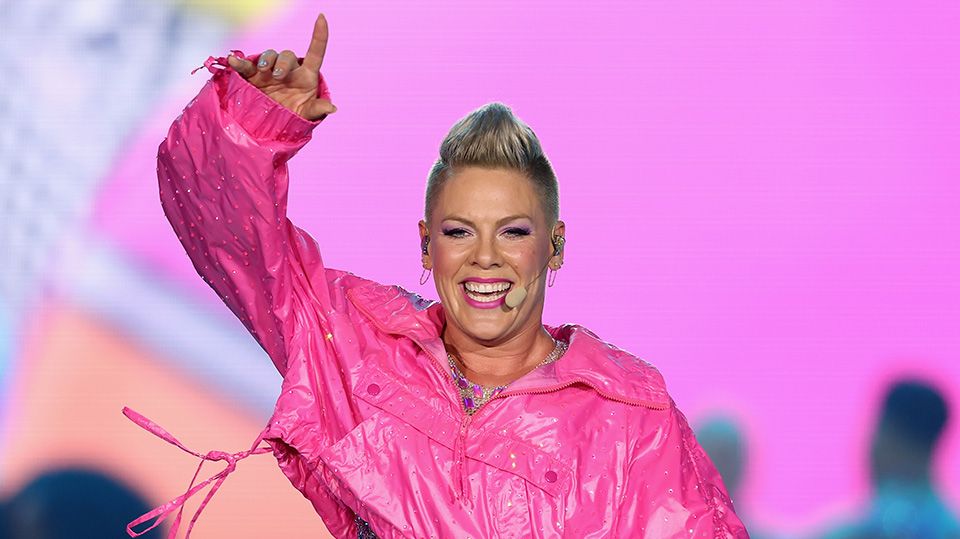
When P!nk steps onto the stage during her Summer Carnival tour, audiences expect spectacle—acrobatics, powerhouse vocals, and emotional highs. But one of the most memorable moments arrives in a quieter form: a duet with her daughter, Willow Sage Hart.
Their performance of Cover Me in Sunshine feels effortless, almost magical. A mother and daughter sharing a spotlight, smiling through harmonies, creating a moment that feels both intimate and enormous at the same time.
What fans don’t see is what happened after the applause.
Willow asked for a raise.
When a Performance Becomes a “Job”
For most kids, stepping onto a stadium stage would feel like a once-in-a-lifetime thrill. For Willow, it quickly became something else: work.
After multiple performances, she reportedly approached her mom with a question that cut straight to the point—what am I getting paid?
Not in a bratty or entitled way. In a practical one.
She had learned about minimum wage and came to a simple conclusion: if she was doing a job, she should be compensated fairly. The logic is almost disarming in its clarity. No celebrity framing, no “special treatment”—just a straightforward application of what she understood about the real world.
And that’s what makes the moment so compelling.
A Child’s Logic vs. an Industry’s Norms
The entertainment industry is filled with blurred lines—especially for family members of celebrities. Appearances can be labeled as “fun,” “special,” or “just for the experience,” even when they require real effort and responsibility.
Willow unintentionally challenged that idea.
By asking about pay, she reframed her role. She wasn’t just a daughter joining her mom for a sweet moment. She was a performer contributing to a live production—one that involves rehearsals, timing, coordination, and pressure.
In other words, she saw herself as part of the system.
That shift—from participant to professional—is subtle, but powerful.
Turning a Funny Moment Into a Real Lesson
Instead of laughing it off or dismissing the question, P!nk reportedly leaned into it. She used the moment to explain how touring actually works: how crews are paid, how roles are defined, and why every person onstage and backstage contributes to the final result.
It’s an approach that reveals something deeper about her parenting style.
Rather than shielding her child from the realities of work, she’s introducing them early—framing performance not just as expression, but as responsibility.
The takeaway isn’t just “you get paid for work.” It’s “if you take the stage, you’re accountable to it.”
Confidence Without Entitlement
There’s a fine line between knowing your worth and assuming privilege. What makes Willow’s request stand out is that it falls firmly on the right side of that line.
She didn’t demand luxury. She didn’t compare herself to headliners. She anchored her request to something universal: fairness.
Minimum wage isn’t glamorous—it’s baseline.
And that’s exactly why the story resonates. It shows a child applying a grounded principle in a context where excess is the norm.
From the audience’s perspective, “Cover Me in Sunshine” is pure emotion. It’s warmth, connection, and authenticity wrapped into a few minutes of music.
But behind that softness is structure.
Willow isn’t just walking onstage and improvising. She’s rehearsing, hitting cues, staying in sync with the band, and delivering a performance that thousands of people are watching in real time.
That requires discipline.
By treating her daughter like a contributor rather than a guest, P!nk is reinforcing an important idea: meaningful moments don’t just happen—they’re built.
Why This Story Hits Beyond Celebrity Culture
At first glance, it’s a funny anecdote—a kid asking her famous mom for a raise. But it taps into something broader.
It reflects how children interpret the world when given real information. They don’t complicate things. They apply what they’ve learned directly and honestly.
And sometimes, that clarity exposes inconsistencies adults overlook.
Why wouldn’t someone get paid for doing work?
Why should being related to someone change that?
These are simple questions—but they carry weight.
Raising a Performer vs. Raising a Person
There’s always curiosity around what it’s like to grow up around fame. Will children of celebrities feel entitled? Will they take opportunities for granted?
Moments like this suggest a different outcome.
By emphasizing effort, fairness, and accountability, P!nk appears to be separating access from achievement. Yes, Willow has access to extraordinary opportunities—but she’s also learning that those opportunities come with expectations.
That distinction matters.
It shapes not just how someone performs—but how they think.
The Bigger Takeaway: Know Your Worth, Then Do the Work
Willow’s “tour raise” conversation is funny because of who she is and where it happened. But the underlying message is surprisingly universal.
Know your value. Ask questions. Understand the system you’re part of.
And once you step into a role—show up fully.
For fans watching from the crowd, the duet may look like a moment of pure joy. And it is. But it’s also something more grounded: a child learning, in real time, how the world works—and having the confidence to speak up about her place in it.
If that instinct sticks, the stage might just be the beginning.