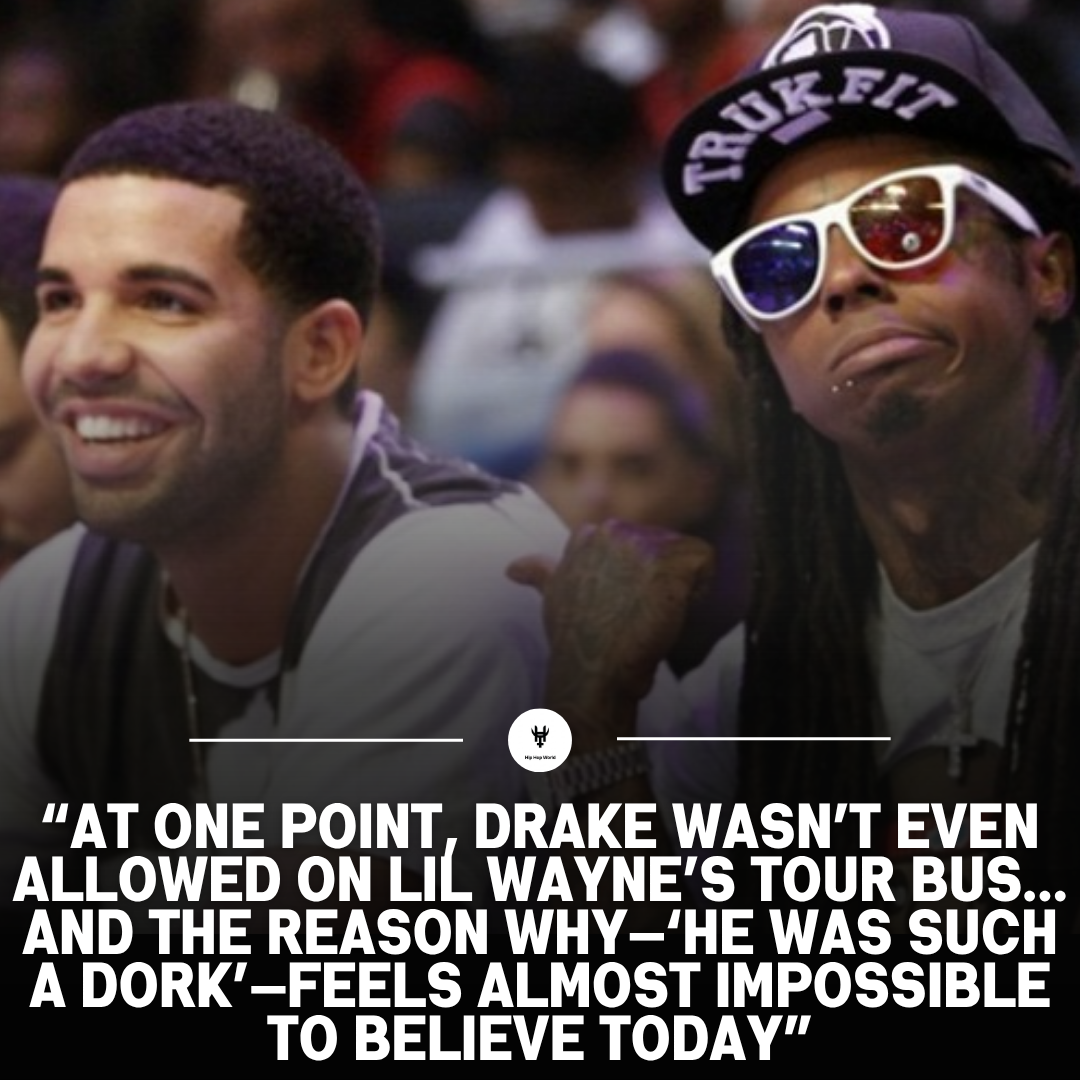
The tour bus wasn’t just a place—it was a boundary.
Inside, the core of Young Money moved together, a tight circle built around Lil Wayne at the peak of his Carter III era. It was a world defined by proximity—who was close, who belonged, and who didn’t.
Outside of it, things looked different.
There were artists still finding their footing, still navigating the space between opportunity and acceptance. Among them was a young Drake, not yet the global figure he would become, but already present—watching, learning, waiting.
And at times, not even allowed in.
A Presence That Didn’t Quite Fit
The story comes from filmmaker Adam Bhala Lough, the director behind The Carter documentary, who spent extended time inside Wayne’s world during one of the most influential moments in modern hip-hop.
When Wayne wasn’t in front of the camera, Lough found himself surrounded by the people shaping that environment—Tez Bryant, Mack Maine, and an early Nicki Minaj, still largely unknown, moving through the same spaces before her own rise began.
It was a setting built on intensity and familiarity. A space where energy mattered, where presence was understood without explanation.
And in that environment, Drake stood out—but not in the way people might expect today.
Lough described him as someone who didn’t fully connect with that world early on. Someone who felt different in a space that didn’t always make room for difference.
“He was, like, such a dork that they wouldn’t even let him on the bus.”
The words are blunt, almost jarring when placed against the image of who Drake would later become. But they reflect a real moment in time—before success rewrote perception.
The Line Between Being There and Belonging
It wasn’t just about personality. The environment itself played a role.
Lough recalled that Drake “wouldn’t hang out with any of [them] because there were real Blood gang members around all the time.” The presence of that reality created a space that could feel intimidating, even to those observing from the outside.
“I’m sure he was intimidated by them, too,” Lough admitted. “I was, even though they were super cool to me.”
There was a seriousness to the atmosphere that didn’t always align with Drake’s energy at the time. Not a weakness, but a difference. A contrast that placed him slightly outside the core dynamic.
In a group defined by shared experience, that difference mattered.
And sometimes, it meant distance.
When Time Rewrites Everything
What makes the story resonate now is not the exclusion—it’s what followed.
Because the same artist who once stood outside that circle would go on to redefine it.
As Drake’s career accelerated—moving from recognition to dominance—the perception around him shifted just as quickly. The disconnect that once defined his early presence began to disappear. Success has a way of doing that. It changes how people see you, how they respond to you, and where you stand within any space.
“When he started selling millions and millions of records, it was a different story entirely.”
The transition wasn’t gradual. It was decisive.
The outsider became essential.
The distance closed.
A Different Story Behind the Camera
While those dynamics were unfolding in front of the lens, another unexpected narrative was developing behind it.
Lough revealed that The Carter documentary, which would later become a defining visual record of Wayne’s era, nearly had a very different origin. Early discussions involved financing tied to figures far removed from the music world—names like Harvey Weinstein and Steve Bannon.
“You’re not going to believe this,” Lough said, reflecting on the moment. “But it was a company owned by Harvey Weinstein and Steve Bannon.”
It was an unlikely intersection—hip-hop, Hollywood, and politics converging around a project that ultimately found its own path when those plans fell apart during production.
Another reminder of how unpredictable that period was, both creatively and structurally.
Footage That Refuses to Stay in the Past
Years later, that same unpredictability resurfaced.
A sequel to The Carter, built from years of archival footage, appeared online after being leaked—offering an unfiltered look into the era that had only been partially captured before. The material showed Wayne in the studio, working through unreleased music, surrounded by artists who were still on their own paths, including early appearances from 2 Chainz and Curren$y.
Moments that were never designed for public release suddenly became visible.
Lough has since expressed interest in completing the project properly, considering both traditional distribution and direct release options. The footage remains unfinished—but undeniably significant.
A time capsule that refuses to disappear.
What the Story Means Now
Looking back, the image of Drake being kept off a tour bus feels almost impossible to reconcile with his present-day position. One of the most influential artists of his generation, once navigating a space where he wasn’t fully accepted.
But that contrast is exactly what gives the story its weight.
Because hip-hop has always been about movement—about the shift from outsider to centerpiece, from overlooked to undeniable. The spaces that initially resist you often become the ones that later reflect your success.
And in that sense, the tour bus becomes more than a detail.
It becomes a symbol of timing.
Of the moment before everything changes.
Because sometimes, the story isn’t about where you start.
It’s about how completely that starting point disappears once the world finally catches up.