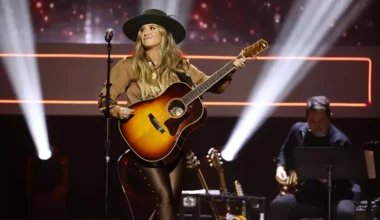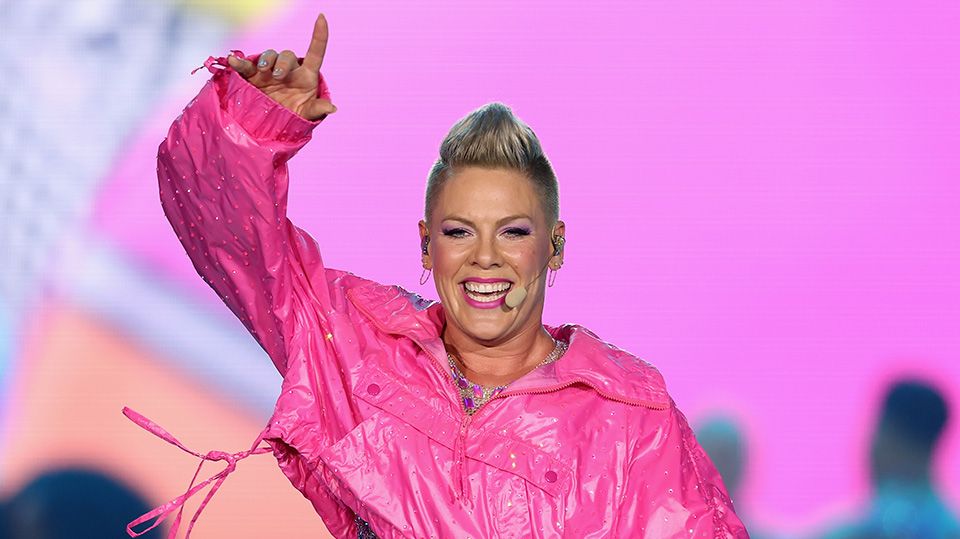
For most performers, stepping onto a stage as large as the Democratic National Convention means managing noise, pressure, and expectation all at once. For Willow Sage Hart, it meant something more personal: learning how to stay grounded in a moment that could easily feel overwhelming.
And in the middle of it all, one word from her mother—Pink—changed everything.
“Breathe.”
When the Biggest Stage Feels Smallest
From the outside, the performance had all the hallmarks of a major live moment. A packed arena. National attention. A song—“What About Us”—already loaded with emotional and cultural weight.
But Willow’s experience wasn’t defined by scale. It was defined by sensation.
The lights were brighter than expected. The crowd louder. The energy heavier. For a young performer, even one raised around music, that kind of environment can distort focus—turning a performance into something you’re trying to survive rather than inhabit.
That’s the part audiences rarely see.
A Whisper That Cut Through the Noise
Just before the performance began, Pink reached for her daughter’s hand and leaned in—not with a technical cue or last-minute correction, but with something far simpler.
“Breathe.”
It wasn’t instruction. It was grounding.
In high-pressure moments, breathing is often the first thing to go. Shoulders tighten, timing rushes, and the body forgets how to settle. By bringing Willow back to something instinctive, Pink wasn’t just calming nerves—she was restoring control.
And just like that, the stage shifted.
Turning Spectacle Into Intimacy
What followed didn’t feel like a conventional arena performance. As mother and daughter moved through the acoustic arrangement, something subtle but powerful happened: the scale of the room stopped mattering.
Willow later described the moment as feeling almost private—like a quiet exchange unfolding in front of thousands.
Even the audience became part of that transformation. Phone lights rose across the arena, softening the space into something closer to a shared atmosphere than a high-stakes event. Instead of pressure, there was presence.
The Humanity Behind the Performance
One of the most revealing details from Willow’s reflection wasn’t about the crowd or the setting—it was about fear.
She worried about missing notes. About getting it wrong.
It’s a small detail, but an important one. It reminds us that even in highly visible, professionally executed performances, the internal experience can be fragile.
Pink’s response to that fragility wasn’t to push harder or demand perfection. It was to steady.
That choice speaks volumes about her as a performer—and as a parent.
More Than a Duet
On paper, the performance checked all the expected boxes:
-
A globally recognized artist
-
A meaningful song
-
A high-profile stage
But what made it resonate had nothing to do with production value.
It was the relationship.
The trust between them allowed the performance to unfold naturally. There was no sense of one leading and the other following. Instead, there was mutual awareness—listening, adjusting, supporting.
That’s not something you can choreograph.
Why This Moment Stuck With People
Audiences didn’t just respond to the vocals—they responded to the authenticity.
In a world where performances are often optimized for perfection, this one felt different. It carried a sense of vulnerability that couldn’t be manufactured.
And that vulnerability came down to a single, almost invisible moment:
-
A hand reached out
-
A voice lowered
-
A word spoken
“Breathe.”
The Note That Matters Most
In music, the most powerful moments aren’t always the loudest or the highest. Sometimes, they’re the ones that never make it into the melody at all.
For Willow Sage Hart, that whispered word became the foundation of everything that followed. It turned a potentially overwhelming experience into something steady, present, and real.
And in doing so, it revealed something deeper than performance:
Even on the biggest stages, the moments that matter most are often the quietest ones.