The store was quiet in the way luxury boutiques often are. Bright glass cases reflected soft white lights, and behind them sat rows of watches worth more than most people’s cars.
Standing there was a young rapper from Detroit who had just released one of the biggest albums in hip-hop history.
But in that moment, Eminem didn’t feel like a global superstar. He still felt like Marshall Mathers — the kid who had spent years scraping by, battling in underground clubs, and wondering if rap would ever actually pay the bills.
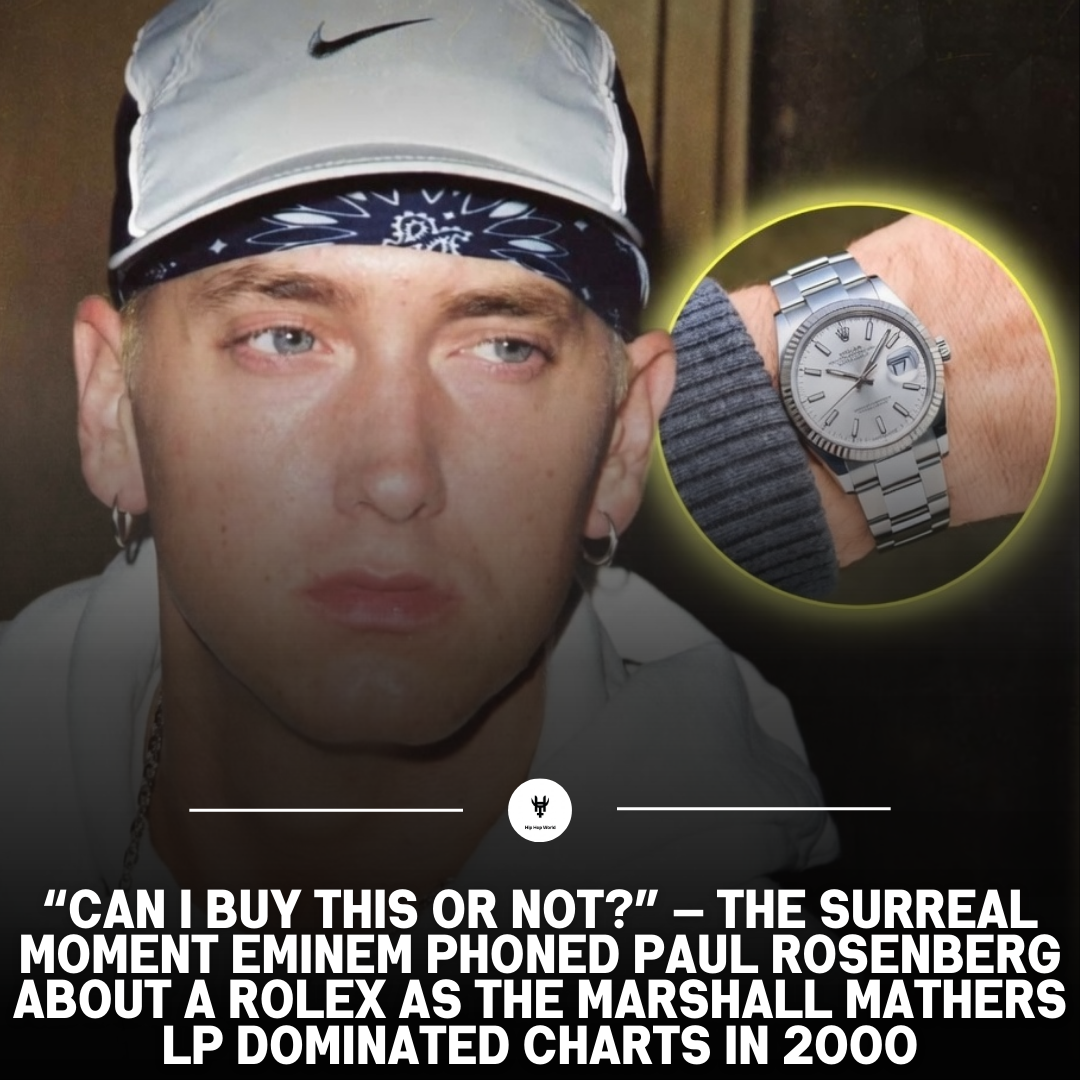
Inside the display case was a Rolex.
And he genuinely didn’t know if he could afford it.
A Mind Still Living in the Past
By the time this moment happened, Eminem’s career had already exploded. His third studio album, The Marshall Mathers LP, had shattered records almost immediately after its release.
The album debuted at number one and quickly became one of the fastest-selling hip-hop albums ever. Songs like “Stan,” “The Real Slim Shady,” and “The Way I Am” were dominating radio and television. Eminem had become the most talked-about rapper in the world almost overnight.
But success moves faster than the mind can adjust.
For most of the 1990s, Eminem had lived a very different life. Money was scarce. Stability was uncertain. He bounced between small apartments in Detroit and struggled to support his young daughter while trying to break into a rap industry that had little room for an unknown white rapper from the Midwest.
Even after the success of The Slim Shady LP, the idea of wealth still felt unreal to him.
So when he stood inside that watch store, staring at a Rolex, his first instinct wasn’t excitement.
It was hesitation.
A Phone Call That Revealed Everything
Instead of assuming he could buy the watch, Eminem did something that perfectly captured where his mindset still was.
He picked up the phone and called his longtime manager, Paul Rosenberg.
Eminem asked him a simple question.
Can I afford this?
The question wasn’t rhetorical. It wasn’t a joke. He genuinely wanted to know whether spending that kind of money made sense.
For Rosenberg, the moment must have been surreal. The artist he represented was currently dominating global charts, selling millions of records, and reshaping the sound and cultural conversation of hip-hop.
Yet he still thought like someone who had barely made it.
Rosenberg reassured him.
Yes, you can afford it.
The answer was simple, but for Eminem it carried a strange emotional weight. It was one of the first times the reality of his success truly sank in.
Not through awards or headlines.
But through a watch in a glass display case.
The Speed of Eminem’s Rise
To understand why that moment mattered, it helps to understand how violently fast Eminem’s career accelerated.
In 1997, he was still performing in small Detroit venues and sending demo tapes across the country hoping someone in the industry might listen. His breakthrough came when legendary producer Dr. Dre heard his music and decided to take a chance on him.
That decision changed everything.
Under Dre’s guidance, Eminem signed to Aftermath Entertainment and released The Slim Shady LP in 1999. The album introduced the world to Slim Shady — a chaotic, brutally honest persona that turned personal trauma, dark humor, and lyrical precision into something entirely new.
But it was The Marshall Mathers LP the following year that turned Eminem into a phenomenon.
The album was controversial, provocative, and impossible to ignore. Critics debated its lyrics. Politicians condemned it. Fans devoured it.
And through it all, Eminem kept writing.
What he didn’t do was slow down long enough to process the scale of what had just happened to his life.
A Reminder of Where He Came From
The Rolex moment became one of those small but revealing stories that show the difference between fame and identity.
The world might have seen Eminem as the most famous rapper alive, but internally he was still the same person who had struggled for years to survive.
That disconnect is something many artists experience when success arrives suddenly. Financial reality changes overnight, but personal habits and instincts take much longer to adjust.
For Eminem, the hesitation about buying a watch reflected something deeper than simple frugality.
It reflected memory.
The memory of eviction notices.
The memory of unstable jobs.
The memory of wondering whether rap would ever be more than a dream.
Those memories don’t disappear just because an album goes platinum.
The Cultural Weight of That Era
The early 2000s represented a turning point not only for Eminem but for hip-hop as a whole.
Rap was expanding globally, becoming the dominant cultural language of youth music. Eminem stood at the center of that shift — controversial, brilliant, and impossible to categorize.
He was praised for his technical skill, criticized for his provocative lyrics, and constantly scrutinized by media outlets that struggled to understand how someone so polarizing could also be so successful.
But fans connected with something deeper in his music.
Honesty.
Whether describing family conflict, addiction, insecurity, or anger, Eminem rarely filtered his experiences. His songs felt raw and unpolished in a way that resonated with millions of listeners who recognized pieces of their own lives inside his lyrics.
That authenticity became the foundation of his legacy.
And moments like the Rolex story quietly revealed the same authenticity offstage.
A Small Symbol of a Massive Transformation
The watch itself was never the point.
What mattered was the realization that came with it.
For years, Marshall Mathers had been chasing the possibility of success without knowing whether it would ever arrive. Suddenly it had — faster and bigger than anyone expected.
Standing inside that store, phone pressed to his ear, asking if he could afford a Rolex, he was confronting the strange reality that the struggle he had known for so long had already changed.
But even as the world began to see Eminem as a superstar, part of him remained grounded in the life he came from.
And in many ways, that tension between global fame and personal memory became one of the defining forces behind his music.
The Rolex was simply the moment when the kid from Detroit realized the world had finally caught up with the dream he had been chasing for years.