Some moments in music feel predestined, as though two voices were always meant to find each other, even if they come from different corners of the world. That is exactly what happened when Chris Stapleton and Dua Lipa shared the stage to perform “Think I’m In Love With You.” On paper, the collaboration seemed unexpected—Stapleton, the rugged troubadour of country soul, and Dua Lipa, the queen of sleek pop anthems. But in the glow of stage lights, their voices met in a way that transcended genre and expectation, creating a performance that audiences will not soon forget.

Stapleton began with the kind of raw vulnerability that has become his hallmark. His voice, gritty yet tender, rolled through the first lines with the weight of lived experience. Each syllable carried a gravelly honesty, as if carved from the Tennessee hills themselves. Then came Dua, her tone smooth, polished, and effortlessly modern, slipping into the song like velvet against stone. The contrast was striking, yet instead of pulling in opposite directions, their voices reached toward one another, entwining in harmonies that felt both fragile and unbreakable.
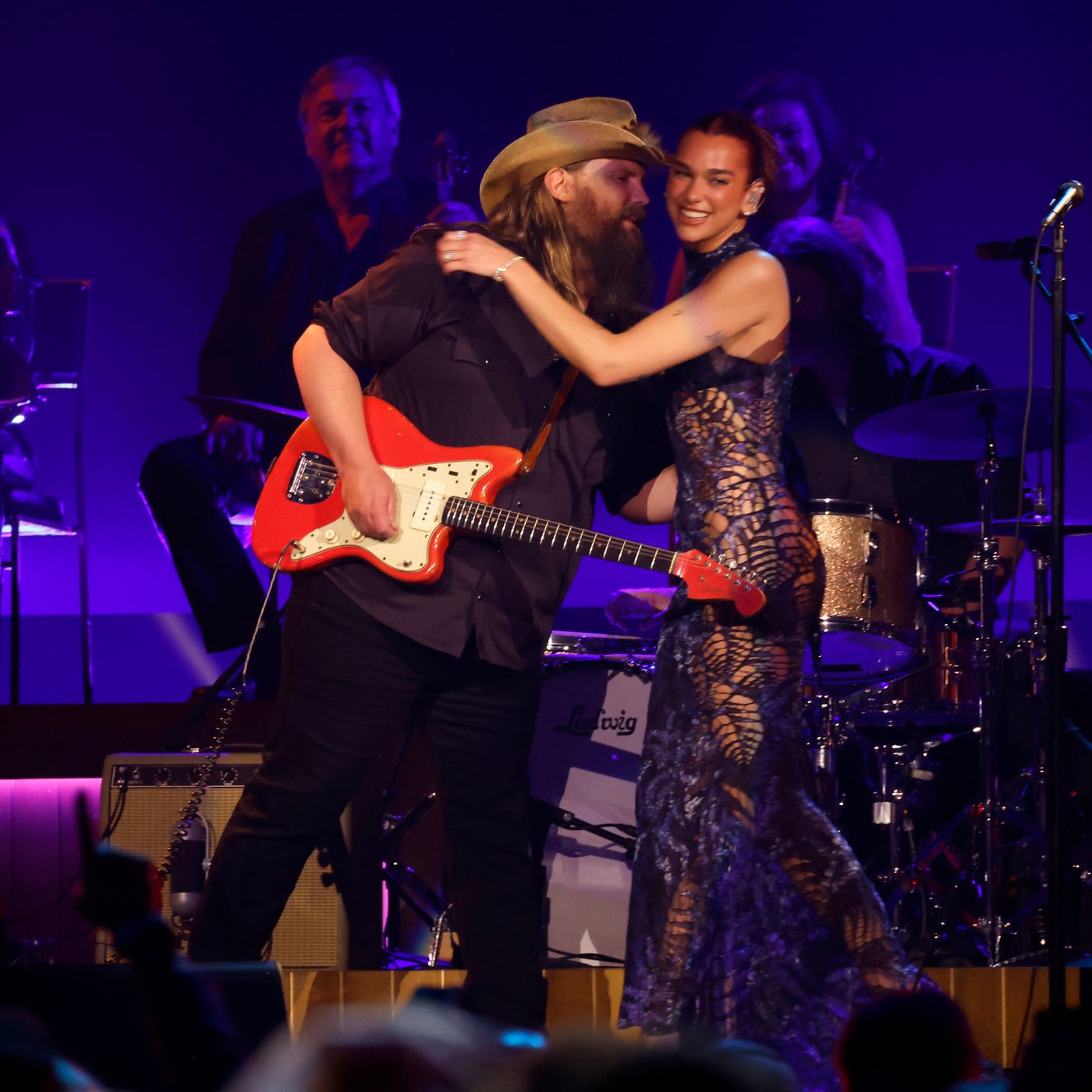
The stage became a dialogue, not a duet. It was as though two people from different worlds were sitting across from each other, confessing something they could not say alone. Stapleton brought the ache, the ache of a love that costs something; Dua brought the allure, the sweetness of surrender. Together, they turned the song into a conversation between grit and grace, pain and hope, reality and dream.

The audience, sensing the rarity of the moment, leaned into the silence between notes. Eyes welled with tears, couples clasped hands, and strangers shared smiles of disbelief at the sheer beauty unfolding before them. When their voices rose together in the chorus, the room seemed to vibrate with an energy that was equal parts intimacy and grandeur, as if the entire crowd had been invited into a private confession.

What made the performance extraordinary was not only the technical mastery, but the way each artist bent toward the other. Stapleton, usually grounded in the raw soil of country tradition, lifted his delivery into something more fluid, more expansive. Dua, often the architect of precise pop structures, loosened her phrasing, letting her voice crack slightly at the edges in a way that revealed new vulnerability. They didn’t just meet in the middle—they reshaped themselves for the sake of the song, for the sake of something bigger than either of them alone.
When the final note hung in the air, a collective pause swept the crowd. No one wanted the spell to break. And then the applause erupted, not the kind born of obligation, but the roar that comes when an audience knows they have witnessed a piece of history. Fans would later describe goosebumps, tears, and an unshakable feeling that they had seen two worlds collide and, in that collision, create something entirely new.

For Chris Stapleton, it was proof of the universality of his music—that the raw emotions of country storytelling can resonate far beyond Nashville. For Dua Lipa, it was a reminder that her artistry can bend into unexpected shapes, finding strength in intimacy as much as in spectacle. And for the audience, it was a testament to the power of music itself: to dissolve boundaries, to surprise, and to make us fall in love all over again, not just with a song, but with the sheer possibility of human connection.