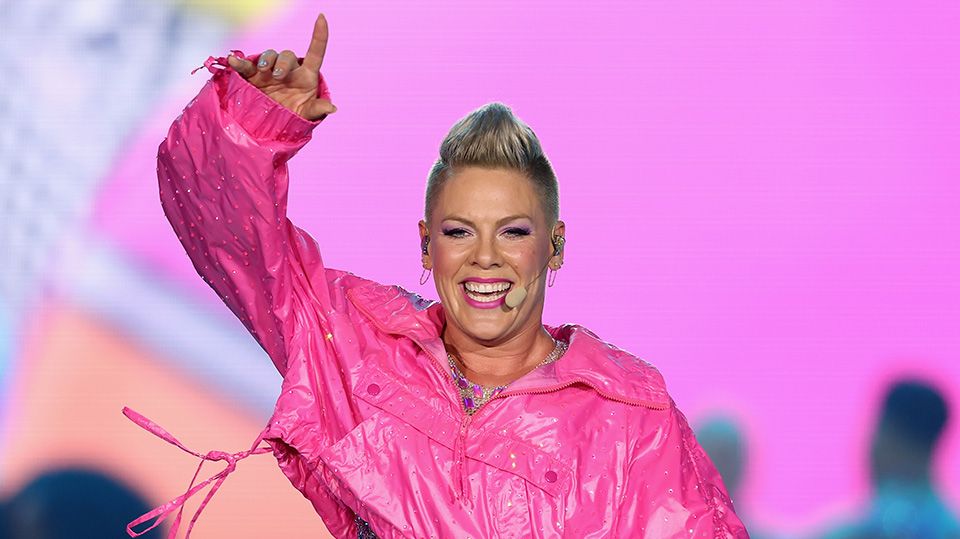
When a global tour stops unexpectedly, the headlines usually focus on what fans lost. In April 2026, when Pink was forced to cancel two sold-out shows in Mexico City, the story quickly became about something else entirely—what she refused to let her audience lose.
Her message to promoters was blunt:
no partial refunds, no fine print, no exceptions.
“Don’t keep a single cent.”
The Problem No One in the Crowd Could See
The canceled concerts—scheduled for April 26 and 27 at Estadio GNP Seguros—weren’t derailed by weather or illness. The issue was technical, and far more complex.
At the center of it: the aerial rigging system.
For most artists, stage production enhances the performance. For Pink, it is the performance. Her shows rely on intricate mechanical setups that allow her to fly above the audience, spin through the air, and execute physically demanding choreography mid-song.
These aren’t optional visuals. They’re engineered systems that require:
-
Precise installation
-
Extensive safety testing
-
Structural reliability under dynamic movement
Without that infrastructure fully operational, the show can’t happen—not safely, and not authentically.
Why She Chose Cancellation Over Compromise
In many cases, artists faced with production issues opt for a scaled-down version of the show. Strip back the visuals. Keep the music.
Pink didn’t take that route.
Performing without the aerial elements wouldn’t just change the show—it would fundamentally alter the experience fans paid for. And more importantly, rushing or improvising around incomplete rigging would introduce unnecessary risk.
So she made the call: cancel both nights.
It was a decision rooted in two priorities:
-
Safety — non-negotiable
-
Integrity of the performance — equally important
The Refund Demand That Shifted the Narrative
Concert cancellations often come with a frustrating reality for fans: refunds that exclude service fees, processing charges, or other hidden costs.
That’s where this situation turned.
Pink reportedly pushed back hard, insisting that fans receive everything back—not just the ticket price, but every additional charge tied to the purchase.
That distinction matters.
For many attendees, especially those who saved or traveled for the event, those extra fees aren’t trivial. They can represent a meaningful portion of the total cost.
By demanding full reimbursement, she reframed responsibility:
-
The failure was logistical
-
The burden should not fall on the audience
A Financial Loss—By Choice
Two sold-out stadium shows represent a significant amount of revenue—not just for promoters, but for the artist as well.
Walking away from that isn’t a small decision.
But for Pink, the calculation wasn’t purely financial. Over a career spanning decades, her touring success has been built on consistency and trust. Undermining that relationship for short-term recovery would cost more in the long run.
In effect, she chose reputation over revenue.
Why Fans Paid Attention
The reaction wasn’t just about disappointment—it was about recognition.
Fans noticed that:
-
She didn’t try to “make do” with a lesser show
-
She didn’t shift costs onto ticket holders
-
She acknowledged the inconvenience without minimizing it
In an industry where cancellations can feel transactional, this approach felt personal.
The Philosophy Behind the Decision
Pink has long positioned her audience as more than ticket buyers. In interviews and onstage, she often refers to them as part of an extended community.
Moments like this test whether that idea holds up under pressure.
Here, it did.
Instead of defaulting to standard industry practices, she treated the situation as a matter of fairness:
-
If the show isn’t delivered as promised
-
The fans shouldn’t absorb the loss
It’s a simple principle—but not always a common one.
What This Reveals About Modern Touring
Large-scale tours today are complex operations, involving:
-
International logistics
-
Heavy equipment transport
-
Local infrastructure coordination
When something breaks down, the ripple effects are immediate and expensive.
What’s notable here isn’t that a problem occurred—it’s how it was handled.
Pink’s response highlights a shift that audiences increasingly expect: accountability at the top, not the bottom.
More Than a Cancellation
In the end, the Mexico City shows didn’t happen.
But the story didn’t end there.
By insisting on full refunds and refusing to compromise on safety or quality, Pink turned a negative moment into a statement about standards—both hers and the industry’s.
Because sometimes, what defines an artist isn’t how they perform when everything goes right.
It’s what they do when everything doesn’t.