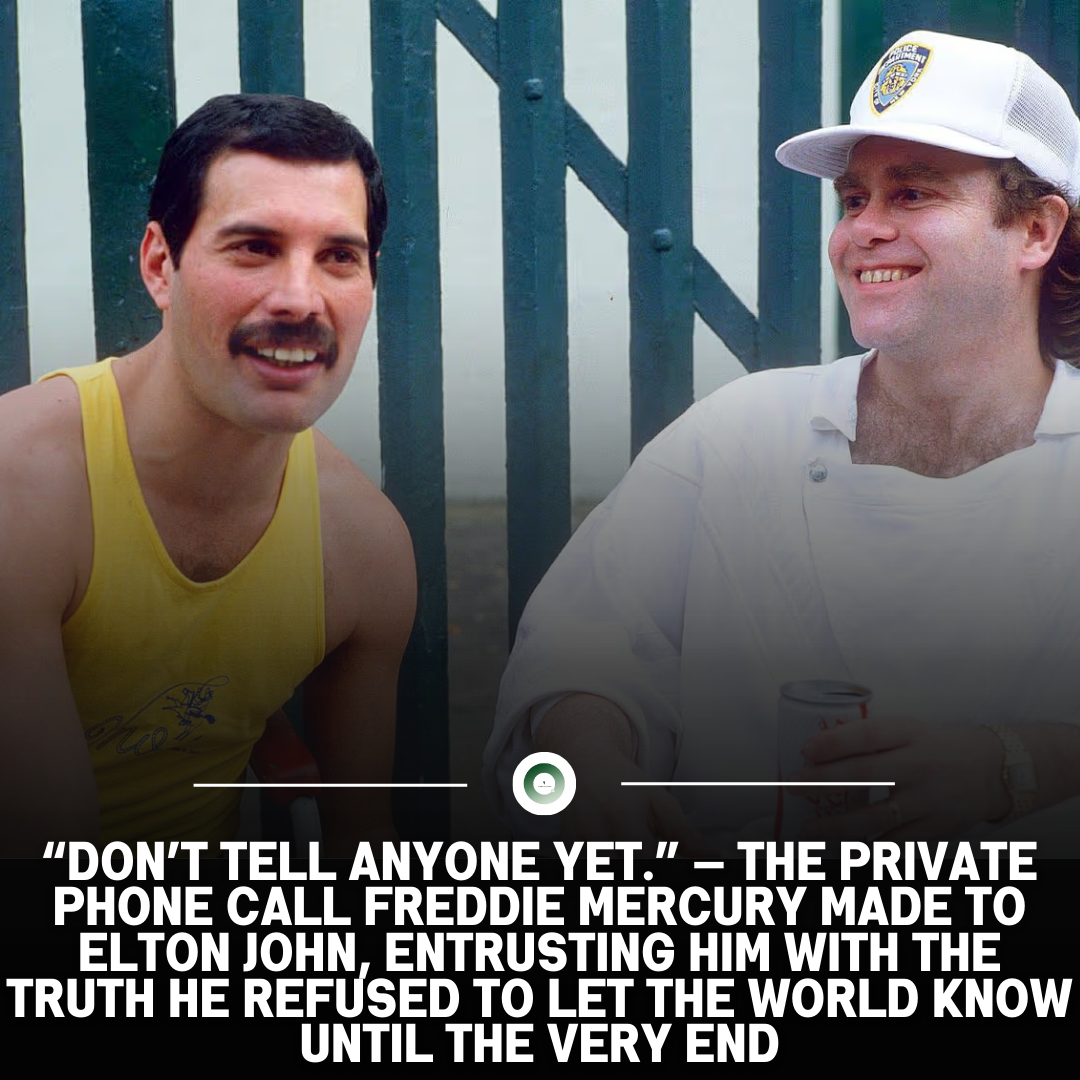
Before the world knew Freddie Mercury was dying, there was one person he trusted enough to tell the truth.
It wasn’t announced publicly. It wasn’t shared with the press. And it wasn’t spoken in the dramatic language the world would later attach to his final years. It happened quietly, through a private phone call, between two men who understood each other beyond the machinery of fame.
Freddie Mercury called Elton John.
A Friendship Built Long Before the Silence
By the late 1980s, Freddie Mercury and Elton John were no longer just two of the most powerful figures in music—they were survivors of an era that consumed nearly everyone around them. Both had risen in the 1970s, when rock stardom meant excess, danger, and absolute exposure. Both had built identities larger than life itself.
But beneath the spectacle, their friendship existed in something far more human.
Elton was one of the few people Freddie allowed close enough to see beyond the armor. He saw the private Freddie—the one who was thoughtful, observant, and far more emotionally fragile than his stage persona suggested.
And as Freddie’s health began to deteriorate, that circle became smaller.
He didn’t explain himself to many people. He didn’t want sympathy. He didn’t want to be watched.
But he wanted Elton to know.
The Call That Changed Everything
When Freddie spoke to Elton privately, he didn’t frame it as a confession. There was no dramatic announcement. He simply acknowledged what was already becoming unavoidable—that his time was limited.
Freddie had been diagnosed with AIDS in 1987, but he chose to keep it secret from the public for years. Even as speculation grew, even as his physical condition changed, he refused to confirm it. He continued recording. Continued working. Continued protecting his privacy.
To the world, Freddie Mercury remained untouchable.
To Elton, he was a friend preparing for the inevitable.
Elton would later describe the emotional complexity of that period—not defined by dramatic conversations, but by restraint. Freddie never asked for comfort. He never asked for intervention. He never allowed himself to become the subject of pity.
He simply continued.
Watching a Legend Protect His Identity
As Freddie’s condition worsened, Elton witnessed something that few others saw: Freddie’s determination to control his narrative until the very end.
He didn’t retreat from music. In fact, some of his most emotionally powerful vocal performances were recorded during this period, including songs like These Are the Days of Our Lives and Mother Love. His voice carried fragility, but also a quiet defiance.
He knew his body was weakening. He knew the public would eventually know.
But he refused to surrender his identity prematurely.
Freddie Mercury did not want to be remembered as a victim. He wanted to be remembered as Freddie Mercury.
And Elton understood that.
The Gift That Arrived After His Death
Months after Freddie passed away on November 24, 1991, Elton received something unexpected.
It was a painting. Wrapped and delivered quietly.
Freddie had arranged it before he died.
The artwork was by Henry Scott Tuke, an artist whose work Freddie deeply admired. Along with it was a handwritten message addressed simply:
“Dear Sharon and Elton, I thought you’d like this. Love, Freddie.”
There was no explanation. No farewell speech. Just a gesture that reflected the person Elton had always known—someone who communicated meaning through action rather than words.
Elton later described receiving it as one of the most emotional moments of his life.
Freddie had known he was dying. And even then, he had been thinking about his friends.
The Public Announcement That Came Too Late
Freddie Mercury officially confirmed his AIDS diagnosis only one day before his death. The statement was brief. Controlled. Final.
He had waited until the last possible moment.
For years, Elton had carried the knowledge privately, honoring Freddie’s decision to protect himself from public scrutiny.
It wasn’t secrecy for secrecy’s sake. It was dignity.
Freddie Mercury understood something most public figures never do—that fame takes ownership of everything it touches. And he was determined to ensure that the final chapter of his life remained his own.
What Elton John Understood That the World Didn’t
To the world, Freddie Mercury’s death marked the loss of a legend. But to Elton John, it marked the loss of someone far more irreplaceable.
Not because of Freddie’s success. Not because of his influence.
But because of his courage.
Freddie never allowed illness to redefine him. He never performed weakness. He never allowed fear to interrupt his purpose. Even in his final months, he continued to create, to plan, and to protect the image he had built.
Elton didn’t just lose a friend.
He witnessed, up close, the quiet strength it takes to leave on your own terms.
And he understood that the private phone call Freddie made all those years earlier wasn’t an admission of defeat.
It was an act of trust.