“Bohemian Rhapsody” was never meant to be simple. From the moment Queen released it in 1975, the song broke every rule that defined popular music. It had no chorus. No predictable structure. It moved from fragile piano confession to operatic chaos to explosive rock within minutes. It wasn’t just a song — it was an experience. And for decades, it carried an unspoken warning: this was not something you attempted lightly.
Because recreating it meant more than singing.
It meant rebuilding an entire universe of sound.
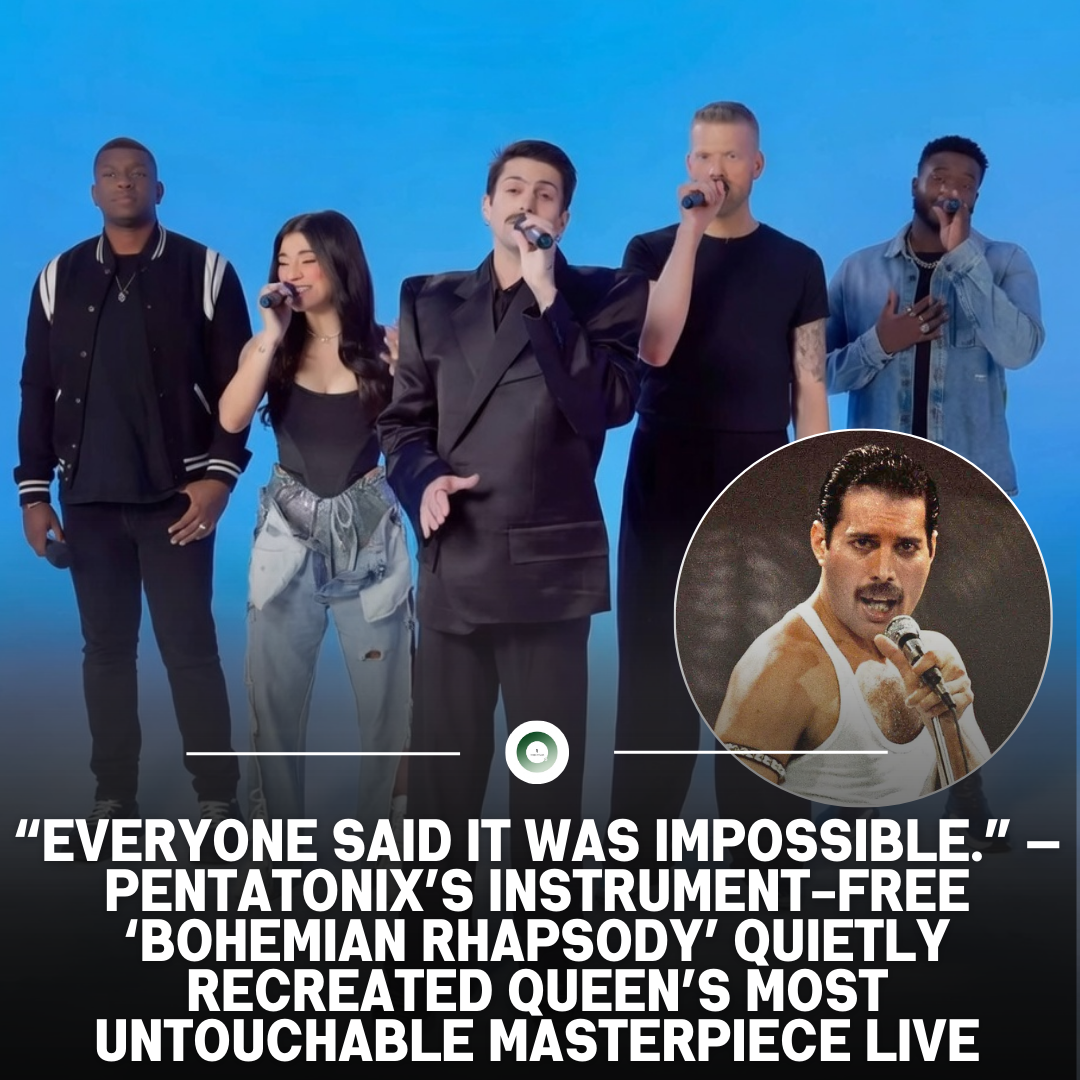
Most artists didn’t dare try. Those who did often relied on instruments, production layers, and backing arrangements to carry the weight. But Pentatonix approached it differently. They removed everything Queen originally used — the guitars, the piano, the drums — and stood in silence with nothing but their voices.
What happened next felt impossible.
Building an Orchestra Out of Nothing
At first, the performance began almost invisibly. A single voice introduced the melody, fragile and exposed. There was no safety net. No instruments to soften mistakes or hide imperfections. Every note stood alone.
Then, slowly, the rest of the group entered.
One voice became harmony. Another became rhythm. Another became texture. Their beatboxer didn’t simply mimic percussion — he recreated the pulse of the entire song. What Queen originally built through layered studio production, Pentatonix constructed in real time through precision and control.
You could hear every moving part.
You could feel every transition.
And yet, nothing physical existed except breath and sound.
The Moment the Impossible Became Real
The true test wasn’t the opening. It was the operatic section — the most chaotic, theatrical, and unpredictable portion of the song. Even with full instrumentation, it remains one of the most difficult segments in music history.
But Pentatonix didn’t avoid it.
They embraced it.
Their voices moved rapidly between roles, shifting from harmony to melody to rhythmic punctuation without hesitation. Each member carried a different layer of the original arrangement, but none tried to imitate Queen directly. Instead, they honored the structure while redefining the texture.
It wasn’t imitation.
It was transformation.
And when the rock section finally arrived, the energy didn’t collapse. It intensified. Their voices replaced electric guitars with raw vocal force. The absence of instruments didn’t weaken the moment. It exposed its strength.
For a brief moment, it became clear that Queen’s masterpiece didn’t depend on instruments.
It depended on conviction.
Why This Performance Meant More Than Technical Skill
Pentatonix’s version wasn’t powerful because it was perfect. It was powerful because it respected the risk Queen originally took. “Bohemian Rhapsody” was never designed to be safe. It was designed to challenge expectations.
Pentatonix understood that instinct.
They didn’t try to simplify the song. They didn’t strip it down to make it easier. They carried its complexity fully, trusting their voices to hold the weight.
And somehow, they did.
What could have felt empty instead felt full. What could have felt fragile instead felt controlled.
They didn’t replace Queen’s version.
They revealed a different way to experience it.
Proof That Some Songs Exist Beyond Instruments
Freddie Mercury once described music as something alive — something that could change depending on who carried it forward. Pentatonix’s performance proved exactly that. They didn’t recreate Queen’s studio production. They recreated its spirit.
No instruments.
No safety net.
Just voices.
And in doing so, they showed that even the most untouchable songs can still breathe in new ways, as long as the people performing them understand why they mattered in the first place.