Few songs in rock history have traveled as far emotionally as Queen’s “Love of My Life.” What began as Freddie Mercury’s quiet confession to one person would eventually become something far larger—absorbed, returned, and completed by tens of thousands of voices who understood its meaning without ever being told its story.
It was never designed to belong to the world.
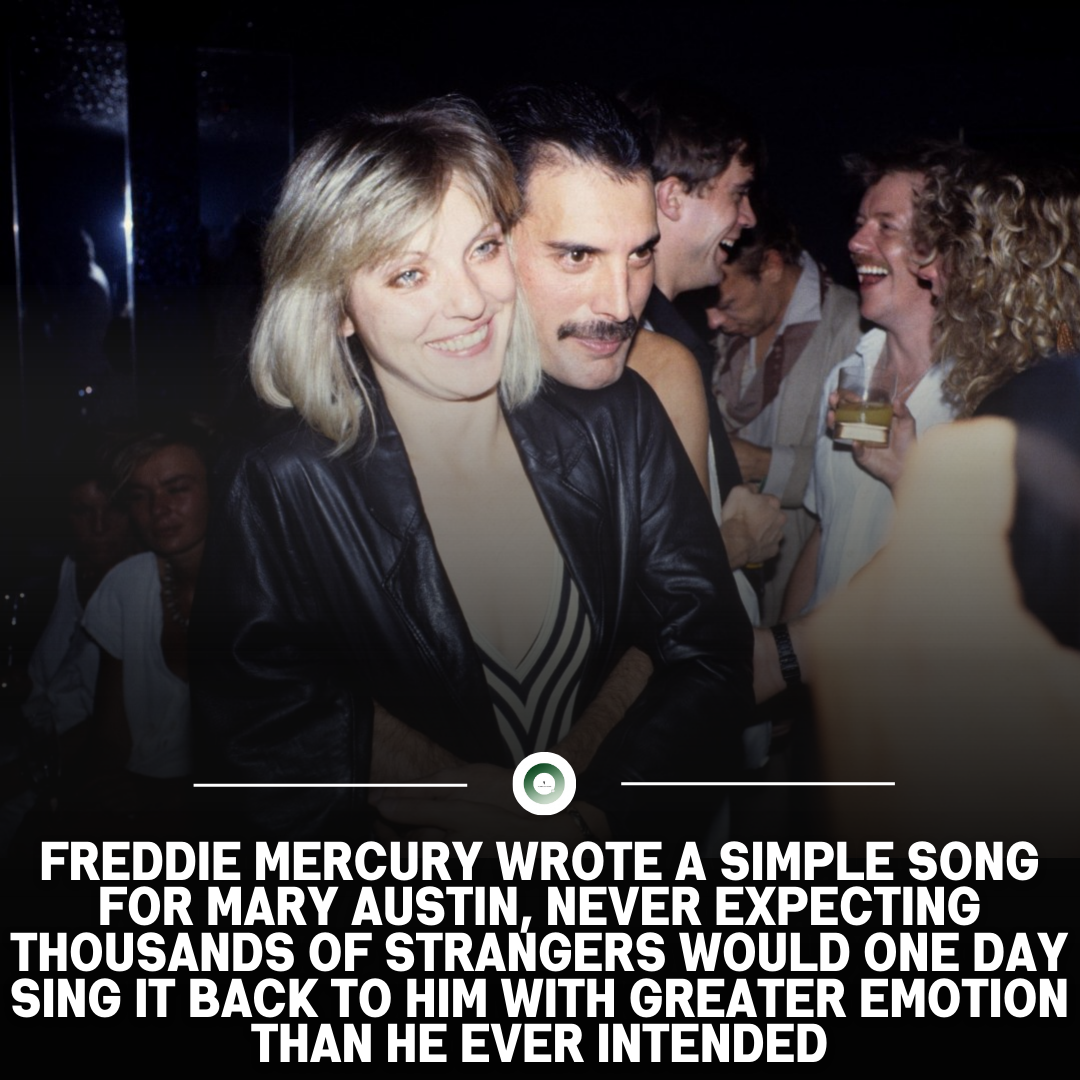
It was written for Mary Austin.
The Woman Freddie Never Replaced
When Freddie Mercury met Mary Austin in the early 1970s, Queen did not yet exist as a permanent force. They were still becoming something. Still uncertain. Still fragile. Mary entered his life before the certainty of fame, before the armor of identity had fully formed.
Their relationship began romantically, but it evolved into something more enduring. When Freddie later acknowledged his sexuality, the romantic aspect ended—but the emotional foundation did not collapse. Instead, it transformed into a lifelong loyalty that neither distance nor circumstance ever weakened.
Mary remained his closest confidante, his emotional anchor, and the person he trusted with the parts of himself the public would never fully see.
Freddie never replaced her.
He simply redefined what love meant.
When he wrote “Love of My Life” for Queen’s 1975 album A Night at the Opera, he wasn’t writing for an audience. He wasn’t writing for charts. He was documenting something private before time could take it away.
The studio version reflected that fragility. Built around piano, acoustic guitar, and Brian May’s delicate harp work, the arrangement avoided spectacle entirely. There was no theatrical excess. No attempt to dominate.
Only restraint.
Only vulnerability.
When Freddie sang, “Bring it back, bring it back, don’t take it away from me,” he wasn’t performing.
He was admitting fear.
The Moment the Song Stopped Belonging to Him
For several years, “Love of My Life” remained exactly what Freddie intended it to be—a personal ballad preserved inside Queen’s larger theatrical catalog. But live performance introduced something he could never have predicted.
The arrangement was simplified for the stage. No harp. No layered instrumentation. Only Freddie’s voice and Brian May’s acoustic guitar.
This exposed the song completely.
There was nothing left to hide behind.
At concerts in the late 1970s, something unexpected began to happen. Audiences didn’t just listen. They responded. They filled in the spaces between Freddie’s lines. At first, it was subtle. Fragmented.
Then it grew.
By the time Queen performed in Frankfurt in 1979—later released on Live Killers—the transformation was unmistakable. The audience wasn’t observing the song anymore. They were participating in it.
And Freddie noticed.
The Ritual That Changed the Song Forever
By the early 1980s, Freddie had begun altering how he performed “Love of My Life.” He would sing the opening lines, establish the emotional frame, and then stop.
He would raise the microphone toward the audience.
And wait.
What followed was never rehearsed. Never instructed. Tens of thousands of voices would answer him, continuing the song without hesitation, without guidance, without fear.
At Rock in Rio in 1985, before one of the largest audiences Queen had ever faced, the sound of the crowd singing back to him became overwhelming. Freddie stood still, listening. Not controlling. Not performing.
Receiving.
The same ritual repeated at Wembley Stadium in 1986. Again, the audience completed the song for him.
Freddie had written it for one person.
But now it belonged to everyone who understood loss, distance, and the quiet fear of losing something irreplaceable.
Why Freddie Allowed It to Change
Freddie Mercury built his career on control. Every movement, every vocal decision, every visual element was deliberate. He understood presentation instinctively.
But with “Love of My Life,” he allowed something rare to happen.
He allowed himself to disappear.
By letting the audience finish the song, he surrendered authorship in the moment. He allowed their voices to carry what he had once carried alone.
It wasn’t weakness.
It was trust.
He understood that the emotion he had written was no longer confined to his experience. It had found resonance beyond him.
And he didn’t try to take it back.
The One Person It Never Stopped Belonging To
Despite its transformation into a global ritual, the original meaning never disappeared.
Mary Austin remained the emotional center of Freddie’s life until his death in 1991. His trust in her never weakened. He left her the majority of his estate, including Garden Lodge, his London home.
He had once called her his “only friend.”
Not because others didn’t exist.
But because she had known him before the world did.
Before the myth replaced the man.
Why the Song Still Exists in That Space
Most songs are performed. Some songs are remembered. Very few songs are returned—given back to the person who created them by those who understand them.
“Love of My Life” became something Freddie never planned.
Not because its meaning changed.
But because its meaning proved permanent.
He wrote it as something fragile.
The world answered by making it immortal.