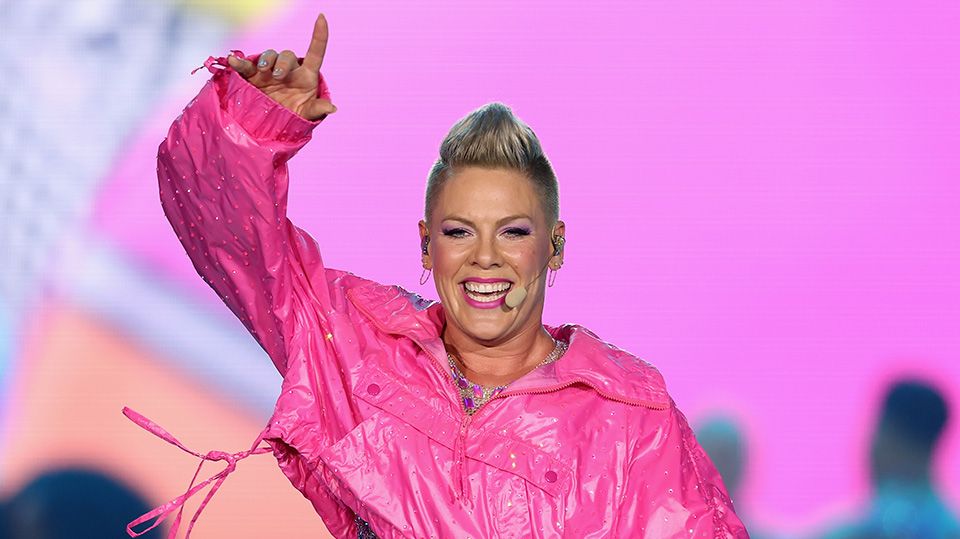
For most performers, a serious neck surgery comes with an unspoken understanding: scale it back, stay safe, adjust expectations.
For P!nk, it raised a far more personal question:
If she couldn’t fly, would she still feel like herself on stage?
That question sat at the center of her recovery after a cervical disc replacement—a procedure that doesn’t just demand healing, but restraint. Doctors were clear. The spine, especially the neck, doesn’t forgive shortcuts. Aerial work—the flips, spins, and suspended drops that define her live shows—was exactly the kind of strain that could undo everything.
The message wasn’t subtle.
Stay grounded.
When medical advice collides with identity
P!nk’s performances aren’t just concerts. They’re physical storytelling—equal parts vocal power and aerial choreography. Over the years, flying above arenas has become more than a signature. It’s a language she uses to express control, freedom, and defiance.
So when doctors suggested that returning to that level might not be realistic, the implication ran deeper than logistics.
It wasn’t just about what she could do.
It was about who she could be.
Publicly, she followed protocol. Recovery was steady, disciplined, and patient. Physical therapy focused on rebuilding strength in controlled, incremental ways. No shortcuts. No public risks. No dramatic declarations.
But internally, the uncertainty lingered.
Not if she would perform again.
But how.
The moment recovery turned into a test
Around six weeks after surgery—well before any official clearance for aerial work—something shifted.
Not in a stadium. Not in rehearsal for a tour. But in a private training space, stripped of pressure and performance.
This wasn’t about proving anything to an audience. It was about answering a question only her body could answer.
She approached the apparatus carefully.
No full routine. No height. No spectacle.
Just a controlled inversion.
By most standards, it was a small movement. For her, it was everything.
The difference between risk and recklessness
From the outside, attempting any aerial movement that early might sound impulsive. But context matters.
This wasn’t a spontaneous act of defiance. It came after weeks of targeted rehabilitation—core stabilization, neck strength, controlled mobility. Every step leading up to that moment had been deliberate.
The inversion itself was slow. Measured. Intentional.
And then came the most important part:
She paused.
Listening for pain. For instability. For any signal that something wasn’t right.
Nothing came.
No sharp warning. No loss of control.
Just a quiet confirmation: her body was holding.
Why that one movement mattered more than any performance
What happened next wasn’t applause-worthy in the traditional sense. There was no audience to react, no cameras to capture the moment.
But emotionally, it was seismic.
Because that inversion wasn’t about technique.
It was about trust.
Trust in the surgery.
Trust in the recovery process.
Trust in her own body again.
For an artist whose career depends on physical precision, losing that trust can be more limiting than any diagnosis. Regaining it—even in a small, controlled way—changes everything.
That moment didn’t mean she was ready to return to full aerial routines.
But it meant something equally important:
She wasn’t finished.
Rewriting the narrative of “comeback”
In entertainment, comebacks are usually framed as public events. A return to the stage. A surprise performance. A headline moment that signals everything is “back to normal.”
But the reality is quieter.
Comebacks are built in private—through repetition, uncertainty, and small wins that never make it into press releases.
For P!nk, the real turning point wasn’t a show announcement or a viral clip.
It was a single, controlled movement in a silent room.
A moment where fear met preparation—and didn’t win.
The long road to 2027
One successful test doesn’t override medical caution. Returning to full aerial performance requires more than confidence—it requires clearance, conditioning, and consistency over time.
The cervical spine isn’t something you negotiate with. It demands respect at every stage.
So while that six-week milestone changed the emotional trajectory of her recovery, the physical journey remains ongoing.
Every step forward will be measured. Every decision weighed.
But the narrative has shifted.
From maybe never again
to
possibly, with care
Why flying was never just about the spectacle
To understand why this moment matters, you have to understand what flying represents in P!nk’s career.
It’s not just visual impact.
It’s a statement.
A refusal to stay within the boundaries typically assigned to pop performers. A blending of strength and vulnerability. A way of turning performance into something immersive and unpredictable.
Being told she might lose that wasn’t just a creative limitation.
It was a challenge to the very thing that set her apart.
The unseen version of resilience
Audiences are used to seeing P!nk suspended high above crowds, executing complex aerial routines while delivering flawless vocals. It looks effortless, even fearless.
What they don’t see is what comes before that.
The conditioning.
The setbacks.
The recalibration after injury.
And in this case, the moment where she had to decide whether to trust her body again.
That kind of resilience isn’t loud.
It doesn’t come with lighting cues or choreography.
But it’s the foundation for everything that follows.
If she flies again, this is where it began
If 2027 audiences look up and see her soaring once more, the moment will feel triumphant. A return. A continuation of something iconic.
But the real story won’t be in the height of the stunt.
It will be in that earlier, quieter moment—when she turned upside down, held still, and realized her body hadn’t betrayed her.
Because sometimes, the most important performance isn’t the one in front of thousands.
It’s the one no one sees.
Where the only thing at stake is belief.
And the only audience is yourself.