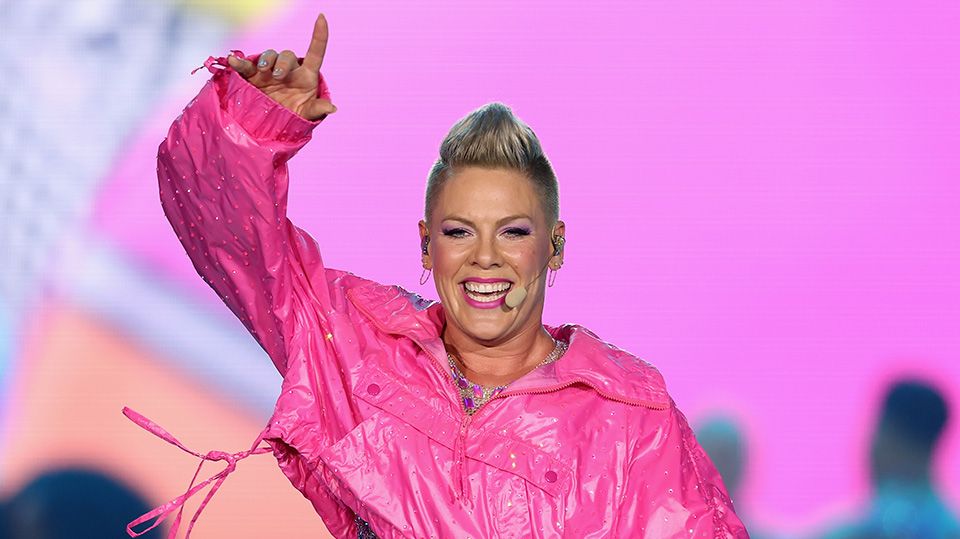
For most artists, a major surgery is a pause.
For Pink, it was a question mark.
Not about charts. Not about touring schedules. But something more fundamental:
Would her body ever let her be the performer she’s known for again?
Because for over two decades, her career hasn’t just lived on stage—it’s lived in the air.
When the body forces a reckoning
Pink’s performances are often described as fearless, but they’re also deeply physical.
Every aerial sequence demands:
- Core stability
- Neck control
- Precise alignment under pressure
Over time, that kind of strain adds up.
What starts as manageable discomfort can evolve into something more serious—and in her case, it did. Nerve compression in the cervical spine isn’t just painful. It’s limiting. It affects movement, coordination, even basic functions like turning your head without discomfort.
At that point, the decision isn’t about pushing through.
It’s about stopping.
The surgery that changed the stakes
Cervical disc replacement isn’t a cosmetic fix—it’s structural.
The damaged disc is removed and replaced with an artificial one, designed to restore movement and relieve pressure on the spinal cord. It’s a procedure that can preserve mobility, but it also requires careful recovery to ensure the body adapts correctly.
For someone whose career depends on controlled, high-impact movement, that adaptation period is everything.
Because healing isn’t just about recovery.
It’s about recalibration.
The first battle: stillness
The early phase of recovery wasn’t dramatic.
No rehearsals. No music. No movement beyond what was necessary.
The focus was simple—and frustrating:
Reduce inflammation.
Restore basic mobility.
Protect the spine at all costs.
For a performer used to constant motion, this is often the hardest part. Not the pain—but the restriction.
Because progress feels invisible.
Relearning movement from the ground up
As the initial healing phase passed, the real work began.
Not with aerials.
With fundamentals.
Physical therapy focused on:
- Rebuilding neck stability
- Strengthening surrounding muscle groups
- Restoring range of motion without strain
Each movement had to be intentional. Controlled. Repeatable.
Lifting an arm without discomfort became a milestone. Holding posture without fatigue became progress. Breathing through controlled exertion became part of the training again.
It wasn’t glamorous.
But it was necessary.
The discipline of not rushing
For someone known for pushing limits, the instinct to accelerate recovery can be strong.
But with spinal recovery, speed is the enemy.
One wrong progression—too much load, too soon—can undo weeks of healing.
So the approach shifted.
No aerial drills.
No harness work.
No shortcuts.
Instead, a structured rebuild:
- Core conditioning to support the spine
- Resistance training for controlled strength
- Neuromuscular work to restore coordination
It wasn’t about getting back quickly.
It was about getting back correctly.
The part no one sees: fear
Physical recovery is measurable.
Emotional recovery isn’t.
For Pink, the uncertainty wasn’t just about pain or mobility. It was about identity.
Aerial performance isn’t an add-on to her shows.
It’s part of how audiences experience her.
So the question lingered:
If that’s gone, what changes?
That uncertainty can be harder to navigate than the physical process itself.
Because it doesn’t follow a timeline.
Turning doubt into direction
Instead of avoiding that fear, she used it.
Not as pressure—but as focus.
Each session, each exercise, each incremental gain became part of a larger goal: not just returning, but returning with awareness.
Because after an injury like this, the objective shifts.
It’s no longer about pushing boundaries.
It’s about sustaining them.
The return—carefully, deliberately
Around 50 days into recovery, the next phase began.
Reintroduction.
Not full routines. Not high-impact sequences.
Just controlled exposure:
- Modified rigging to reduce strain
- Extended warm-ups to prepare the body
- Strict limits on duration and intensity
Every movement was tested. Monitored. Adjusted.
The goal wasn’t to prove capability.
It was to confirm stability.
A different kind of strength
At 46, Pink isn’t chasing the same kind of performance she did at 26.
Not because she can’t—but because she doesn’t need to.
This phase of her career is about longevity.
That means:
- Smarter conditioning
- More intentional recovery
- A deeper understanding of limits—and how to work within them
Strength, in this context, isn’t just about what the body can do.
It’s about how well it can keep doing it.
What her comeback really represents
When she returns fully to the air—and she likely will—it won’t just be a continuation of what audiences expect.
It will be a redefinition.
Because the performance will carry something new:
Awareness.
Every movement backed by experience. Every risk calculated with precision. Every decision informed by what it took to come back.
Why this story matters beyond the stage
It’s easy to focus on the spectacle—the height, the movement, the visuals.
But the real story is in the process.
In the patience required to rebuild.
In the discipline required to hold back.
In the resilience required to start again.
Those elements don’t make headlines.
But they make everything else possible.
Rising, differently
Pink’s career has always been associated with defying gravity.
But this chapter adds something more grounded.
The understanding that rising isn’t always about going higher.
Sometimes, it’s about rebuilding from where you are—carefully, deliberately, and without skipping steps.
And when she does take flight again, it won’t just be about what she can do.
It will be about everything it took to get there.