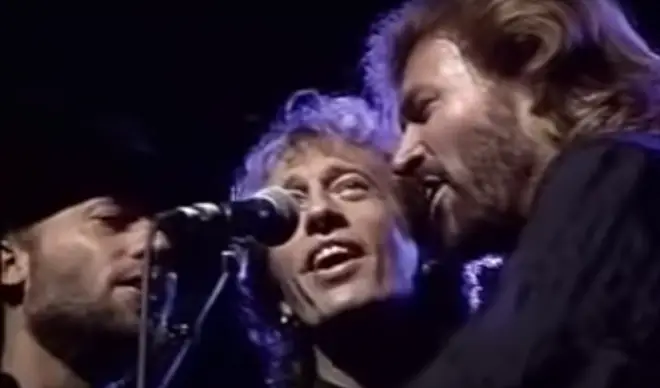
March 20th, 1999 and I’m in some kind of delirious state of nirvana because I’m backstage with Barry, Robin and Maurice Gibb – the Bee Gees – at Western Springs stadium in Auckland, New Zealand. Against the hum of 70,000 awaiting fans and here I am, a 17-year old in my new corduroy pants and my best “going-out shirt”, the unlikely winner of a nationwide Bee Gees mastermind radio competition, shaking hands and posing for photos with my heroes.

Most of that encounter is a blur, but a couple of things are tattooed in my brain and both involve Maurice. I had my line for Maurice prepared and it came out pretty much as planned, even if on a scale of 1 to Anna Paquin at the Oscars in 1994, I was about a 7.

TR: “I always said to myself that if I ever got to meet you I’d tell you that Railroad is one of my all time favourite songs”.
MG: “I’m glad somebody liked it!”
Maurice cracked up as he said this, laughing at the fact his debut solo single from April 1970 had flopped all over the world. Well, not entirely, because unknown probably to even the man himself, Railroad had done well in Southeast Asia, charting as high as #6 in Malaysia and #9 in Singapore. Still, it was hardly enough to ignite significant transatlantic interest in him as an entity separate to the Bee Gees.

Confusing matters further was that Railroad’s release inexplicably coincided with I.O.I.O – the latest single from the two-man, Barry and Maurice incarnation of the Bee Gees. With Robin having quit the band in 1969, and Barry and Maurice working on solo projects in conjunction with the spluttering continuation of “the Bee Gees”, most people thought it was over for one of the biggest, most creative bands to emerge in the late 60s.
And yet I.O.I.O’s success across Europe, Asia and Australasia showed there was still a commercial appreciation out there for the Gibbs, and by the end of 1970 all three of the brothers would reunite, going on to become not just the highest selling act of the 70s, but statistically (and ultimately critically) up there with the greatest pop acts of all time.
All of which distracts from the fact that Railroad was an absolutely sensational little song, even if it initially slipped through the cracks.
I can still remember the first time I heard it. I’d saved up from my after-school job at Woolworths supermarket and bought the Tales From The Brothers Gibb boxed set, a lavish 4-CD collection complete with glorious Gibb rarities like Railroad. I remember paying NZ $119.99 for the set back in 1998, which the handy Reserve Bank Of New Zealand online inflation calculator tells me is a cheeky $186.20 in today’s money (US $110.78). A substantial chunk of change when you’re making $7.36 an hour as a butcher boy with a decided aversion to raw meat. If only I’d got a job in the produce department. I digress.

It was the violins on Railroad’s chorus that first got me. The song was playing on our car stereo and that six-second violin line that starts at the 59-second mark and goes through until 1:05 made my ears prick. What a hook. And I loved how the vocals were kind of buried within that orchestral hook. I turned the volume up and I’ve been addicted ever since.
The quiet intro, the quiet outro, the intervening verses that trot along with the kind of country-influenced Americana that Maurice and Barry adored, the deep vocals that contrast with the upper-register harmonies, the piano lines, the bass run and wobble at the 47-second mark, the extra layer of strings that’s introduced at 1:33, the final repetition of the rousing chorus; this is a simple song put together extremely well.
Railroad’s lyrics – cowritten with Maurice’s then brother-in-law, Billy Lawrie (Lulu’s brother) – tell a mostly non-specified tale of someone who’s leaving – perhaps controversially – their adopted town to return to where they grew up. Once there, they’ll be back into the arms of their “woman”, as well as having the support of their family.
On the one hand it’s suggested that “everything’s gone wrong” in the protagonist’s new town, while on the other, the song’s lyrical highpoint hints at some triumphs too:
There’s been lies told in my story
But I ain’t juiced none of that glory
But still, I’ve served my time
And there’s no use in cryin’
‘Cos I’m walkin’ by that railroad till I’m home
Maurice always did have the most swagger of the Gibb brothers, but “I ain’t juiced none of that glory”, is cool even by his standards. The question is though, are the lies told by the protagonist or by the people talking about him? And those lies would have to have been about the bad things he’s done if he insists he hasn’t exaggerated – or “juiced” – any of the good stuff. Unless, of course, the bad stuff is the glory and Maurice is pitching himself as some kind of loveable rogue a la Butch Cassidy & The Sundance Kid.
Which would then make “served my time” a literal reference to jail time instead of just the spending of time in another town or city chasing dreams.
Like countless Gibb songs, there is a feel that surpasses the lyrics. This is a song that feels like the proud announcement of a come back, as much as a simple proclamation of coming home. And speaking of come backs, the B-side was called just that – I’ve Come Back – and in many ways is equally as good and even more rare.
I’d love Maurice’s daughter Samantha, a fine singer/songwriter in her own right, to do a cover of that one day, but in the meantime, Bee Gees fans have been treated to her attractive reworking of Railroad to mark the 50th anniversary of her father’s most beloved song. As she said on her Facebook page (@samgibbmusic), “[I] heard that trains can be a metaphor for passing time. Hope this helps you all get through some of those quarantine hours”.
March 20th, 1999 and it’s time to say goodbye to the Bee Gees before they take to the stage. I say something to the three of them and it’s Maurice’s reply I’ll never forget:
TR: ” I really hope to meet you all again someday”.
MG: “You absolutely will, I guarantee you that”.
Both Maurice and Robin would pass away before I ever got to see them again, but 21-years and half-a-dozen radio and print interviews later, getting to know the genius, gentleman that is Sir Barry Gibb has been one of the great joys of my life. I recounted this whole yarn to Samantha the other day via email and she said how, “it’s always nice hearing stories about [Maurice] and when people first met him. He always made an impression”.
Imagine always making a good impression on people? Even nervous teenagers in bad corduroy pants and ill-fitting “going out shirts”.