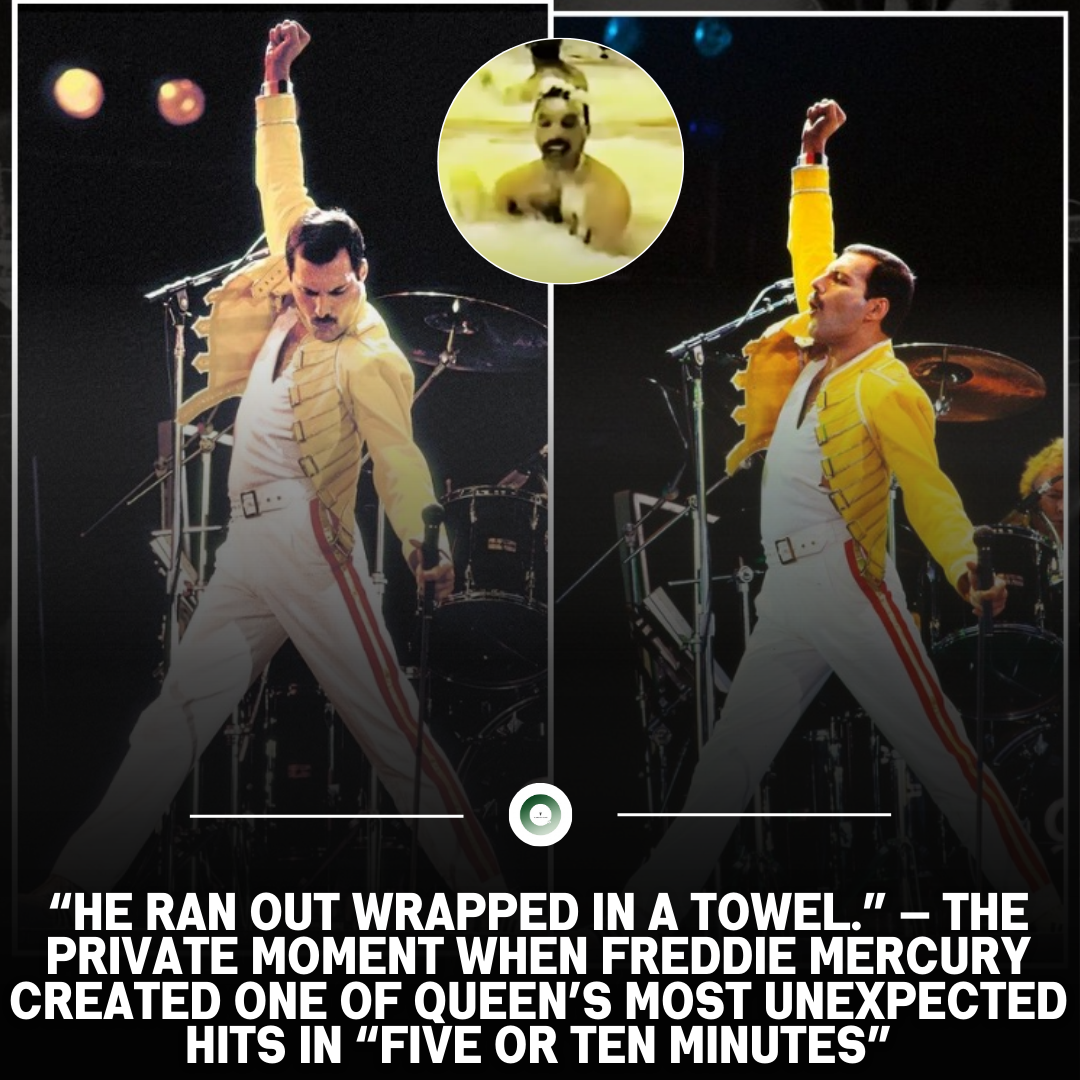
In 1979, Freddie Mercury wasn’t chasing greatness when inspiration found him. He wasn’t standing under stage lights or sitting inside a studio surrounded by instruments. He was alone, resting in a bathtub at the Munich Hilton, letting his mind drift. It was supposed to be a moment of stillness. Instead, it became the beginning of one of Queen’s most enduring songs.
Without warning, the melody appeared.
It wasn’t gradual. It didn’t arrive piece by piece. It arrived whole. The rhythm, the feeling, the pulse of something alive and urgent. Freddie knew immediately that this wasn’t something he could trust to memory. He stepped out of the bath, wrapped in a towel, and reached for the nearest guitar—not as a guitarist, but as a man trying to capture something fragile before it disappeared.
The Song That Refused to Wait
Freddie Mercury was never known as Queen’s primary guitarist. That role belonged to Brian May, whose technical brilliance shaped much of the band’s sound. Freddie’s relationship with the instrument was different. He didn’t rely on precision or theory. He relied on instinct.
With only a few chords at his disposal, he began building the structure of the song in real time. There was no overthinking, no revision process stretching across weeks. The song existed in its simplest form, and Freddie understood that simplicity was its strength.
Within minutes, the foundation of “Crazy Little Thing Called Love” was complete.
It wasn’t designed to be complex. It wasn’t trying to rival the layered storytelling of “Bohemian Rhapsody.” It was something else entirely. It was immediate. Direct. Alive.
Why Limitation Became His Greatest Advantage
Freddie would later admit something surprising: his limited guitar skills helped him write the song. Without the ability to explore endless chord variations, he was forced to stay inside a narrow framework. That restriction removed hesitation. It removed doubt. It allowed instinct to lead.
Instead of constructing the song intellectually, he allowed himself to feel it.
This gave “Crazy Little Thing Called Love” its unmistakable character. The song didn’t sound engineered. It sounded discovered. Its four-chord structure carried the spirit of early rock and roll, echoing an era defined by energy rather than perfection.
Freddie wasn’t trying to impress anyone. He was trying to preserve a moment.
The Quiet Birth of One of Queen’s Most Human Songs
When Queen began recording The Game, the song became something larger than its spontaneous origin suggested. It carried a rawness that couldn’t be manufactured. It didn’t demand attention with theatrical drama. It earned attention through honesty.
The song’s energy translated instantly to audiences. It became one of Queen’s biggest hits, not because it was their most technically ambitious creation, but because it felt real. It felt unfiltered.
Freddie Mercury had always been associated with control, precision, and performance. But “Crazy Little Thing Called Love” revealed something else. It revealed how quickly brilliance could appear when he allowed himself to trust instinct instead of mastery.
The Moment Inspiration Chose Him
Some songs are built slowly, shaped over time through careful refinement. Others arrive fully formed, as if waiting for the right person to hear them.
“Crazy Little Thing Called Love” belonged to the second kind.
It wasn’t forced into existence. It wasn’t chased. It appeared when Freddie Mercury was doing nothing at all. And when it did, he recognized it instantly.
He didn’t question it. He didn’t analyze it.
He simply listened.
And in doing so, he captured a moment of inspiration that would outlive him, proving that sometimes the greatest songs are not written—they’re received.