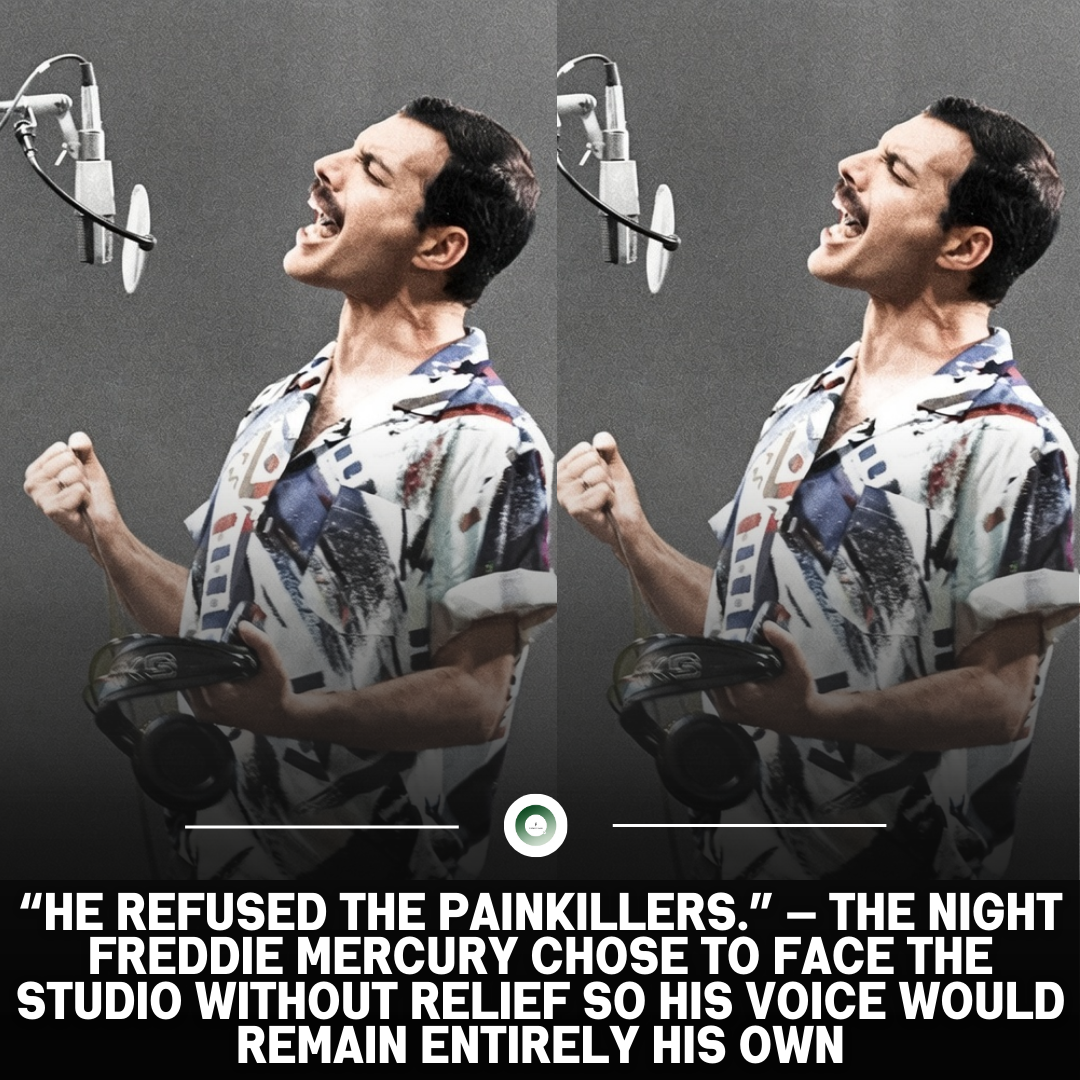
By the early 1990s, the studio had stopped being a place of routine. It had become a place of negotiation — between time and strength, between pain and control. Freddie Mercury no longer moved through recording sessions the way he once had. The hours were shorter. The silences were longer. And yet, when the red recording light appeared, something in him remained unchanged.
His voice was still his.
Those closest to him understood what the public did not. His body was weakening, steadily and without reversal. Every day introduced new limits. Walking required more effort. Standing required more balance. Even breathing, at times, carried weight. The natural response, in such circumstances, would have been retreat — to prioritize comfort, to accept quiet, to let the body dictate its own terms.
Freddie chose something else.
There were moments when relief was available to him. Medication could dull the physical cost. It could soften the sharp edges of what he was enduring. But it also carried another effect — it could distance him from the one instrument he still fully controlled. His voice required precision, presence, and clarity. It was not something he could access through sedation or surrender.
And so he protected it.
This was not an act of denial. It was an act of ownership. Freddie Mercury understood that his voice was more than a physical function. It was identity. It was authorship. It was the one place where illness had no authority unless he allowed it.
Those final recording sessions were built around that understanding. He would arrive, often already exhausted, conserving energy not for the day, but for the moment that mattered. When he stepped to the microphone, the outside reality paused. The limitations remained in his body, but they did not fully cross into his voice.
Brian May would later recall the quiet determination behind those recordings — the absence of complaint, the absence of self-pity. Freddie never framed the act as bravery. He treated it as continuation. There were still songs unfinished. Still words unspoken. Still pieces of himself that had not yet been left behind.
What emerged from those sessions was not defined by physical decline, but by deliberate presence. He was not singing in spite of what was happening. He was singing within it, refusing to let anything else speak for him.
There is a difference between losing strength and losing authorship. Freddie Mercury allowed the first. He never allowed the second.
And in that space — between what the body could endure and what the voice could still claim — he continued, choosing clarity over comfort, knowing exactly what that choice would cost, and exactly why it mattered.