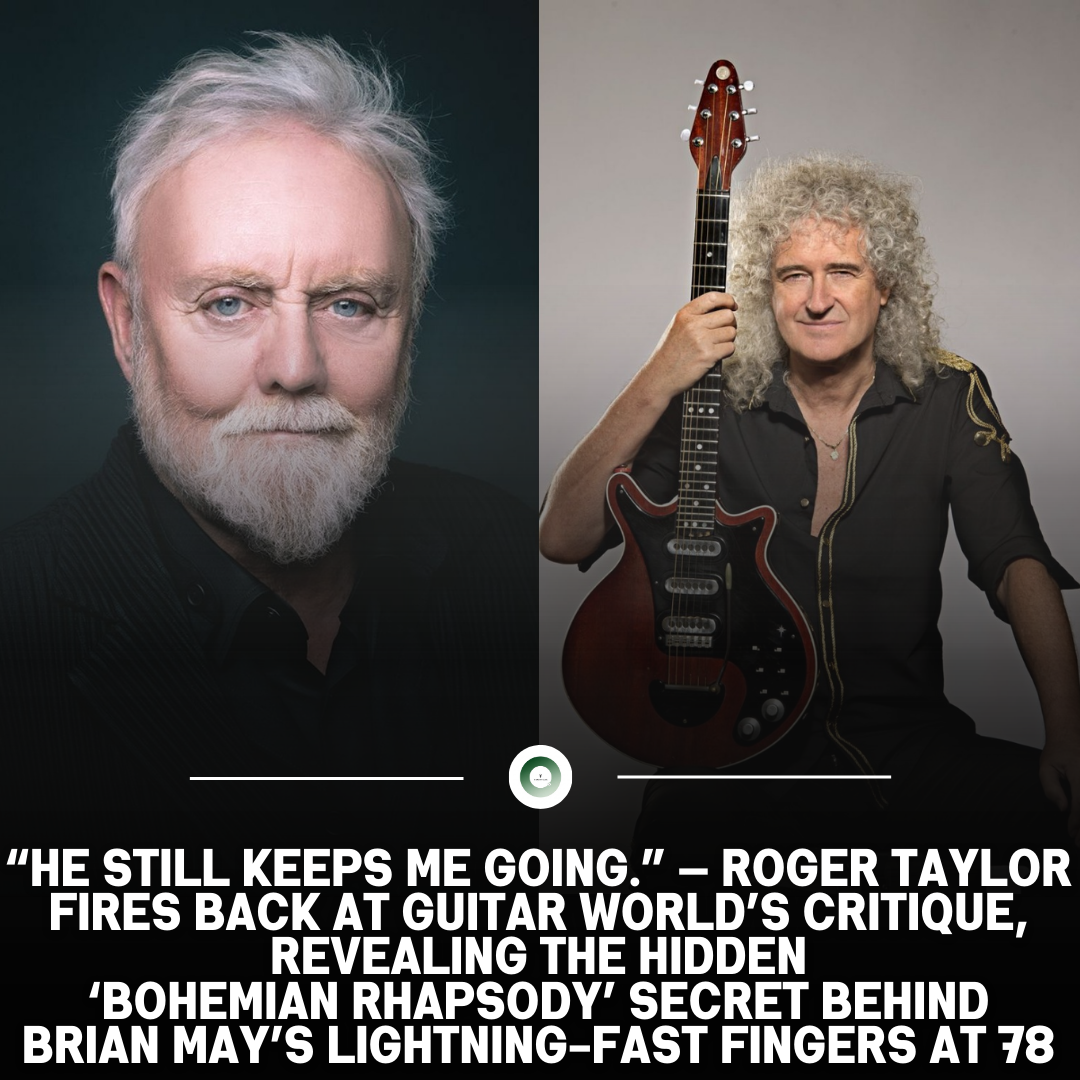
For more than half a century, Brian May’s guitar hasn’t just accompanied Queen’s music—it has defined it. Every note he played carried a sense of precision, identity, and emotional force that made his sound instantly recognizable anywhere in the world. But recently, that legacy was quietly questioned when Guitar World magazine suggested that May’s fingers were “no longer fast,” pointing specifically to modern performances of the iconic “Bohemian Rhapsody” solo and describing them as a “slow burn.” It was a critique that touched something deeper than speed. It challenged the endurance of a legend.
Roger Taylor didn’t hesitate.
To him, this wasn’t just a technical debate. It was personal.
Taylor, who has stood beside May since Queen’s earliest uncertain days, didn’t rely on nostalgia or reputation to defend his bandmate. He relied on something far more powerful: firsthand truth. “I just jammed with him last week,” Taylor said firmly, dismissing the suggestion that May’s ability had faded. Then came the line that captured everything—not just about May, but about the bond they share: “Age is just a number, but the fire is still burning.”
That fire is the part critics often miss.
Brian May’s playing was never built purely on speed. From the very beginning, his guitar voice was constructed around phrasing, emotion, and control. The solo in “Bohemian Rhapsody” was never meant to overwhelm with sheer velocity. It was designed to breathe. Each note rises, lingers, and resolves with intention, creating tension and release that feels almost vocal in nature. It’s not a race. It’s a conversation.
And that conversation hasn’t stopped.
Even at 78, May still approaches his instrument with the same discipline that defined him decades ago. The muscle memory built from years of touring, recording, and relentless rehearsal doesn’t simply disappear. It evolves. His fingers may no longer chase speed for its own sake—but they no longer need to. What remains is something deeper: timing refined by experience, phrasing sharpened by perspective, and a connection to the instrument that cannot be measured in milliseconds.
Roger Taylor knows this better than anyone.
He has watched May in empty rehearsal rooms and crowded arenas. He has heard the quiet moments, the spontaneous jams, the unfiltered sound of May playing not for an audience, but for himself. And that is where the truth lives—not in magazine critiques or technical comparisons, but in the undeniable reality of a musician still fully connected to his craft.
Because the secret behind Brian May’s endurance was never about maintaining the exact same speed forever.
It was about maintaining the same purpose.
The same curiosity.
The same fire.
That fire began long before Queen ever filled stadiums. It lived in the homemade Red Special guitar May built with his father, shaping a sound that was entirely his own. It carried through the uncertainty of Queen’s early years, through their rise to global dominance, and through the silence that followed Freddie Mercury’s death. And today, decades later, it still burns—not because time stood still, but because his devotion never faded.
Critics may measure fingers.
But Roger Taylor measures something else entirely.
He measures the fire.