From the outside, it looks like everything.
Sold-out arenas, global recognition, a catalog that reshaped hip-hop. For decades, Eminem has existed at a level of success few artists ever reach. But in 2026, a different picture began to emerge—not from headlines, but from someone who has been there through it all.
“Em is my brother,” 50 Cent said. “But sometimes I look at his life and I see a prison that he built for himself.”
It wasn’t criticism.
It was recognition.
When Success Starts To Change Shape
The idea of success usually carries a clear promise—freedom, access, the ability to move through the world on your own terms. But at a certain level, that promise begins to shift. Visibility becomes constant. Attention becomes unavoidable. And what once felt like opportunity starts to feel like exposure.
For Eminem, that shift didn’t happen overnight. It built slowly, year after year, as his name moved beyond music into something larger. By the time it settled, the solution was already in place.
Distance.
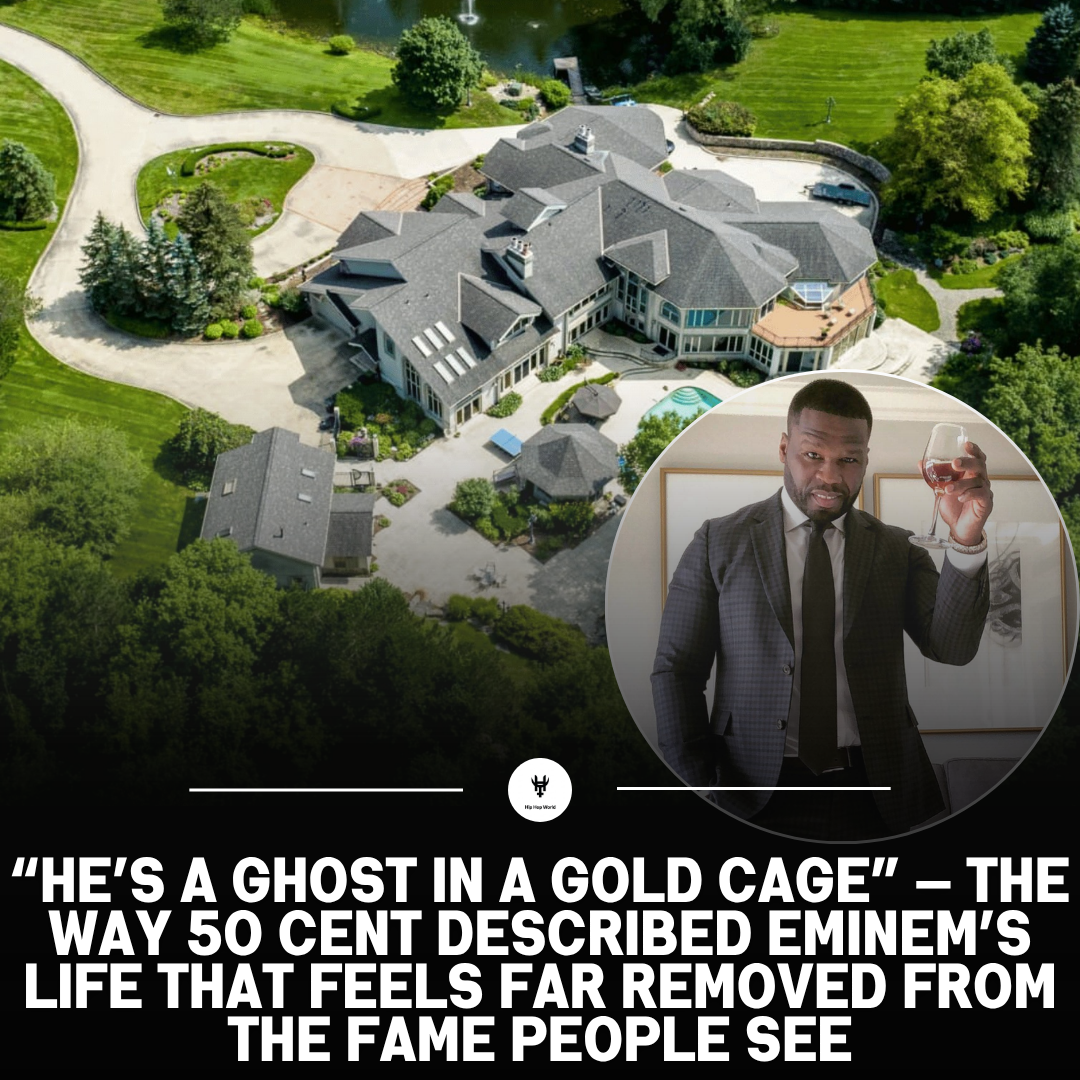
His home in Detroit, as described by 50 Cent, isn’t just a residence. It’s designed to hold the world back. Security isn’t a feature—it’s a requirement. Layers of protection, constant surveillance, controlled access. The kind of environment that doesn’t invite movement—it restricts it.
Not out of choice alone, but out of necessity.
The Cost Of Being Recognized Everywhere
There’s a point where recognition stops being flattering.
When a face becomes known to hundreds of millions, even the smallest action carries risk. A trip outside isn’t simple. It’s unpredictable. Crowds form quickly. Control disappears just as fast. What should be ordinary becomes complicated.
Over time, the effort required to exist in public begins to outweigh the value of being there.
So the world gets smaller.
Not physically—but practically.
“A Ghost In A Gold Cage”
That’s how 50 Cent describes it.
Not trapped in the traditional sense. Not lacking anything material. But separated. Surrounded by everything success can offer, while at the same time removed from the things it can’t provide—normal interaction, spontaneity, anonymity.
It’s a paradox that doesn’t resolve easily.
Because the same success that builds the life also limits it.
The Part No One Plans For
What makes this situation more complex is that it isn’t entirely forced. Fame creates pressure, but it doesn’t dictate every decision. Over time, those living within it learn to adapt—to protect themselves, to control their environment, to reduce risk wherever possible.
Each decision makes sense.
Each layer of protection feels necessary.
But together, they create something else entirely.
A life that is safe, controlled, and increasingly distant.
Looking At It From The Inside
For 50 Cent, this isn’t an observation from afar. He understands the terrain. He’s lived within it. He knows what it takes to maintain that level of presence, and what it costs to sustain it.
That’s what gives his words weight.
Because this isn’t about judgment. It’s about awareness.
Two decades at the top doesn’t just build a legacy. It builds pressure—constant, invisible, and cumulative. And over time, that pressure changes how a person moves, how they think, how they connect.
What Success Doesn’t Always Give Back
Eminem’s story, seen through this lens, shifts away from achievement and toward consequence. Not in a negative sense, but in a real one. It asks a question that doesn’t have an easy answer.
What does success mean when it takes away the freedom it was meant to provide?
There’s no clear resolution.
Only an image that stays with you.
A house built for safety.
A life built on impact.
And somewhere inside it, a man who has everything—and still has to give something up to keep it.