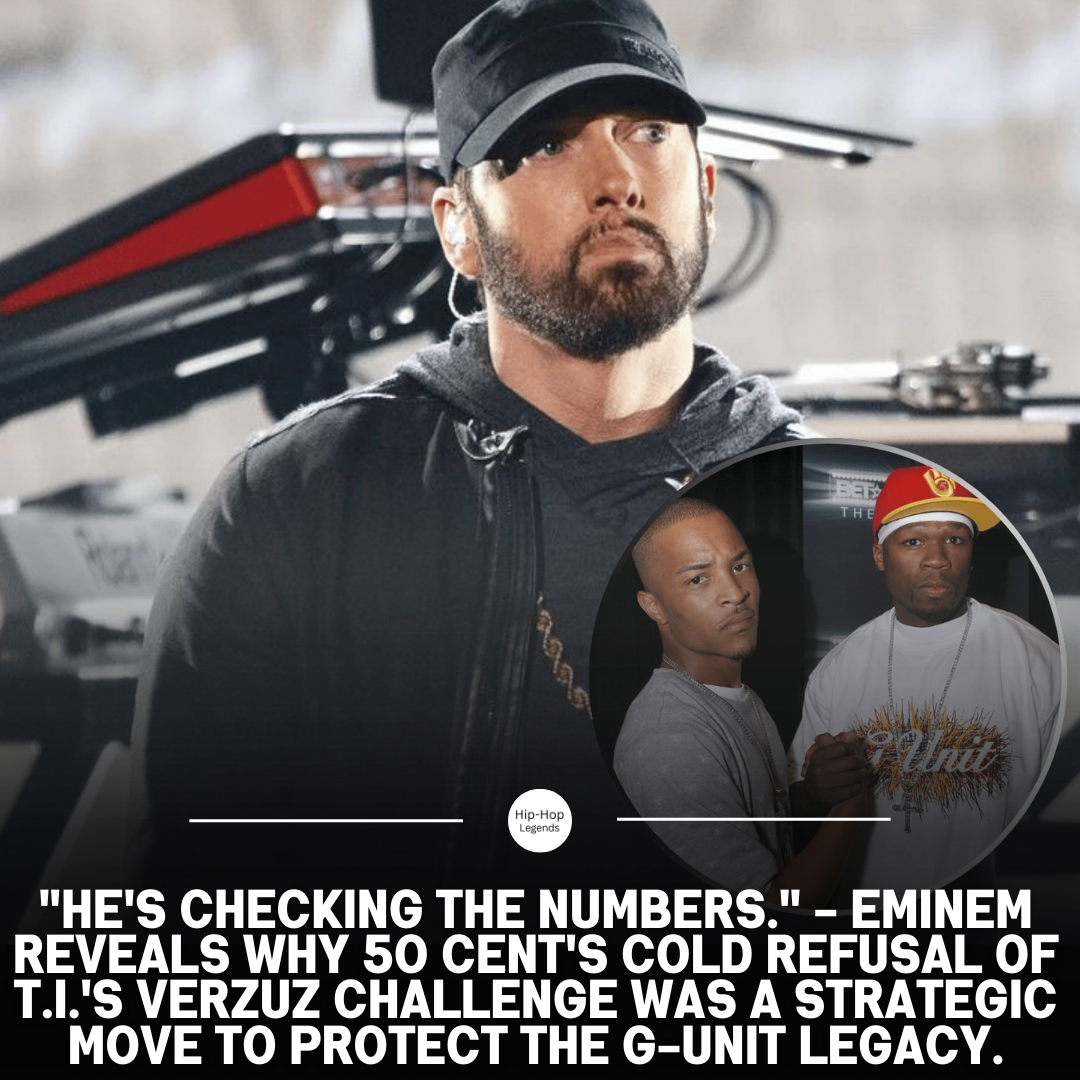
When conversations about a potential Verzuz showdown between 50 Cent and T.I. began circulating, the idea felt inevitable. Two dominant forces of the 2000s. Two regional generals. Two catalogs dense enough to carry a twenty-round collision without filler.
On paper, it was combustible: New York’s G-Unit architect versus Atlanta’s self-anointed “King of the South.” A cultural North-versus-South moment that could have defined an era retroactively.
But what followed wasn’t a scheduling conflict. It wasn’t hesitation. And according to those close to the situation, it certainly wasn’t fear.
It was calculation.
“He’s checking the numbers,” Eminem reportedly said in private discussions surrounding 50’s decision. The comment reframed the entire narrative. This wasn’t about lyrical competition. It was about positioning.
When T.I. publicly suggested he could go record-for-record with the Get Rich or Die Tryin’ architect, social media instantly began constructing imaginary round lists. Club anthems. Street staples. Radio crossovers. The debate fueled itself. But a Verzuz battle is never just a playlist exchange. It’s a reframing mechanism.
Verzuz places two catalogs on equal footing by design. That equality is the format’s appeal — and its risk.
For 50 Cent, whose early-2000s dominance reshaped commercial rap, shattered first-week records, and globalized the G-Unit brand, stepping into that arena carries asymmetry. Participation implies parity. And parity suggests comparison.
From a branding standpoint, the equation was uneven.
T.I., with a defining Southern run and regional influence that helped solidify Atlanta’s national command, would benefit from the renewed spotlight regardless of outcome. Sharing the stage would validate the matchup itself.
For 50, however, the upside was less obvious.
His debut era exists in near-mythic framing: explosive sales, crossover ubiquity, international touring power, and a cultural moment that felt seismic rather than incremental. Engaging in a round-based duel could humanize that legacy — but it could also reduce it to metrics inside a scoreboard.
Eminem, who has observed 50’s industry instincts for decades, reportedly recognized the dynamic immediately. Longevity at the highest tier isn’t just about talent. It’s about controlled visibility. Not every invitation warrants acceptance.
Sometimes, abstaining reinforces status more effectively than participation.
The situation escalated when 50 leaned into his trademark irreverence. Instead of offering a diplomatic decline, he publicly dismissed the idea, telling T.I. to “go play with somebody else.” The comment was humorous on the surface — but strategically definitive underneath. It shut down speculation before it could solidify into expectation.
In the streaming era, legacy operates differently. Every appearance, battle, and viral moment contributes to a broader narrative architecture. Artists no longer just protect catalog value — they protect aura.
For veterans like 50 Cent and Eminem, relevance isn’t about activity frequency. It’s about selective engagement. Entering a comparison framework can elevate one party while flattening another.
And in a culture built on competitive spectacle, the most powerful signal may not be stepping into the ring.
It may be choosing to stand outside of it.
In declining the Verzuz proposal, 50 Cent didn’t frame the decision as avoiding competition. He framed it — implicitly — as preserving an era that, in his estimation, doesn’t require side-by-side validation.
In hip-hop, battles built legends.
But in business, restraint can protect them.