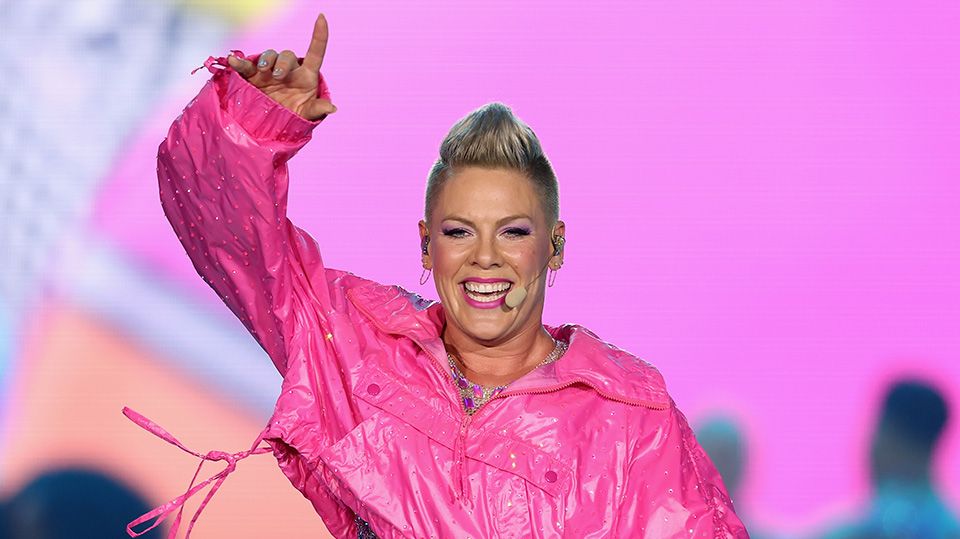
For an artist who built her legacy in midair, being told to stay grounded wasn’t just inconvenient—it was existential.
At the start of 2026, P!nk underwent cervical disc replacement surgery, a procedure that forced her into a reality she had spent her entire career defying: stillness. No harness. No spins. No aerial choreography. Just recovery.
And for a moment, it nearly stopped everything.
When Identity Meets Limitation
P!nk isn’t just a singer who performs.
She’s a performer who flies.
Her concerts have long blurred the line between music and physical theater, with aerial stunts becoming as essential to her identity as her voice. Remove that element, and the question becomes unavoidable:
Who is P!nk without flight?
That question hit hardest in the earliest days of rehab, when even basic movement felt unfamiliar.
“I can’t fly yet,” she admitted.
It wasn’t just a statement of fact.
It was a confrontation with reality.
The Rehab No One Sees
The public often imagines recovery as a steady climb—painful, yes, but linear.
This wasn’t that.
The first phase of P!nk’s rehabilitation stripped everything back to fundamentals. Before she could think about performing, she had to relearn control over the smallest movements: stabilizing her neck, aligning her spine, holding tension without strain.
At one point, a session reportedly left her in tears.
Not because she couldn’t handle the pain—but because of what it represented.
After years of executing high-speed aerial routines, she was being coached through controlled chin lifts and resistance-band exercises. Movements so simple they felt almost disconnected from the performer she had been.
It wasn’t physical difficulty that broke her.
It was the humility of starting over.
The Moment She Nearly Walked Away
Behind the scenes, the pressure was mounting.
A comeback tour was already in motion. Dates were being mapped. Production plans were taking shape. The expectations weren’t just artistic—they were logistical, financial, global.
But her body wasn’t ready.
For a brief window, cancellation became a real possibility.
Not because she lacked the will—but because the gap between where she was and where she needed to be felt enormous.
That’s where the story could have ended.
It didn’t.
Rebuilding Like an Athlete, Not an Artist
Instead of stepping back, P!nk leaned in—with a mindset more commonly associated with elite athletes than pop stars.
Her rehab shifted into something more structured, more intense, more deliberate.
Mornings were dedicated to cervical stabilization—slow, controlled isometric exercises designed to rebuild strength without risking injury. No shortcuts. No acceleration.
Afternoons focused on core integration. Because for someone who performs in suspension, strength doesn’t start with limbs—it starts at the center. Every aerial move depends on precise coordination between spine, core, and balance.
Even her vocal routines were adjusted.
Singing, something that had always been instinctive, now required awareness of how breath and posture affected her healing neck.
Nothing was automatic anymore.
Everything was intentional.
The Hardest Part Wasn’t Physical
What made the process grueling wasn’t intensity.
It was patience.
Aerial performance demands fluidity—movements that feel effortless, continuous, almost instinctive. But rebuilding that fluidity meant breaking it down into fragments.
Weeks spent mastering balance drills that looked insignificant. Incremental progress that only became visible over time. Constant evaluation before advancing to the next step.
It’s the kind of work that doesn’t feel like progress—until it suddenly does.
Redefining Strength
P!nk has always been associated with fearlessness.
But this chapter introduced a different kind of strength.
Not the kind that leaps from rafters.
The kind that stays grounded long enough to rebuild the ability to leap again.
That early moment—when she broke down during therapy—didn’t mark a failure.
It marked a shift.
Instead of resisting the process, she accepted it. Instead of chasing where she used to be, she committed to where she was.
And that changed everything.
A Comeback That Won’t Look the Same
As preparations for her late-2026 return quietly progress, one thing is clear: this won’t be a simple reset.
It will be an evolution.
While she’s gradually reintroducing elements of aerial work, the approach is more measured. More calculated. Built around sustainability rather than spectacle alone.
Production teams are reportedly rethinking staging—not to reduce impact, but to support longevity.
Because the goal isn’t just to come back.
It’s to stay back.
Why This Moment Matters
Fans have always admired P!nk for her physical daring.
But this chapter reveals something deeper.
It shows the discipline behind the spectacle. The unseen work that makes the impossible look effortless. The willingness to start from zero—even after reaching the top.
That’s what makes this comeback different.
It’s not about proving she can still fly.
It’s about proving she can rebuild the ability to do so—step by step, muscle by muscle, decision by decision.
Final Thought
If P!nk rises above the stage again—and all signs suggest she will—it won’t just be another breathtaking moment.
It will carry weight.
Because this time, every lift, every spin, every second in the air will represent something the audience didn’t see:
The hours of frustration. The slow progress. The moment she almost quit—and chose not to.
She may not have been able to fly yet.
But she never stopped climbing back toward it.