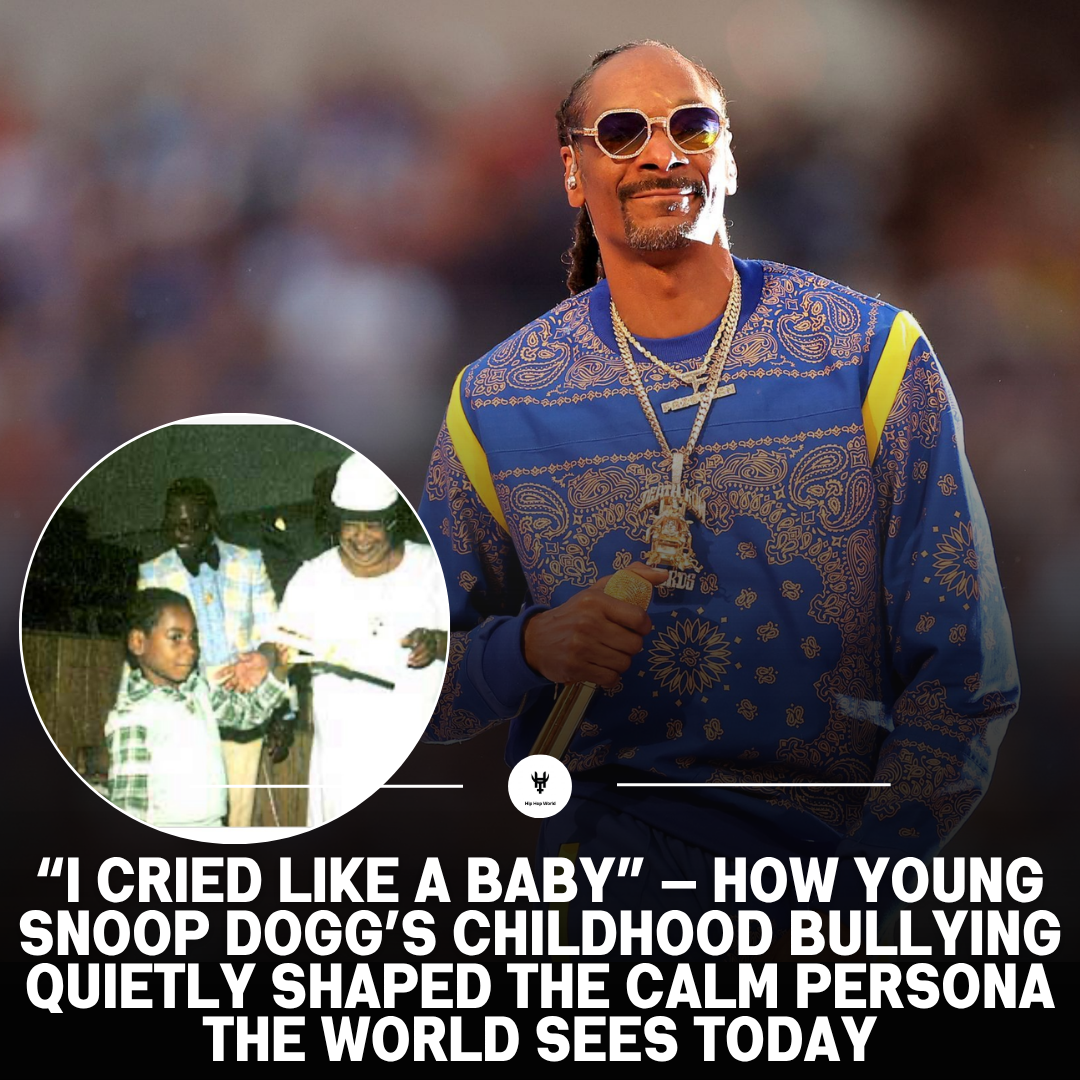
Long before the effortless cool, before the slow drawl and unbothered presence that would come to define him, there was a version of Snoop Dogg that didn’t know how to hide how he felt.
It wasn’t the image the world would later come to recognize.
It was something far more exposed.
A young boy who hated losing so much that it showed—openly, visibly, and without restraint. In a world where vulnerability often draws attention, that kind of honesty didn’t go unnoticed. It made him a target.
“I cried like a baby—for real,” he admitted years later.
And for that, he got picked on.
It’s a detail that feels almost impossible to reconcile with the figure Snoop would become. Today, he moves through the world with a kind of calm that feels permanent, as if nothing could disturb his balance. But that composure wasn’t always there.
It was built.
The Version the World Never Saw
Snoop’s public identity has always been carefully defined—laid-back, humorous, untouchable in his own rhythm. It’s the version people expect, the one that has carried him through decades of music, television, and cultural relevance.
But beneath that image is a history that tells a different story.
As a child, losing wasn’t just disappointing to him—it was emotional. It brought out something he couldn’t control yet. And in the environments he grew up in, that reaction didn’t invite sympathy.
It invited pressure.
Moments like that have a way of shaping how a person learns to move through the world. They teach you what to hide, what to show, and when to hold everything in.
For Snoop, those early experiences became part of a quiet transformation.
A Different World, A Different Perspective
That transformation didn’t happen in isolation.
At one point during his early years, Snoop found himself in an environment that felt completely unfamiliar—an elementary school where most of his classmates were white, and where the resources and opportunities looked nothing like what he had known before.
It wasn’t just a change of setting.
It was a shift in perspective.
The school offered things he hadn’t been exposed to—gymnastics, swimming, structured athletics, music programs. It wasn’t just about access; it was about possibility. It showed him that there were different ways of living, different systems, different expectations.
And more importantly, it forced him to adapt.
In that space, he learned how to interact with people outside of his immediate world. Not in theory, but in practice. Day by day, conversation by conversation.
It wasn’t something he realized the value of immediately.
But it stayed with him.
The Skill That Carried Him Further Than Music
Years later, as his career began to take shape, that early exposure became something more than just a memory.
It became an advantage.
When Snoop Dogg’s music reached audiences beyond the neighborhoods that shaped him, it didn’t feel unfamiliar to him. He had already learned how to connect across different environments, how to navigate spaces that weren’t originally his own.
So when his music resonated with people from entirely different backgrounds, it didn’t surprise him.
He understood it.
That understanding became part of what made him different—not just as a rapper, but as a figure who could move between worlds without losing himself in the process.
From Reaction to Control
Looking back, the contrast is striking.
A child who once reacted openly to every loss eventually became an artist known for his composure. A figure who rarely appears shaken, no matter the situation. Someone who seems, at all times, completely in control of his space.
But that control didn’t come naturally.
It was learned.
Shaped by moments of discomfort, by environments that demanded adjustment, and by experiences that forced him to understand both himself and the people around him.
The calm wasn’t always there.
It was built over time.
What Remains Beneath the Surface
Today, Snoop Dogg stands as one of the most recognizable and widely embraced figures in hip-hop. His presence extends far beyond music, into culture itself. He’s seen as steady, consistent, and almost impossible to disrupt.
But that image is only part of the story.
Because behind it is a version of him that once struggled with the simplest things—losing, reacting, being seen too clearly.
And maybe that’s what makes the evolution matter.
Not just that he changed.
But that he learned how to turn those early moments into something that would carry him through everything that came after.
Because sometimes, the strongest presence in the room isn’t the one that never felt pressure.
It’s the one that learned how to handle it—and never let it show again.