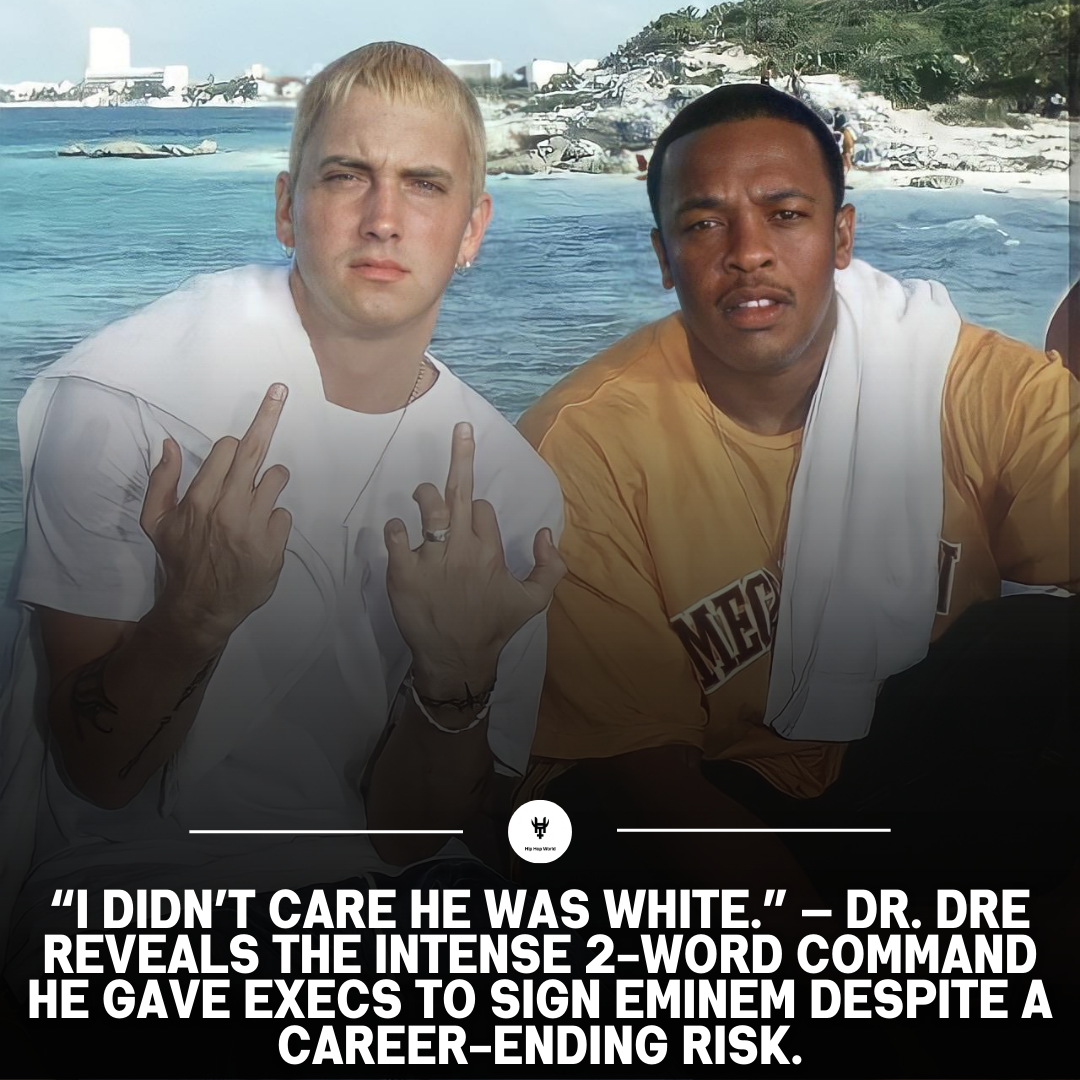
“Find Him”: The Moment Dr. Dre Heard Eminem And Changed Hip-Hop Forever
When Dr. Dre first heard the Slim Shady EP, it wasn’t inside a sleek office or a polished conference room. The moment happened in a garage, where music executive Jimmy Iovine pressed play on a rough demo that sounded nothing like the music dominating radio at the time.
Through the speakers came the voice of a young Detroit rapper named Eminem.
The flow was unpredictable yet controlled. His rhyme schemes twisted through internal patterns that felt almost mathematical. The humor was dark, aggressive, and unapologetically strange. But beyond the shock value, Dre heard something deeper: technical precision.
At the time, Aftermath Entertainment was in a fragile position. Dre’s transition away from Death Row Records had not yet produced a defining success story. The label needed a breakthrough artist, and choosing the wrong one could have pushed things further off course.
Then there was the issue few people wanted to say out loud.
Eminem was white.
In the late 1990s, hip-hop’s cultural boundaries were fiercely protected. For a West Coast icon like Dre, publicly backing a white rapper carried real professional risk. Some industry insiders warned it could damage his credibility. Others predicted backlash from within the hip-hop community itself.
To them, the move looked dangerous.
To Dre, it looked irrelevant.
What mattered wasn’t optics. What mattered was skill.
As the demo played and doubts filled the room, Dre reportedly cut through the hesitation with a simple instruction: “Find him.”
It wasn’t framed as a discussion or negotiation. It was a decision.
Dre believed authenticity in hip-hop didn’t come from appearances—it came from mastery of the craft. The only way to answer skepticism was to prove it in the studio.
When Marshall Mathers eventually arrived in Los Angeles, Dre didn’t treat the moment like a publicity opportunity. Instead, he focused on the work.
Inside the studio, the two artists began building something from the ground up. Dre approached Eminem’s verses with the same meticulous attention he had always brought to production. Rhymes were tightened, breath patterns refined, syllables positioned with careful timing. Every line was treated like structural design, where rhythm and clarity had to align perfectly.
The process was relentless.
Out of those sessions came The Slim Shady LP.
What emerged wasn’t a novelty or curiosity—it was a project that forced listeners to pay attention. Eminem’s intricate wordplay pushed rhythmic boundaries, while Dre’s production gave the chaos a sharp, controlled framework. The result felt confrontational, strange, and impossible to ignore.
The impact was immediate.
The album didn’t just revive Aftermath Entertainment—it helped reshape hip-hop’s global reach. Eminem’s rise introduced millions of new listeners to the genre while proving that technical skill could break through assumptions about who belonged in hip-hop.
Critics who once predicted backlash were forced to acknowledge the scale of the moment.
Looking back, Dre has often described the decision in simple terms: he heard greatness. Everything else was background noise.
In a moment when caution might have been the safer choice, he trusted his instincts. Two words—“Find him”—set in motion a partnership that would redefine multiple careers and shift hip-hop’s trajectory for years to come.
In hip-hop, talent has always been the ultimate currency.
Dr. Dre made his bet on that principle.
And the results changed the game.